WmMoney appears in the smaller end of the exchange market, the part built around manual or semi-automated conversions rather than a full trading terminal. This is a very different proposition from WhiteBIT. You are not opening an account to trade an order book. You are asking an operator to exchange one payment instrument or cryptocurrency for another at a quoted rate.
That model can be useful. A focused exchanger may support routes that large exchanges ignore, especially transfers involving regional electronic money systems, bank cards, or wallet services. It can also be quicker for a simple one-off conversion. The problem is that smaller exchangers demand a much higher standard of user caution because published operational information is often thinner.
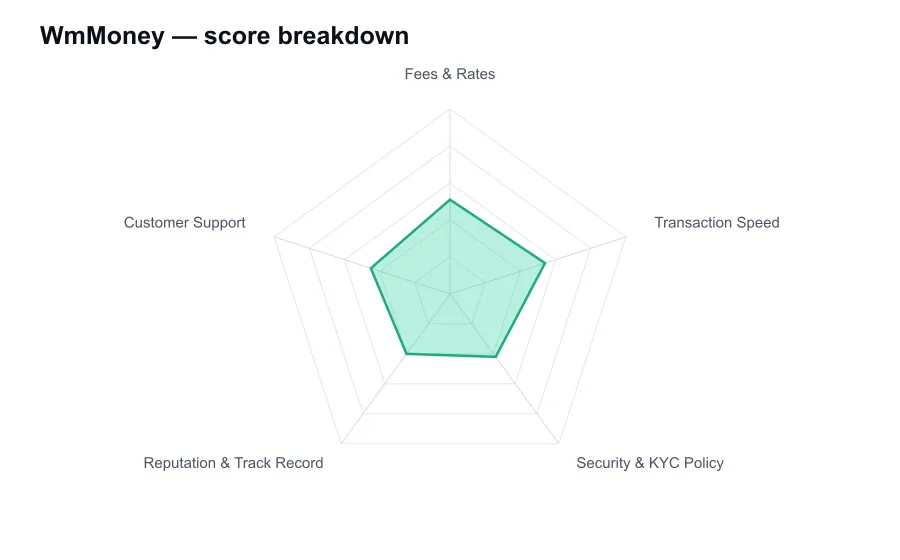
WmMoney does not have the public corporate footprint, independently audited reserves, or widely documented trading history expected from a major centralized exchange. That does not prove it is dishonest. It does mean I cannot treat it as equal to a regulated or heavily scrutinized platform. Reputation should be earned through long-term, verifiable service rather than a polished exchange form.
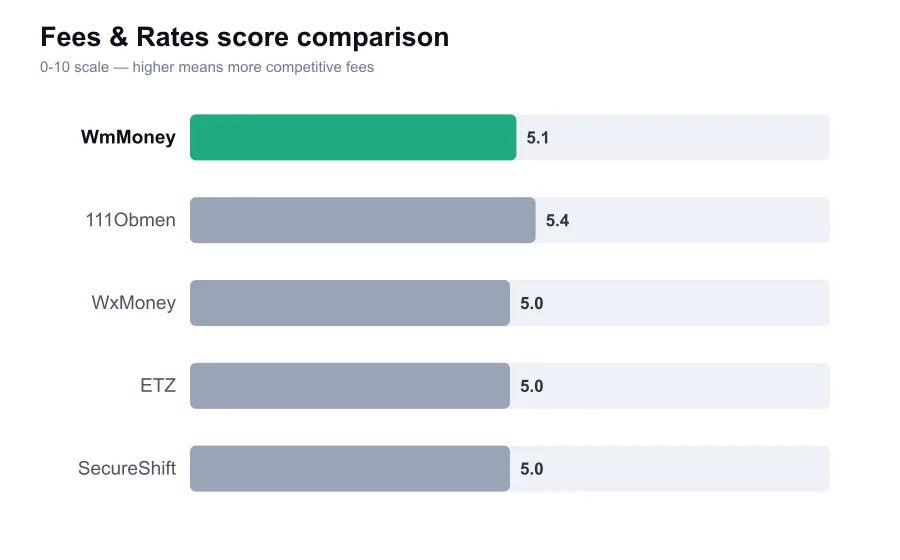
Pricing needs careful attention here. Small exchangers often present a rate that includes their margin rather than displaying a clean percentage commission. The number that matters is the amount you will actually receive after the send amount, processor charges, network fees, and any payment-provider deductions. Compare that final amount against at least two established alternatives before sending money.
The advertised quote may also be conditional. A rate can change if the payment arrives late, arrives in several pieces, is sent from a third party, or does not include the required payment reference. If a provider describes an application as fixed, save the rate, order number, timing rules, and payout amount before making the transfer.
Speed depends less on blockchain technology than on the payout route and the operator's workflow. Crypto transfers can be completed quickly after confirmations, while card, bank, and electronic-money routes may need staff action. A small service that says it works automatically can still pause an order if the amount, sender details, or destination triggers a review.
That makes transaction discipline essential. Send exactly the amount requested. Use the stated network. Do not split a payment unless the exchange explicitly tells you to do so. A large exchange may have systems that reconcile mistakes at scale. A small exchanger is more likely to ask you to wait for an operator, and that can turn a five-minute swap into a support case.
KYC is another area where users should avoid assumptions. An exchanger may let you create an application without uploading identity documents, yet still require documents if its AML system flags the transaction. No-KYC marketing does not remove screening rights or legal obligations. Anyone who cannot accept a possible review should not send funds to a custodial exchanger.
The security question is not only whether the site has HTTPS or a login code. It is whether you can identify the operator, verify the payment details, and get a useful answer when an order goes wrong. I would not leave a balance at WmMoney. Use it, if at all, as a conversion service for a limited amount, then withdraw to a wallet you control.
Support is especially important for this category because exceptions are where users lose time and sometimes money. Before using WmMoney, test how clearly it explains order status, confirmation requirements, refund rules, and disputed payments. A vague contact page or an unanswered pre-sale question is a much more meaningful warning sign than a slick home page.
There is no obvious reason to choose a small exchanger for a mainstream BTC to USDT conversion if a major exchange or a well-known noncustodial swap provider offers a better final rate. WmMoney's case rests on a specific route or payment method that you cannot conveniently access elsewhere. If it does not solve that specific problem, the added counterparty risk is hard to justify.
I would also avoid making WmMoney the first stop for a large transaction. Start with a small test amount, confirm the exact receiving method, and retain every receipt. This is sensible behavior with any exchanger, but it matters more where public information and independent reporting are limited.
The service may be practical for experienced users who understand payment-system quirks and can evaluate a quote in real time. It is not where I would send a newcomer who needs customer protection, transparent corporate disclosures, and predictable escalation paths. Those users are better served by a recognized exchange or a licensed local provider.
My view is cautious rather than dismissive. WmMoney can be judged only order by order, based on the current rate, payment route, visible operating details, and responsiveness of its staff. Until it offers the transparency expected of stronger brands, it belongs in the specialist-tool category, not the default recommendation category.