ETZ is a much less documented name than the large exchanges or even the better known instant-swap brands. That matters immediately. A crypto service can have a clean site and a functioning quote engine, but a reviewer should not confuse presentation with proof of long-term reliability. ETZ appears to position itself as a simple crypto exchange service rather than a full-featured trading venue, aimed at quick conversions rather than professional market activity.
The limited public footprint makes ETZ difficult to assess with the confidence readers should demand before committing serious money. There is no widely established institutional reputation comparable with Coinbase, Kraken, Bitstamp, or even several mature non-custodial swap services. That does not establish misconduct. It does mean a sensible user should apply a lower transaction limit and a higher standard of verification before using it.
Its apparent user journey follows the familiar instant-exchange pattern. A customer chooses an asset pair, enters a receiving address, receives a deposit address, then waits for the conversion and payout. This is convenient because it avoids the account onboarding required by a centralized exchange. It also removes features some users need, including an order book, account history with advanced reporting, and a regulated fiat balance.
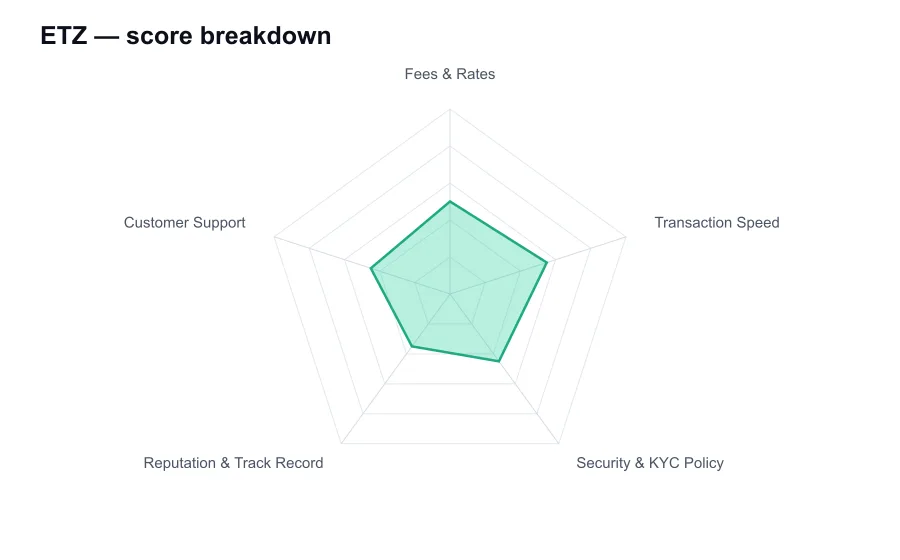
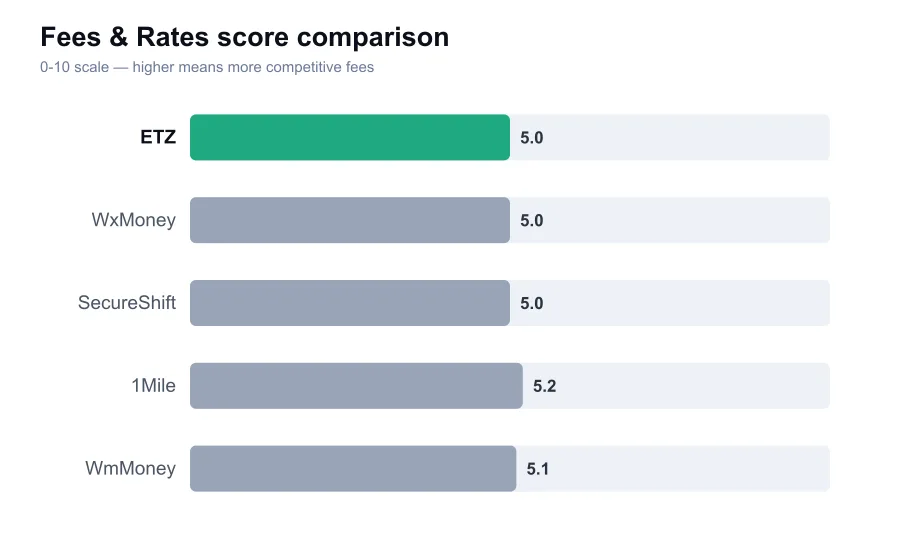
ETZ should be judged on final quotes rather than fee claims alone. Smaller exchange services frequently source liquidity from third parties, and the cost is often embedded in the rate. A site may use words such as low fee or best rate without publishing enough detail for a customer to separate commission, spread, and network cost. If the full payout is not clearly displayed before a deposit is sent, that is a reason to walk away.
Price comparison is especially important with a thinly documented provider. Get an identical quote from at least two established alternatives, such as ChangeNOW, Exolix, or a liquid centralized exchange. If ETZ's payout is meaningfully lower, there is no compelling reason to accept the added uncertainty. If it is better, confirm the rate type, minimum amount, and deposit deadline before assuming the quote is locked.
Speed has the same limitation. An instant exchange can process its internal leg quickly, but the customer experience is governed by blockchain confirmations, liquidity availability, and any compliance intervention. A USDT transfer on Tron may be processed much more quickly than a BTC transfer with a low miner fee. ETZ should not be selected on speed claims alone until a user has tested it with a small, low-risk transaction.
The security question is more serious than the interface question. A non-custodial transaction model can reduce exposure to a large stored balance, since the user supplies a receiving wallet rather than leaving assets in an account. Yet an active swap remains custodial in the practical sense that the provider takes possession of the deposit before it pays out. A service needs clear policies, responsive support, and a demonstrated history of resolving exceptions.
Publicly accessible information about ETZ's company structure, licensing position, security controls, and formal audit record is limited. That is not unusual for small crypto conversion services, but it is not a feature. It makes due diligence harder. I would not send a treasury-sized transfer, an urgent settlement payment, or funds that cannot tolerate delay through a provider whose operating history is difficult to independently verify.
KYC expectations should also be treated cautiously. Some instant exchange services allow ordinary orders without registration, then reserve the right to ask for documents if transaction monitoring raises a flag. If ETZ uses a similar model, users should understand that no-account access is not the same as a contractual guarantee of anonymity. Funds can become delayed while a compliance question is resolved.
The absence of a large public feedback record has a second effect. It is harder to tell the difference between isolated complaints and a recurring operational problem. With an exchange that has years of reviews, support patterns emerge. With ETZ, a prospective customer has less external evidence to work with. The safer approach is mundane but effective: check recent independent feedback, inspect the domain carefully, and make a test transaction.
Customer support is where little-known exchange services either prove themselves or fail. A live chat icon is useful, but the important questions are whether agents can identify an order, explain a delay, and follow through if a partner or compliance system has paused it. Without a well-established public record for ETZ's support team, I would not regard fast resolution as a given.
ETZ may still be useful for a small, uncomplicated conversion if its quote is clearly superior and the user has verified the destination network. Its stripped-down model can be attractive to people who dislike exchange accounts. But convenience has a price when the provider's ownership, fee structure, and operational history are harder to inspect than those of established alternatives.
For any first use, send the smallest practical amount. Keep screenshots of the quoted rate, the deposit address, and the order reference. Do not send an asset on an assumed compatible network. A token with the same ticker on two chains is one of the easiest ways to create an expensive support case.
My assessment is deliberately conservative. ETZ has not earned a high reputation score because the public evidence needed to award one is thin. It may function perfectly well for routine swaps, but that is not enough to justify casual trust with large value. Until it publishes clearer fee, entity, and operational information, it belongs in the test-first category rather than the default recommendation category.