111Obmen is a small instant crypto exchange service aimed at users who want to swap coins or cash-linked payment methods without opening a full trading account. It sits in the same broad category as services listed on monitoring sites such as BestChange, rather than competing directly with Binance, Kraken, or a self-custodial protocol like 1inch. The proposition is simple: select a direction, send funds, and receive the other asset or payment method.
That simplicity is attractive, particularly for someone who doesn't want an order book, identity checks for every small transaction, or the operational clutter of a large exchange. It also creates a different risk profile. With a small exchanger, the customer is trusting one operator to honor the quoted rate, process the payment correctly, and resolve an error if the bank transfer or crypto transaction gets stuck.
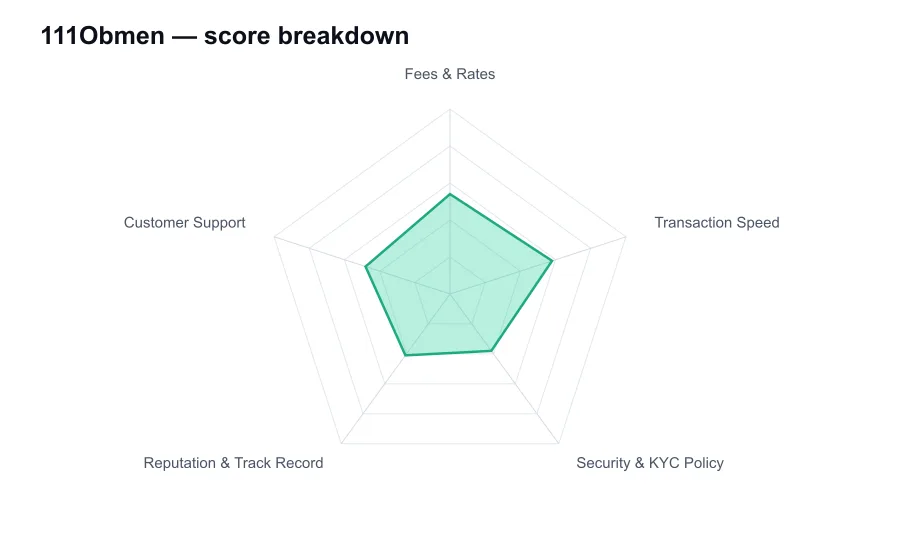
The first issue is transparency. I could not independently verify a detailed public company profile, a clear founding date, audited reserve information, or a substantial body of reliable reporting about 111Obmen outside of exchange-monitoring and user-review ecosystems. That doesn't prove misconduct. It does mean the service should not be treated like a large, extensively scrutinized financial institution.
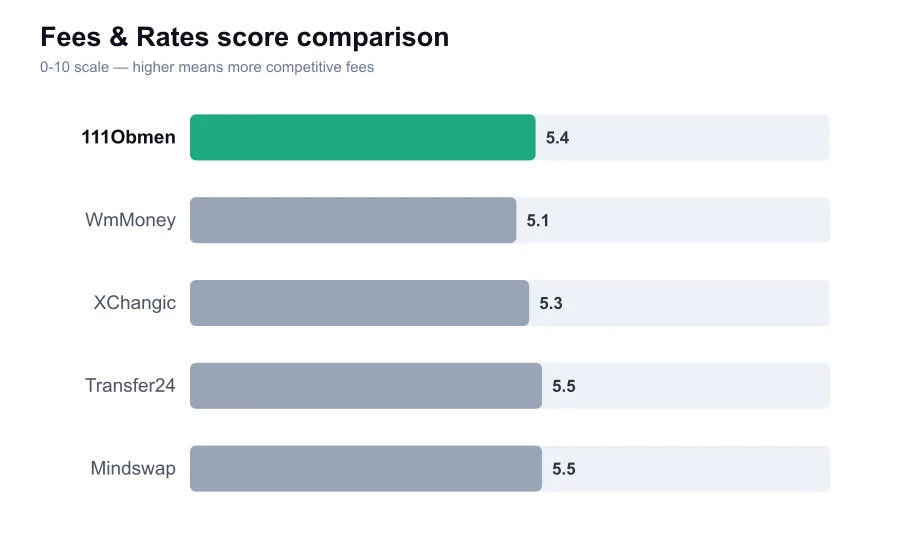
Fees are usually embedded in the displayed exchange rate on services of this type, and 111Obmen appears to follow that familiar model rather than publishing a simple maker and taker schedule. This can be convenient because the final quote is what matters. Still, it makes comparisons harder. A rate that looks good on the first screen can become less competitive once network costs, payment-system fees, or a spread for a manual payment route are included.
My advice is to compare the actual amount you will receive against at least two established alternatives immediately before paying. Don't compare a headline percentage because there may not be one. Compare the final payout. For a Bitcoin, USDT, or card-to-crypto exchange, a difference of a few tenths of a percent can be reasonable. A gap of several percent needs a very good explanation.
Speed depends heavily on the direction selected. A blockchain swap can be completed after the required confirmations and an operator check, while bank cards, e-wallets, and local transfers can introduce delays that have little to do with the exchanger itself. Services in this category often advertise rapid processing, but rapid should mean minutes after all required funds and confirmations arrive, not an unconditional promise from the moment an order is created.
The practical danger is sending a payment with the wrong reference, the wrong network, or an amount that differs from the order amount. Those situations commonly move an otherwise automatic exchange into manual review. Before you send anything, confirm the network, destination, memo requirement, and whether the rate is fixed or floating. A cheap-looking exchange can become expensive quickly if a token arrives on an unsupported chain.
111Obmen's security posture is difficult to assess from public information alone. A no-account or low-friction exchange can reduce the amount of personal data a customer hands over, which is a genuine privacy advantage. It does not remove compliance risk. Operators may request verification if a transaction triggers fraud controls, sanctions screening, an anti-money-laundering review, or a disputed bank payment.
That point matters because many customers misunderstand no-registration services. No registration is not a guarantee that funds can never be paused. If the provider suspects a payment issue, it may ask for source-of-funds documents, identification, or proof that a bank card belongs to the sender. Anyone who cannot tolerate that possibility should use a regulated service with published compliance terms, even if it costs more.
The reputation picture is modest rather than persuasive. Small exchangers can build loyal customers through fast, personal service, and a long run of completed orders has value. Yet public reviews on monitoring sites are not equivalent to audited operational history, a named management team, formal licensing disclosures, or a tested record of handling major incidents. I would regard reviews as one signal, not the entire case for trust.
Customer support is especially important here because the product is a one-off transaction. With a major exchange, you can often inspect balances, order history, and system status yourself. With an exchanger, the operator may be the only person who can explain why an order is waiting. Look for a visible ticket route or live contact before paying, save the order page, and keep transaction IDs and payment receipts.
I would start with a small test transaction. That is not paranoia, it is sensible risk control with an operator whose public footprint is limited. If the first order settles cleanly, the quoted amount matches the promise, and support answers a specific question clearly, you have useful evidence. It still doesn't turn the service into a suitable place to route a large amount.
111Obmen may suit an experienced user who understands payment rails, checks rates carefully, and needs an occasional conversion that is unavailable or inconvenient on a large platform. It is a poor fit for beginners sending their first crypto transfer, people moving savings, or anyone who expects bank-like dispute handling. The friction saved at the start can become costly if an order goes wrong.
My view is cautious. The service may be functional for small, controlled exchanges, but its limited independently verifiable public record keeps it far below established exchanges and transparent decentralized alternatives on trust. Treat the quote as a service offer, not as a guarantee until funds have arrived. Use a test amount, document everything, and don't send money you cannot afford to have tied up in a compliance or support review.