WhiteBIT is a centralized cryptocurrency exchange founded in Ukraine and now operating through a broader European group structure. It sits in the middle of the market rather than trying to outmuscle Binance globally or imitate a tiny no-account swap site. Its appeal is a polished trading interface, extensive fiat access in Europe, and a product range that reaches beyond simple spot trading.
The exchange has grown quickly since its 2018 launch. That matters because WhiteBIT is no longer a lightly used regional venue with a thin order book. Major pairs such as BTC, ETH, USDT and EUR tend to have usable liquidity, although the experience gets less convincing on minor altcoins and obscure trading pairs. Serious traders should still inspect the order book before placing a large market order.
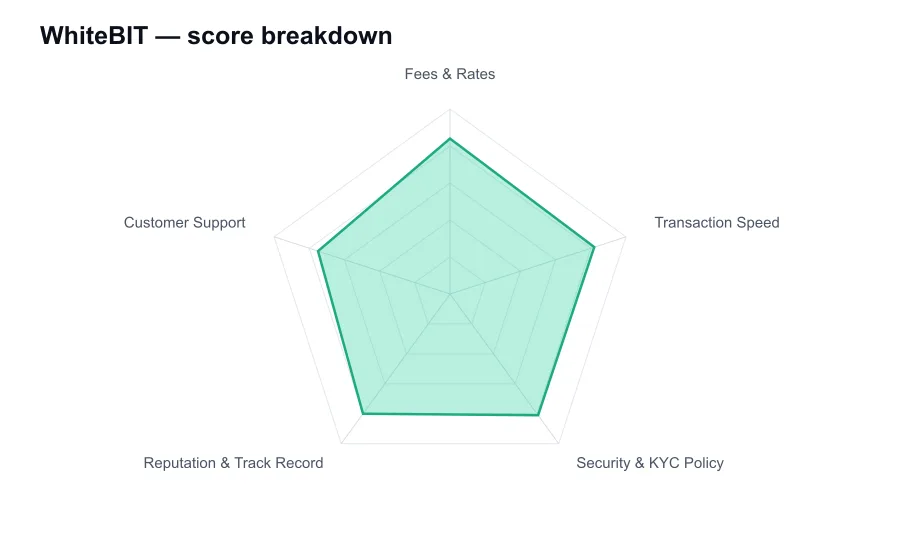
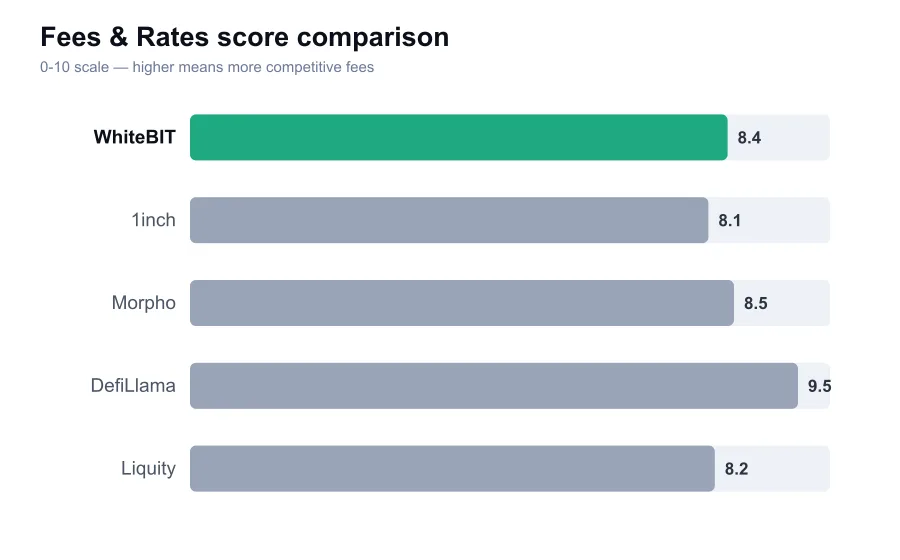
Its standard spot fees are competitive. WhiteBIT advertises spot trading fees of up to 0.1 percent, with lower rates available through its fee tiers and selected pair promotions. That puts it close to the better-priced large exchanges. A straightforward 0.1 percent trade fee is easier to accept than the spread-heavy pricing used by many instant exchangers.
The important catch is that trading fees are only one part of the bill. Deposit and withdrawal costs vary by asset and network, and those charges can change with blockchain conditions. Stablecoin withdrawals are often cheap on lower-cost networks, while sending assets through Ethereum can become expensive. Don't judge the platform from its headline trading fee alone.
WhiteBIT also offers futures, margin-related products, staking-style yield products, launchpad activity, P2P functions and a native WBT token ecosystem. That breadth is useful if you want one account for several jobs. It can also make the platform feel busier than it needs to be for someone who only wants to buy bitcoin, withdraw it, and move on.
Execution speed is generally one of WhiteBIT's stronger points. Internal order matching is fast, deposits on supported networks are credited after the required confirmations, and stablecoin transfers on networks such as Tron or Polygon can settle quickly. Withdrawal processing still depends on the asset, network conditions, risk screening, and whether the withdrawal is selected for manual review.
That last point deserves emphasis. No centralized exchange can honestly promise every withdrawal will clear instantly. WhiteBIT's compliance controls can hold activity that triggers its risk systems, particularly unusual account behavior, recent account changes, or funds with problematic transaction history. This is frustrating when it happens, but it is preferable to pretending that custody and AML controls do not exist.
Security is credible by mainstream exchange standards, though users should avoid treating any exchange as a long-term vault. WhiteBIT promotes cold-storage custody, two-factor authentication, anti-phishing tools, address controls and monitoring procedures. Those are sensible protections. The real risk is still centralized custody, where access to assets depends on the company, its systems, and its interpretation of compliance obligations.
KYC is part of the WhiteBIT experience, not an optional afterthought. The platform asks users to verify identity for full access, and it may request additional documentation in higher-risk cases. That will disappoint privacy-first users, but it makes WhiteBIT more workable for customers who need fiat ramps, card services, and an exchange that can operate with European financial partners.
WhiteBIT's reputation is stronger in Central and Eastern Europe than in North America. It has invested heavily in brand partnerships and public visibility, which helps it look more established than anonymous exchange brands. Marketing does not replace operational proof, but a visible company with an identifiable business presence is easier to assess than a site with no accountable operator.
Its support setup is better than the support offered by most small exchangers. WhiteBIT provides help-center material and ticket-based assistance, and users can reach support around the clock. Response quality can vary, especially during a compliance dispute. That is common across large exchanges, but it means you should preserve transaction IDs, screenshots, and wallet hashes before opening a ticket.
The mobile apps are competent and suit users who need alerts, basic trading, deposits, and withdrawals away from a desktop. Advanced traders will probably prefer the browser terminal for charting and order management. The app is not the reason to choose WhiteBIT, but it is not a weak link either.
My biggest reservation is not its trading fee or its interface. It is the usual centralized-exchange tradeoff. You get convenience, fiat access and reasonably deep markets, but you hand over identity documents and rely on a custodian. For active trading that is a reasonable bargain. For long-term cold storage, it isn't.
WhiteBIT is a solid pick for verified European retail users and intermediate traders who want a credible exchange without paying premium fees. It is less attractive for people seeking complete privacy, unrestricted global access, or the deepest derivatives market on earth. The platform has earned a good score, but it is best used as an exchange, not as your permanent wallet.