Report Chain logo Report Chain

1inch

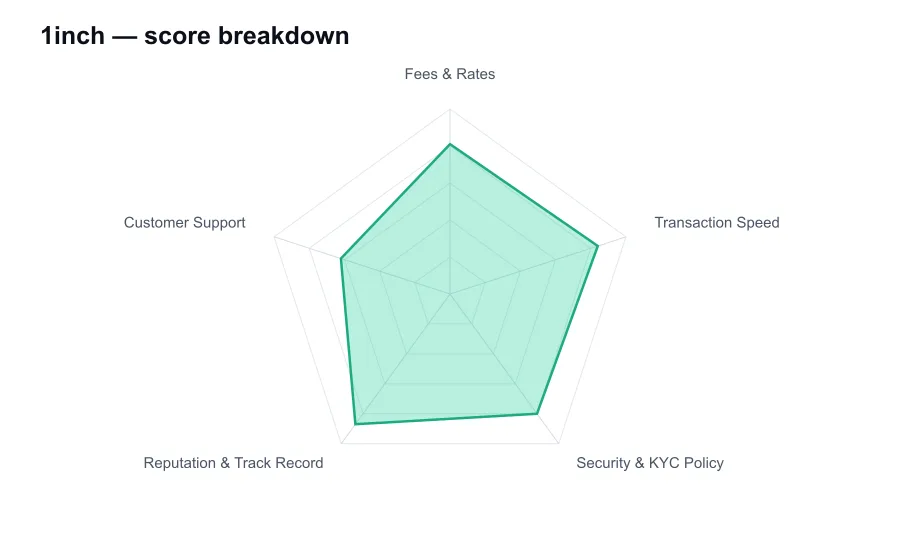
1inch scores 8.1/10 overall in our independent review, measured against every other provider we've compared, strongest on Reputation & Track Record (8.7/10) and weakest on Customer Support (6.2/10).

Visit official site
Status: active (checked 2026-10-13T17:47:09.245Z)

Editorial independence: our scores and rankings are produced using the fixed criteria above and are not influenced by advertisers. This is an independent ranking site and is not operated by, or affiliated with, any provider we list.

Affiliate disclosure: some links on this page may earn us a commission at no extra cost to you. This does not affect our rankings.

Quick Verdict
1inch is still among the strongest tools for decentralized token swaps because its routing can create meaningful execution improvements without taking custody. Its cost advantage is real only after gas, liquidity fees, and network choice are considered. Fusion is useful, but the final received amount remains the only number that matters. The protocol has earned its reputation, yet it cannot protect users from careless approvals or a bad wallet setup. For capable DeFi users, it deserves a place in the toolkit.
  • Best for: Competitive multi-DEX routing
  • Best for: Self-custody swaps without routine KYC
  • Best for: Fusion can avoid direct gas payment
  • Best for: Limit orders and broad DeFi integrations
  • Best for: Established protocol with a long DeFi record
  • Not for: Ethereum gas can erase savings on small trades
  • Not for: No support team can undo signed transactions
  • Not for: Network, approval, and fake-token risks remain
  • Not for: Fusion pricing must be checked against standard routes
Market snapshot
AssetPrice (USD)24h change
Bitcoin (BTC)$81,809+0.87%
Ethereum (ETH)$2,396.01+1.27%
Tether (USDT)$0.9992+0.01%
BNB (BNB)$725.91+1.94%
Solana (SOL)$103.79+1.58%
XRP (XRP)$1.3+1.97%

Market data via CoinGecko, for informational purposes only. Not financial advice.

What is 1inch?

1inch is a decentralized exchange aggregator that finds token-swap routes across multiple on-chain liquidity sources. Users connect their own wallet and sign transactions, so 1inch does not operate like a conventional custodial exchange account. Its tools include standard aggregation, Fusion orders, and decentralized limit orders.

How 1inch Works

  1. Connect a compatible self-custody wallet
  2. Choose the token pair, amount, and network
  3. Review the route, estimated output, and price impact
  4. Approve the token if the wallet requires approval
  5. Sign the swap or Fusion order
  6. Confirm settlement in the wallet and block explorer

Criteria Breakdown

Scoring breakdown for 1inch
Criterion Score Note
Fees & Rates 8.1 No typical aggregator fee, but gas and pool fees matter
Transaction Speed 8.4 Fast routing, settlement follows the selected chain
Security & KYC Policy 8.0 Self-custody and audited contracts, with smart-contract risk
Reputation & Track Record 8.7 Established DeFi protocol active since 2019
Customer Support 6.2 Strong documentation, but no reversal of wallet mistakes

Key Facts

Key facts for 1inch
Fact Value Source
Founded 2019 Source
Core product Decentralized exchange aggregator Source
Custody model Self-custody wallet connection Source
Standard swap fee No typical 1inch protocol fee Source
Fusion model Resolver-filled signed orders Source
Governance token 1INCH Source

Review of 1inch

1inch is one of the best-known decentralized exchange aggregators in crypto. It started as an Ethereum-focused tool for finding better swap routes across decentralized liquidity sources, then expanded into a broader protocol suite with aggregation, limit orders, Fusion swaps, a wallet, developer products, and cross-chain functionality. It is not a centralized exchange. There is no 1inch order book holding your balance in the way Coinbase or Binance does.

That distinction shapes nearly every part of the review. In its standard swap flow, your wallet signs a transaction and the smart contracts route the trade through decentralized exchanges and liquidity pools. You keep control of the wallet keys. 1inch can reduce the need to manually check Uniswap, Curve, Balancer, and other venues one by one, which is why it remains relevant even after the first generation of DEX aggregators became crowded.

The core strength is routing. A direct trade on one automated market maker may be poor because the pool is shallow or the price impact is high. 1inch can split a transaction across several sources and paths. For liquid pairs, the difference may be tiny. For less common tokens, a route that uses multiple pools can materially improve execution. The interface makes this sophisticated process feel reasonably simple.

Fees need a careful explanation because users regularly get this wrong. The 1inch aggregation protocol generally does not impose a standard retail swap fee comparable to the 0.1 percent trading fee at a centralized exchange. Your costs arise from the liquidity venues used, the price impact of the trade, the Ethereum or network gas cost, and potentially a spread embedded in a specialized execution mode. A trade can therefore be routed efficiently yet still be expensive.

Ethereum gas is the most obvious issue. Swapping a modest amount of a token on mainnet can be irrational during congestion, particularly if you must first approve the token. 1inch supports several networks, and using lower-cost chains can make a real difference, but the chain choice introduces its own risks. Tokens with the same ticker on different networks are not interchangeable, and bridges add another transaction and another point of failure.

Fusion is 1inch's most distinctive consumer feature. Instead of the user paying gas for a normal on-chain swap, the user signs an order and resolvers compete to fill it. The resolver handles execution costs, while the trade is subject to an auction-style process and its effective price. This is appealing for users who hate failed transactions or don't hold native gas tokens, but it is not free money. Judge Fusion by the final output, just as you would judge any other route.

For large trades, 1inch can be genuinely useful. It gives traders more control than a simple swap widget, including settings for slippage and a clear route preview. It also offers limit orders through its Limit Order Protocol. Those orders are signed rather than necessarily posted as a conventional on-chain order at creation, which can save gas, but users should understand that liquidity and fill behavior differ from the deep, centralized books on a major exchange.

Speed is usually excellent once a route is selected, though the word speed needs context. A standard swap settles according to the underlying chain. On Ethereum, confirmation can take seconds or minutes depending on gas conditions. On Polygon, Arbitrum, Optimism, BNB Chain, Avalanche, and similar supported environments, it can be much faster and cheaper. Fusion may feel quick, but it depends on resolver interest and the order's pricing conditions.

Security is better than at a custodial exchange in one major respect: 1inch does not normally take custody of your wallet's assets. That does not mean the user is safe by default. The risks move to smart contracts, token approvals, malicious websites, wallet compromise, fake tokens, poor slippage settings, and the bridge or liquidity source used by a route. A self-custodial protocol gives you control, then expects you to use it competently.

1inch has published audit and security information, runs a bug bounty program, and has been a visible protocol since 2019. That longevity carries weight. Still, it has faced the sort of security events that remind users why crypto's trust model is complicated. In 2023, an incident involving a compromised resolver's private key affected some Fusion orders. The protocol's response and remediation mattered, but the episode showed that off-chain actors can still matter in a supposedly decentralized trade flow.

There is generally no KYC for standard use of the protocol from a self-custody wallet. That is a privacy benefit for lawful users who simply want to swap on-chain assets. It does not guarantee universal availability. Interface access can be restricted in certain jurisdictions, and third-party wallet providers, RPC services, bridges, and fiat on-ramps have their own policies. Also, on-chain activity is public, so no KYC is not equivalent to anonymity.

Reputation is one of 1inch's strongest categories. It is a recognized name among DeFi users, its 1INCH token has governance relevance, and its routing technology is widely integrated. I would place it above obscure swap widgets and many short-lived aggregators. I would not equate that reputation with deposit insurance, human account recovery, or the customer protections offered by a regulated brokerage. Those are different products with different trade-offs.

Support is competent for a decentralized protocol, which is faint praise because no support team can reverse a wallet signature or retrieve crypto sent to the wrong address. Documentation, community channels, and support resources can help diagnose an issue, but the user remains responsible for transaction confirmation. If you expect someone to cancel a mistaken trade or refund a bad wallet transfer, 1inch is the wrong venue.

The mobile wallet is a useful addition for people who prefer a dedicated self-custody application, though I would not recommend building an entire security model around convenience. A hardware wallet connected to a reputable browser wallet remains a stronger setup for serious holdings. In either case, inspect every approval request. Unlimited token approvals are convenient, but they enlarge the damage from a compromised dApp or wallet session.

1inch is best for users who already understand wallets and networks and want better execution than blindly swapping through one pool. It is especially strong for on-chain traders comparing routes or using Fusion for a gasless-feeling experience. It is a bad first destination for someone who does not know how to recover a wallet, read a transaction simulation, or distinguish USDC on Ethereum from USDC on another network.

My verdict is positive, with boundaries. 1inch remains one of the more capable and credible tools in decentralized trading, and its routing engine can save money on the right trade. The protocol's lack of custody and lack of routine KYC are strengths for knowledgeable users, not substitutes for judgment. Check the final output, control approvals, and avoid forcing a small trade through expensive mainnet gas. Used with those habits, it is a serious DeFi tool rather than a novelty.
Pros & Cons

Pros and cons of 1inch
Pros Cons
Competitive multi-DEX routing -
Self-custody swaps without routine KYC -
Fusion can avoid direct gas payment -
Limit orders and broad DeFi integrations -
Established protocol with a long DeFi record -

Verdict

1inch is still among the strongest tools for decentralized token swaps because its routing can create meaningful execution improvements without taking custody. Its cost advantage is real only after gas, liquidity fees, and network choice are considered. Fusion is useful, but the final received amount remains the only number that matters. The protocol has earned its reputation, yet it cannot protect users from careless approvals or a bad wallet setup. For capable DeFi users, it deserves a place in the toolkit.

KYC

Requirement none
Notes Standard self-custody protocol use does not normally require KYC. Interface availability and connected third-party services can still have regional or compliance restrictions.

Supported Assets

Notable Coins: ETH, WETH, USDC, USDT, DAI, WBTC, 1INCH
Networks: Ethereum, BNB Chain, Polygon, Arbitrum, Optimism, Avalanche, Gnosis Chain

How to Use 1inch Safely

  • Use the official 1inch domain and verify wallet prompts
  • Check the token contract, not just its ticker
  • Review slippage, price impact, and final token amount
  • Revoke unused unlimited token approvals
  • Use a hardware wallet for significant balances
  • Confirm the selected network before signing

Mobile App

iOSYes
AndroidYes
Notes1inch provides a self-custody wallet application for iOS and Android.

Frequently Asked Questions

Does 1inch charge a standard swap fee?

The aggregation protocol generally has no standard retail swap fee. You still pay underlying liquidity-provider fees, price impact, and network gas for standard swaps.

What is 1inch Fusion?

Fusion lets users sign an order that resolvers fill, rather than directly submitting a gas-paying swap transaction. Compare its final output with the standard route before accepting.

Did 1inch have a Fusion security incident?

Yes. In 2023, a compromised resolver private key affected some Fusion orders. The event did not mean users lost custody through a centralized 1inch account, but it showed resolver risk.

Can 1inch reverse a swap sent to the wrong address?

No. Standard on-chain transactions are generally irreversible after confirmation. 1inch support cannot recover assets sent to an incorrect address or undo a transaction you signed.

Why does a small Ethereum swap sometimes look expensive?

Ethereum gas and a possible token approval can cost more than the swap's price improvement. Check lower-cost supported networks where the asset and destination are appropriate.

Do I need to connect a wallet to use 1inch?

Yes. Standard swaps require a compatible self-custody wallet connection because you approve and sign the transaction from your own wallet.

Editorial independence: our scores and rankings are produced using the fixed criteria above and are not influenced by advertisers. This is an independent ranking site and is not operated by, or affiliated with, any provider we list.

Affiliate disclosure: some links on this page may earn us a commission at no extra cost to you. This does not affect our rankings.

About the Author

Yvette Saran Crypto Exchange Research Editor
  • 8 years in fintech and payments journalism
  • Crypto exchange testing and fee analysis
  • Former consumer finance reporter
  • Contributor to digital asset custody research

Yvette Saran is a crypto exchange researcher and former payments journalist with eight years of experience covering trading platforms, custody, and consumer finance. She reviews exchanges by testing the parts users actually feel, from order execution and withdrawal friction to fee disclosures and support quality.

1inch score breakdown by criterion, shown as a radar chart
Score breakdown
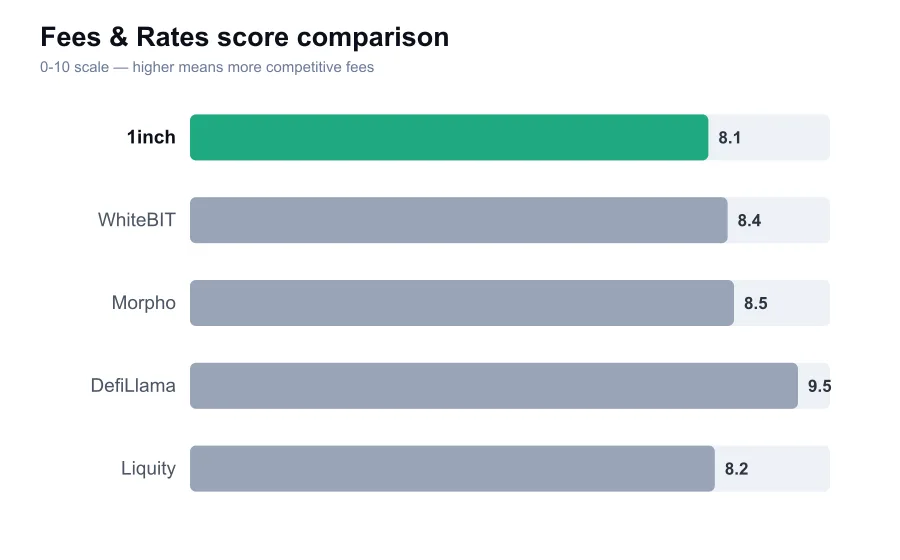
1inch fees score compared against similar providers
Fees vs. alternatives
Illustrative swap flow preview for 1inch - not an actual product screenshot
Illustrative swap flow preview

Alternatives to 1inch

Alternatives to 1inch
AlternativeScore
Morpho Review8.1/10
WhiteBIT Review8.1/10
DefiLlama Review8.2/10
Liquity Review8.0/10
Independent Reserve Review7.8/10
Kamino Review7.7/10