Morpho is one of the most serious attempts to make onchain lending less wasteful. It started by optimizing rates on top of Aave and Compound, then moved to Morpho Blue, a permissionless lending protocol where each market is defined by a collateral asset, loan asset, oracle, interest-rate model and liquidation threshold. That shift matters. Morpho is no longer simply a rate optimizer. It is lending infrastructure that other interfaces, curators and vaults can build around.
The product is best understood as two connected layers. Morpho Blue provides isolated lending markets, while MetaMorpho vaults let a curator allocate deposited assets across selected Blue markets. A user can supply USDC to a vault without individually assessing every borrower market, or can use the Blue interface directly and accept the responsibility of selecting collateral and risk parameters. That choice is powerful, but it creates a much steeper learning curve than a retail lending app such as Nexo.
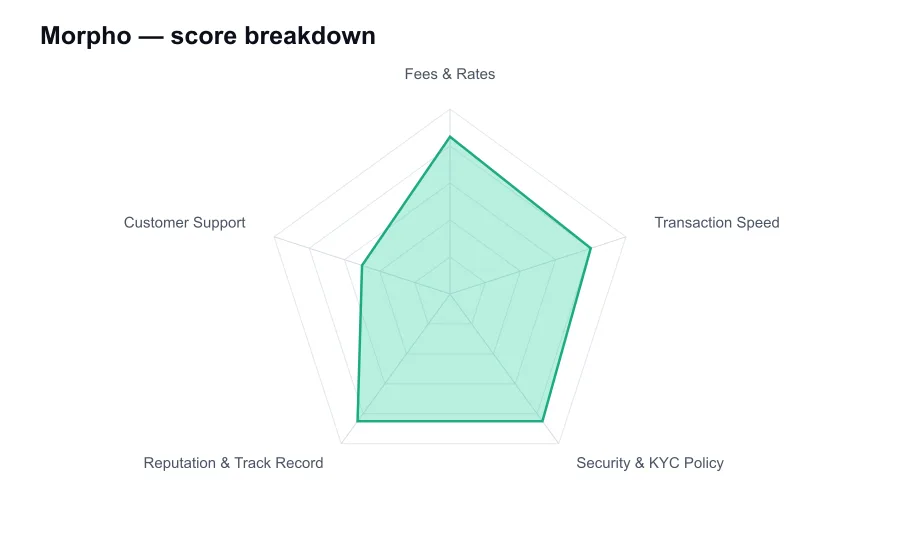
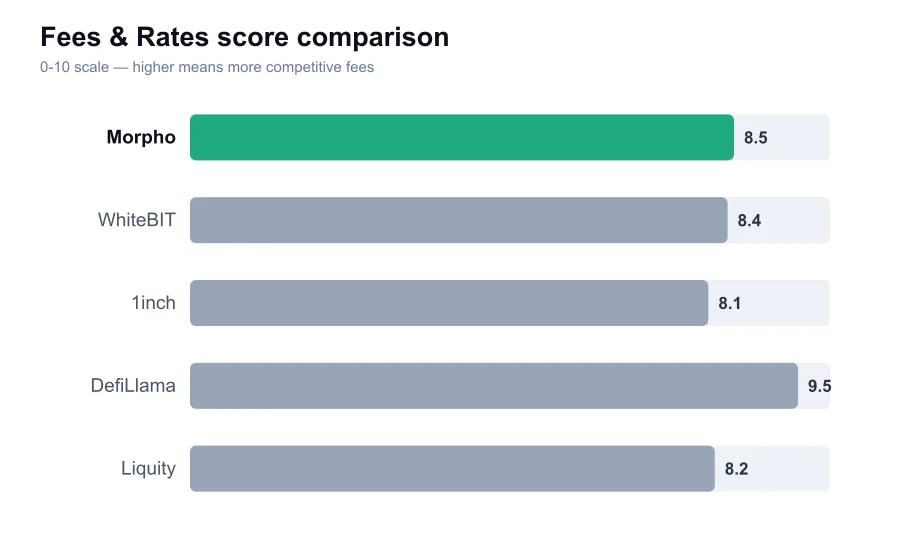
Its fee structure is unusually attractive because the core protocol does not impose a standard protocol fee on every Blue loan. Borrowing costs are determined by the individual market's interest-rate model, so rates can be very competitive when liquidity is deep and utilization is moderate. A borrower is still paying interest, and the rate can move sharply if liquidity becomes scarce. Calling Morpho cheap without checking the live annual percentage rate would be careless.
Vaults are where costs become more variable. A MetaMorpho vault curator may set a performance fee, and the fee must be checked on the vault's page before depositing. This is not a hidden charge in the traditional exchange sense, but it can meaningfully affect returns. Two USDC vaults can look nearly identical on a headline yield screen while having different risk mandates, curators and fee terms. That is exactly why chasing the highest displayed APY is a poor way to use the protocol.
Gas is another real cost. Morpho transactions occur on public blockchains, so the user pays network gas as well as any borrowing interest or vault fee. Ethereum mainnet can make small deposits uneconomic during congestion. Morpho's deployments on lower-cost networks improve that picture, though bridging assets across chains introduces another set of costs and security decisions. There is no customer-service agent who can reverse a transaction sent to the wrong chain.
Speed is governed more by the underlying chain than by Morpho itself. A supply, borrow, repayment or withdrawal generally settles once the blockchain confirms it. On a fast, inexpensive chain that can feel near-instant. On Ethereum, confirmation is normally measured in minutes rather than the seconds promised by a centralized trading platform. Liquidations are automatic and can occur as soon as an oracle price and market conditions trigger them, which is fast enough to punish a borrower who is not monitoring collateral health.
Morpho Blue's isolated-market design is one of its strongest security ideas. Risk is compartmentalized by market rather than pooled across every asset and borrower in one giant lending pool. A bad oracle choice or risky collateral configuration should not automatically compromise unrelated markets. The trade-off is that users must judge each market's parameters. Permissionlessness removes gatekeepers, but it also removes a great deal of protective product curation.
The protocol is noncustodial and does not require conventional identity verification to interact through a compatible wallet. Users keep control of their wallet keys and sign transactions directly. That is a genuine privacy and custody advantage over a centralized lender. It is not the same thing as risk-free access. Wallet compromise, malicious approvals, unsafe front ends and smart-contract exploits remain the user's problem.
Morpho has had code audits and runs a public bug-bounty program through Immunefi. Those are meaningful positives, especially for a protocol that handles substantial collateral value. Still, audits are not insurance and a bounty cannot guarantee that a novel economic attack will be found before it causes damage. Oracle risk, liquidation mechanics, governance decisions and vault-curator judgment all sit outside the simplistic question of whether the code was audited.
The project's reputation is strong among DeFi-native users. It has attracted recognizable curators, integrations and institutional interest because its architecture is flexible without being needlessly ornate. Morpho's earlier Aave and Compound optimization product gave the team a practical track record before Blue launched. That said, the protocol is younger and more experimental than lending incumbents such as Aave. A long list of integrations is not a substitute for surviving several full market cycles.
The MORPHO token and DAO governance add another layer. Governance can shape incentives and protocol direction, but token governance is not a guarantee that ordinary lenders have meaningful influence. Users should distinguish between the immutable mechanics of a chosen Blue market and the more changeable policies of vault curators, interfaces and governance-led initiatives. The protocol's design is deliberately modular, which is elegant but demands attention.
Customer support is the obvious weak spot. Morpho has documentation, community channels and a support presence, but it does not operate like a bank or a centralized exchange with a ticket queue empowered to restore account access. If a wallet key is lost, a transaction is mis-signed or a liquidation occurs according to the market rules, support cannot simply fix it. Experienced DeFi users accept that bargain. Beginners often discover it too late.
The best way to approach Morpho is to start small, inspect a market's collateral factor, oracle, utilization and liquidity, then understand the withdrawal path before committing a meaningful amount. With a vault, identify the curator and read its allocation policy rather than treating a yield figure as a savings-account rate. Borrowers should leave a material buffer below the liquidation threshold. Tight collateral ratios are an invitation to be liquidated during a volatile hour.
Morpho is excellent infrastructure for users who want transparent, self-custodied lending and are capable of reading onchain risk. Its economics can be better than centralized alternatives, and its isolated-market model is genuinely thoughtful. But it is not a passive income product and it is not designed to hold a novice's hand. I rate it highly as DeFi lending technology, with the caveat that the protocol's sophistication transfers a large share of due diligence from the company to the user.