Report Chain logo Report Chain

Liquity

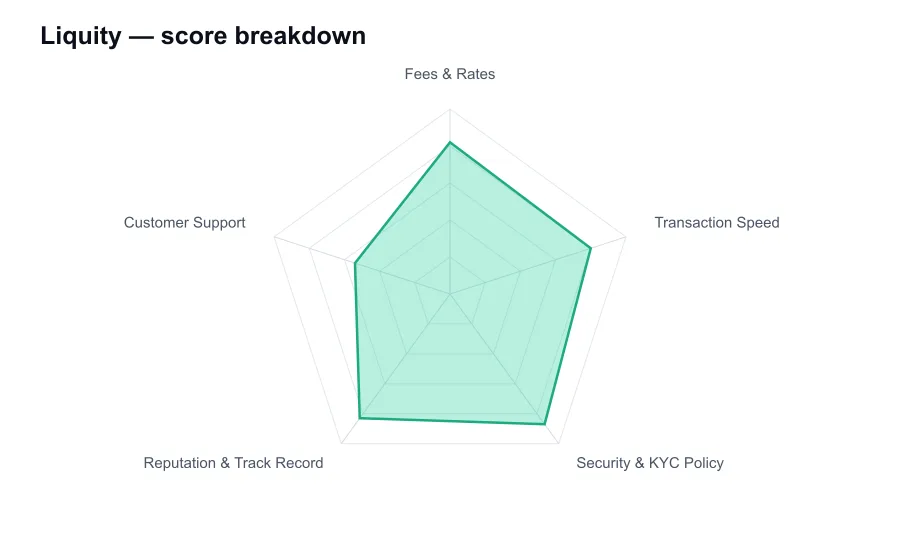
Liquity scores 8.0/10 overall in our independent review, measured against every other provider we've compared, strongest on Security & KYC Policy (8.7/10) and weakest on Customer Support (5.4/10).

Visit official site
Status: active (checked 2026-10-13T18:10:58.245Z)

Editorial independence: our scores and rankings are produced using the fixed criteria above and are not influenced by advertisers. This is an independent ranking site and is not operated by, or affiliated with, any provider we list.

Affiliate disclosure: some links on this page may earn us a commission at no extra cost to you. This does not affect our rankings.

Quick Verdict
Liquity deserves respect because its design puts rules in contracts rather than in a lender's credit committee. Its fee mechanics are understandable once learned, settlement is quick, and its record is better than most DeFi credit experiments. The trade-off is brutal personal responsibility. There is no KYC gate and no custodian, but there is also no rescue if a wallet is compromised or collateral is liquidated. For capable DeFi users, that is the point. For everyone else, it is a warning.
  • Best for: No mandatory KYC for protocol use
  • Best for: Self-custodied collateral
  • Best for: Long-running ETH-backed lending design
  • Best for: Fast Ethereum settlement
  • Best for: Transparent onchain debt positions
  • Not for: Liquidation risk remains severe in sharp selloffs
  • Not for: Ethereum gas can be expensive
  • Not for: No human support for irreversible mistakes
  • Not for: LUSD and BOLD liquidity are narrower than USDC
Market snapshot
AssetPrice (USD)24h change
Bitcoin (BTC)$81,809+0.87%
Ethereum (ETH)$2,396.01+1.27%
Tether (USDT)$0.9992+0.01%
BNB (BNB)$725.91+1.94%
Solana (SOL)$103.79+1.58%
XRP (XRP)$1.3+1.97%

Market data via CoinGecko, for informational purposes only. Not financial advice.

What is Liquity?

Liquity is a decentralized borrowing protocol on Ethereum. Users deposit crypto collateral and borrow protocol stablecoins without giving custody of their wallet to a lender. Its public smart contracts do not require a traditional account or identity check.

How Liquity Works

  1. Connect a self-custody Ethereum wallet
  2. Choose a Liquity interface and collateral market
  3. Deposit ETH or supported collateral
  4. Set the debt amount and collateral buffer
  5. Confirm the Ethereum transaction
  6. Monitor the position and repay before risk becomes excessive

Criteria Breakdown

Scoring breakdown for Liquity
Criterion Score Note
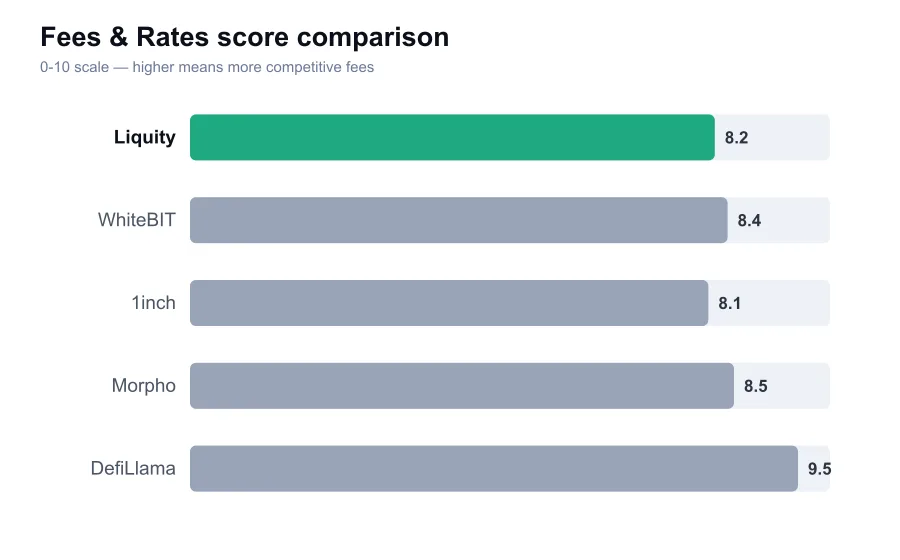
Fees & Rates 8.2 Borrowing fees are transparent, with a 0.5% minimum in V1.
Transaction Speed 8.0 Transactions settle on Ethereum, usually within minutes.
Security & KYC Policy 8.7 Audited, immutable-contract design and no custodial wallet risk.
Reputation & Track Record 8.3 One of DeFi's longer-running ETH-backed borrowing protocols.
Customer Support 5.4 Documentation and community help, not personal account support.

Key Facts

Key facts for Liquity
Fact Value Source
Original launch 2021 Source
V1 minimum borrowing fee 0.5% Source
V1 minimum collateral ratio 110% Source
Original stablecoin LUSD Source
Settlement network Ethereum Source
Identity verification Not required by protocol Source

Review of Liquity

Liquity is not an exchange in the familiar Coinbase or Kraken sense. It is a decentralized borrowing protocol built on Ethereum, originally centered on borrowing LUSD against ETH and later expanded through Liquity V2 and the BOLD stablecoin system. Its place in the market is unusually clear. Liquity is for people who want liquidity without selling their ETH or liquid staking tokens, and who are comfortable taking responsibility for a self-custodied DeFi position.

The protocol's appeal starts with its design. Traditional crypto lenders often make users accept a variable APR, custody risk, a central counterparty, or all three. Liquity's original model used interest-free borrowing with a one-time borrowing fee, while V2 introduced user-set interest rates and more flexible borrowing markets. That is a meaningful shift. It makes Liquity more competitive with other onchain borrowing venues, though it also makes the product less simple than the original version.

Fees are better than they first appear, but they are not free. In the original LUSD system, borrowers paid a borrowing fee that had a 0.5 percent minimum and could rise with protocol demand. Redemptions also carried a dynamically calculated fee. In V2, borrowers choose their annual interest rate, and that rate affects their position's priority in redemptions. The important practical point is that Liquity's cost is transparent in smart contract terms, but a borrower still needs to understand several moving parts before opening a position.

For a long-term ETH holder who wants stablecoin liquidity, Liquity can be cheaper and cleaner than selling ETH, triggering a taxable disposal, then buying back later. That does not make it cheap in every situation. A high chosen rate, Ethereum gas costs, and an eventual redemption can turn a casual borrowing decision into an expensive one. This is a protocol for users who will monitor their debt, not for someone who wants to click once and forget about it.

Liquity is fast in the way Ethereum applications are fast. Opening a trove or position, borrowing stablecoins, repaying debt, and withdrawing collateral normally settle once the Ethereum transaction confirms. Under normal network conditions, that can mean a few minutes. During congestion, it can mean longer waits and higher gas. There is no customer-service queue deciding whether your withdrawal is approved, which is a real advantage over centralized lenders.

That speed has a hard limit. You cannot cancel an already confirmed onchain transaction, and gas estimates can move quickly when Ethereum becomes busy. Liquidations can also happen automatically if collateral value falls beneath the required threshold. In Liquity V1, ETH-backed positions needed at least a 110 percent collateral ratio. Keeping a position close to that line was never sensible, regardless of how attractive the borrowing fee looked.

Security is one of Liquity's stronger areas, particularly compared with newer DeFi protocols that launch after a single audit and a lot of marketing. Liquity's original contracts were designed to be immutable, publicly inspectable, and heavily tested before deployment. The protocol has had audits from firms including ChainSecurity, Coinspect, and Dedaub across its releases. Its core contracts have also been battle-tested through volatile market conditions that exposed weak collateral models elsewhere.

Still, an audited protocol is not a savings account. Smart contract risk remains, oracle design matters, stablecoin liquidity can thin out, and users can make expensive mistakes without any recovery route. Liquity does not hold a password reset button because it does not control your wallet. That self-custody model is a strength for experienced users and a harsh lesson for anyone who treats a browser wallet like a bank login.

Liquity does not require KYC for borrowing through its public contracts. There is no account approval flow, no identity document upload, and no centralized operator deciding whether a wallet may create a position. That is a major difference from Nexo, Ledn, or institutional credit platforms. It also means users remain responsible for legal compliance, tax reporting, wallet security, and confirming whether a front end is legitimate.

The protocol's reputation is solid, although its stablecoins have never become as universally used as USDC or DAI. LUSD earned respect among DeFi users for its collateralized design and lack of governance-controlled monetary policy. Liquity V2's BOLD system is more ambitious, but it is also newer and therefore has a shorter real-world record. I would trust Liquity's older architecture more readily than I would assume every new feature carries the same years of proof.

Its history is cleaner than that of many lending projects. Liquity did not become known for reckless yield incentives, opaque lending books, or a dramatic insolvency episode. Its biggest challenge has been product adoption and stablecoin liquidity rather than a spectacular failure. That matters. A protocol can be technically elegant and still feel awkward if the stablecoin it issues is not easy to use across exchanges, bridges, and payment rails.

Customer support is where Liquity feels least like a consumer financial service. The public resources are documentation, community channels, governance material, and interface guidance. There is no call center that can reverse a liquidation, recover a seed phrase, or intervene in a redemption. The support model is appropriate for decentralized finance, but it is not forgiving. A user who expects ticket-based personal assistance should choose a regulated lender instead.

I also dislike how easily Liquity's apparent simplicity can encourage bad habits. Borrowers see stablecoins arrive in their wallet and may forget that their ETH remains exposed to price risk. A larger collateral buffer, a plan for repaying debt, and alerting tools are far more important than shaving a fraction of a percent off the borrowing cost. The protocol rewards disciplined users and punishes complacency without sentiment.

Liquity remains one of the more credible decentralized borrowing systems available to Ethereum users. It has a thoughtful design, no mandatory KYC, and far less institutional counterparty risk than centralized lending products. But it is not beginner-friendly, and its support model will feel cold when markets turn violent. My view is straightforward: experienced self-custody users can use Liquity well, while newcomers should learn how liquidation, redemptions, gas, and wallet security work before depositing a meaningful amount.
Pros & Cons

Pros and cons of Liquity
Pros Cons
No mandatory KYC for protocol use -
Self-custodied collateral -
Long-running ETH-backed lending design -
Fast Ethereum settlement -
Transparent onchain debt positions -

Verdict

Liquity deserves respect because its design puts rules in contracts rather than in a lender's credit committee. Its fee mechanics are understandable once learned, settlement is quick, and its record is better than most DeFi credit experiments. The trade-off is brutal personal responsibility. There is no KYC gate and no custodian, but there is also no rescue if a wallet is compromised or collateral is liquidated. For capable DeFi users, that is the point. For everyone else, it is a warning.

KYC

Requirement none
Notes Liquity's public contracts do not require KYC. Wallet providers, fiat ramps, and third-party interfaces may apply their own rules.

Supported Assets

Notable Coins: ETH, LUSD, BOLD
Networks: Ethereum

Limits

NotesThere is no conventional account-level daily borrowing limit. Practical limits depend on collateral, protocol parameters, liquidity, and transaction gas.

How to Use Liquity Safely

  • Use the official Liquity links and verify the connected site
  • Keep collateral well above the liquidation threshold
  • Check gas and transaction details before confirming
  • Never share a seed phrase or wallet private key
  • Set price alerts for collateral and health factor changes

Frequently Asked Questions

Does Liquity require KYC?

No. Public use of Liquity's smart contracts does not require identity verification or an account approval process.

What was the minimum borrowing fee in Liquity V1?

Liquity V1 used a dynamically calculated borrowing fee with a 0.5% minimum. The fee could rise when borrowing demand was high.

Can a Liquity position be liquidated?

Yes. In Liquity V1, ETH-backed troves could be liquidated below a 110% collateral ratio. Users should keep a much larger safety buffer.

How fast are Liquity transactions?

Borrowing and repayment are Ethereum transactions. They commonly confirm within minutes, though timing and gas costs depend on network congestion.

Can Liquity reverse a mistaken transaction?

No. Liquity is non-custodial. Confirmed blockchain transactions, liquidation events, and wallet mistakes cannot be manually reversed by support staff.

What is the difference between LUSD and BOLD?

LUSD is Liquity's original ETH-backed stablecoin. BOLD is associated with Liquity V2, which introduced user-set interest rates and expanded collateral options.

Editorial independence: our scores and rankings are produced using the fixed criteria above and are not influenced by advertisers. This is an independent ranking site and is not operated by, or affiliated with, any provider we list.

Affiliate disclosure: some links on this page may earn us a commission at no extra cost to you. This does not affect our rankings.

About the Author

Yvette Saran Crypto Exchange Research Editor
  • 8 years in fintech and payments journalism
  • Crypto exchange testing and fee analysis
  • Former consumer finance reporter
  • Contributor to digital asset custody research

Yvette Saran is a crypto exchange researcher and former payments journalist with eight years of experience covering trading platforms, custody, and consumer finance. She reviews exchanges by testing the parts users actually feel, from order execution and withdrawal friction to fee disclosures and support quality.

Liquity score breakdown by criterion, shown as a radar chart
Score breakdown
Liquity fees score compared against similar providers
Fees vs. alternatives
Illustrative swap flow preview for Liquity - not an actual product screenshot
Illustrative swap flow preview

Alternatives to Liquity

Alternatives to Liquity
AlternativeScore
Morpho Review8.1/10
WhiteBIT Review8.1/10
1inch Review8.1/10
DefiLlama Review8.2/10
Independent Reserve Review7.8/10
Kamino Review7.7/10