SimpleSwap is one of the better-known account-free instant exchange services. It has been operating since 2018 and occupies a useful middle ground between a centralized exchange and a direct decentralized swap. You do not need to place orders, learn a trading interface or hand over custody for months. You select a pair, send the deposit and receive the output. For users who want that narrow job done without fuss, SimpleSwap remains a credible option.
The service is an aggregator and exchange facilitator, not a conventional spot market with its own visible order book. That distinction matters. Its liquidity comes from connected partners and its quoted output reflects market conditions, network costs and the service's commercial margin. You are not matching with another SimpleSwap customer. You are accepting a conversion quote and asking SimpleSwap to coordinate its execution.
The site supports a large catalog of coins and tokens, which is one reason it has stayed relevant. SimpleSwap says it supports more than 1,000 cryptocurrencies. The list includes major assets such as Bitcoin, Ethereum, Solana, Litecoin, XRP, Cardano and common stablecoins. This breadth is helpful, although availability differs by pair and network. A listed token does not guarantee that every chain version of that token is supported for both deposits and withdrawals.
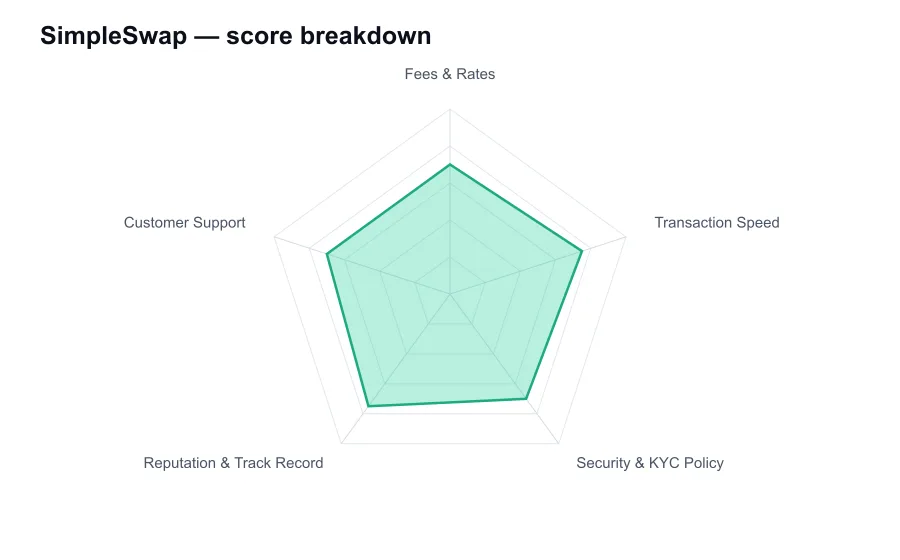
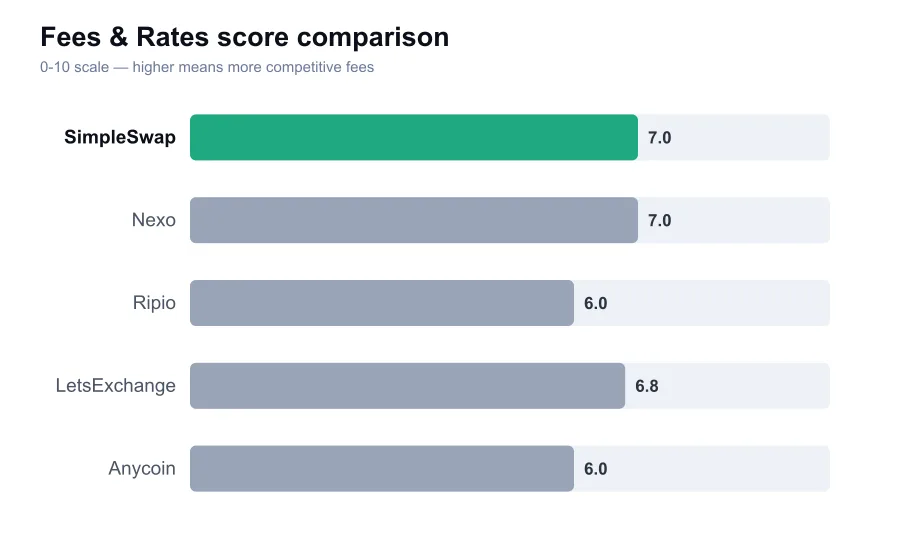
Pricing is decent, though it is not always the bargain hunters hope it will be. SimpleSwap offers floating-rate and fixed-rate exchange modes. A floating-rate order follows the market during execution, so the final payout can move from the estimate. A fixed-rate order aims to preserve the rate shown for a limited time, usually at a higher embedded cost because someone is taking market-movement risk. For a volatile asset or a large order, paying a little more for a fixed quote can be rational.
There is no single universal percentage that tells you what SimpleSwap costs. The true cost is the difference between your deposit's market value and the final amount delivered, after network fees. That spread can be competitive on liquid pairs, but it can widen sharply on obscure tokens or small transactions. Compare actual receive amounts rather than treating a marketing claim about low fees as a price guarantee. ChangeNOW, StealthEX and a direct DEX route may all produce different results within seconds.
SimpleSwap's minimum is pair-specific. That is the right approach technically, because each network has different fee requirements and dust limits, but it does mean users must read the order screen carefully. Sending less than the stated minimum can create a support case. The maximum may also depend on liquidity, compliance checks and the selected currency. It is not designed as an institutional execution desk, despite being suitable for many ordinary retail-sized conversions.
Speed is usually good on common pairs. A swap can complete after the deposit receives enough confirmations and the provider can execute the outbound transfer. Fast networks tend to feel quick, while Bitcoin and Ethereum can take longer, particularly during congestion. Fixed-rate does not mean instant, and a transaction sent with too low a miner fee can delay the entire process before SimpleSwap has the deposit available to exchange.
The order tracking page is more useful than it sounds. It gives customers a way to see whether an order is waiting for deposit confirmation, exchanging, or sending the payout. That transparency is not perfect, because it does not expose every action by liquidity partners, but it is better than a blank screen after you have sent money. Keep the order ID. It is the first thing support will need if the status stops progressing.
SimpleSwap does not normally require a user to create an account or complete KYC before a standard exchange. That is a real benefit for users who do not want another custodial account. It is not an unconditional anonymity guarantee. The service can request verification where an order triggers risk controls, and it can hold a transaction pending review. Anyone who cannot tolerate that possibility should not use any compliance-aware instant exchanger for time-sensitive transfers.
Its security posture is reasonable for the model. The company reduces persistent custody risk because it does not ask users to maintain a platform balance. Still, the most consequential risks are practical: phishing copies of the site, wrong recipient addresses, wrong networks and tokens that carry transfer restrictions. SimpleSwap cannot recover a transaction you voluntarily send to the wrong chain. The same caution applies to any service using generated deposit addresses.
Reputation is one of SimpleSwap's stronger areas. It has been around long enough to accumulate a recognizable public footprint and substantial user feedback. That does not make every complaint invalid. Like all instant exchanges, it attracts frustrated reports from customers whose transactions were delayed, repriced or screened. The relevant comparison is that SimpleSwap has a longer operating history and more visible support presence than many newer aggregators.
Support is available around the clock through live chat and email channels. In simple cases, that can be enough. The harder cases involve a missing memo or tag, a token sent over the wrong network, a compliance review, or a partner-side delay. Those cases may take time and occasionally require documents. SimpleSwap is not exceptional at making those moments painless, but it is more established than many no-name services that leave users with no meaningful escalation route.
The mobile experience deserves a mention. SimpleSwap has promoted mobile apps, but I still prefer using a browser with a hardware wallet or a trusted self-custody wallet for substantial trades. Mobile makes quick swaps convenient, yet it also makes it easier to overlook one character in an address or select the wrong network. Convenience has a cost when blockchain transactions cannot be undone.
SimpleSwap is best viewed as a practical retail utility, not a trading venue. It is good at reducing friction for a straightforward conversion, particularly for people moving between chains or exiting a token that their usual exchange does not list. It is less compelling for active traders who need the narrowest spread, advanced execution, fiat rails or formal account controls. For those users, a liquid centralized exchange or a direct on-chain route is usually superior.
My take is favorable, with limits. SimpleSwap has earned its place among established instant exchangers because it is easy to use, broad in asset coverage and more proven than newer lookalikes. Its main weakness is pricing opacity, which is a structural issue with quote-driven services rather than a SimpleSwap-only failing. Check the output, select fixed rate when certainty matters, and do not send a large amount without first testing the exact route.