Anycoin Direct, commonly shortened to Anycoin, is a Dutch cryptocurrency broker that has been operating since 2013. It occupies a different place in the market from anonymous instant exchangers. Customers buy, sell, and swap crypto through a broker-style interface, with payment options aimed heavily at European users and identity verification as part of the normal customer relationship. It is built for accessibility and regulatory accountability rather than for people trying to avoid onboarding or shave every possible basis point from a trade.
That distinction is important. Anycoin is not primarily an exchange where traders place orders against one another. The company provides a quoted price for a buy, sale, or swap, then settles the transaction. For a first-time buyer, this can be less intimidating than a traditional spot exchange. There is no need to interpret candlestick charts, choose order types, or worry about a limit order sitting unfilled. The price for that simplicity is that the spread is embedded in the broker quote.
The service has strong roots in the Netherlands and the wider European Economic Area. Its support for familiar European payment methods has long been part of its appeal, especially for people who prefer SEPA transfers or local options such as iDEAL where available. That regional focus is a strength because payments and compliance are not afterthoughts. It is also a limitation. Anycoin is not the natural choice for a customer outside Europe who wants the broadest payment menu or universal access.
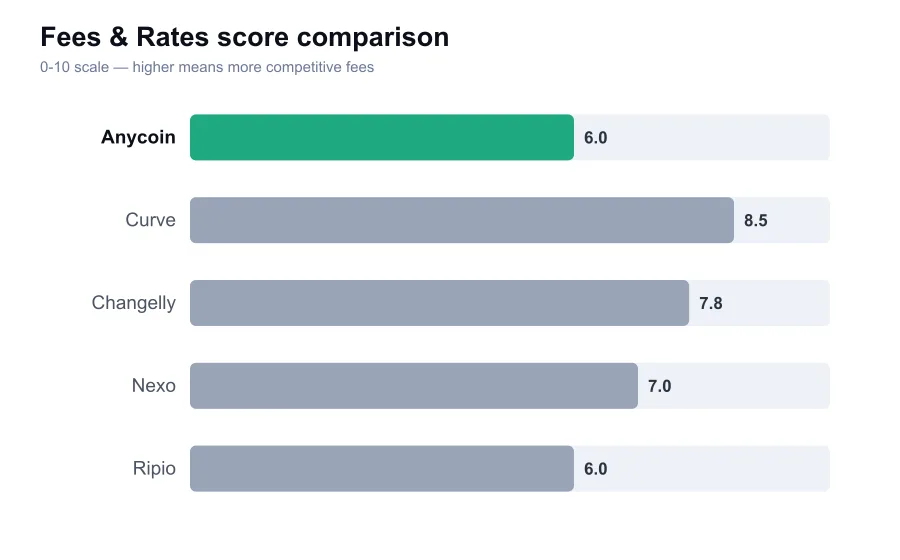
Fees are the main area where prospective users should look past the friendly interface. Anycoin does not use the low maker-taker schedule associated with deep spot markets. The cost is generally represented in the quoted buy or sell rate, and payment methods can have different charges or processing costs. This is standard broker practice. It can be reasonable for a small, straightforward purchase, but frequent traders will often find lower all-in costs by using a liquid exchange and withdrawing to self-custody.
The correct way to judge Anycoin's pricing is to check the final euro cost or final euro proceeds, then compare that exact figure with a competitor at the same moment. Do not compare against a headline Bitcoin price on a market-data site. A broker quote includes execution, service, and sometimes payment processing. In return, Anycoin removes several steps for a casual buyer. That is a fair trade for some people, but it is not a bargain by default.
Purchase and sale speed vary by payment rail. A crypto withdrawal after a completed purchase can be sent promptly, but a bank transfer needs to clear and compliance checks must be complete first. SEPA timing depends on the sending bank and whether an instant transfer is used. Card or local-payment routes can feel faster, though they may carry different pricing or verification rules. Selling crypto for euros also depends on the incoming blockchain transaction being confirmed before the fiat payment can be processed.
Anycoin's security posture is more reassuring than that of small instant exchangers because it operates in a regulated European environment and has an identifiable company presence. It has been subject to Dutch registration and supervisory requirements connected to crypto service provision. Regulation is not a promise that every transaction will be effortless or every asset is risk-free. It does mean the company has stronger incentives to document controls, identify customers, monitor transactions, and maintain operational procedures than an anonymous swap widget does.
KYC is not optional in the way it can appear to be at an instant exchanger. Customers should expect identity verification and, depending on activity, further checks relating to payment method, address ownership, source of funds, or transaction purpose. Some crypto users will see that as a disadvantage. I think it is better understood as the cost of using a Europe-focused broker with formal payment relationships. If avoiding identity verification is your highest priority, Anycoin is the wrong product.
The broker model also has a custody question. Anycoin can facilitate purchase and sale, but long-term holders should avoid treating any broker account as their main vault unless they fully understand the custody arrangement and account protections. The safest routine for a long-term buyer is to receive purchased crypto into a wallet they control, back up the seed phrase securely, and use a fresh verified address for each withdrawal where appropriate. Self-custody has its own risks, but it removes broker insolvency and account-access exposure.
Anycoin's reputation is good by retail European-broker standards. Its 2013 founding date matters, and it has remained visible through multiple crypto cycles, including periods when many smaller firms disappeared. It does not have the global scale, liquidity, or institutional brand recognition of Coinbase or Kraken. It has nonetheless built a credible record as a regional provider. That is a much stronger position than a brand with a polished website but no clear legal or operational history.
Support is a real advantage for the audience Anycoin targets. New buyers often have questions about verification, bank transfers, wallet addresses, and tax records. A Europe-oriented broker with established support channels is better suited to those conversations than an automated swap service. Still, customer support cannot reverse a blockchain withdrawal sent to the wrong address, and compliance teams cannot always provide immediate answers while a review is active. Customers should expect professional help, not instant exceptions to financial-control rules.
The asset selection is adequate for mainstream investors but is not the reason to choose Anycoin. Bitcoin, Ethereum, and other major cryptocurrencies are the core attraction. Traders seeking every new layer-one coin, obscure DeFi token, perpetual futures market, or high-yield product will outgrow the platform quickly. This conservatism is not necessarily a flaw. A broker aimed at ordinary European customers should be more selective than a venue that lists every speculative token with a social-media following.
Anycoin also makes more sense for buying and selling than for active swapping. A user who makes one monthly Bitcoin purchase with euros can value the straightforward payment flow and clear local orientation. A trader making twenty conversions per day will care about spreads, order-book depth, APIs, and execution control. Those are different jobs. Trying to force a retail broker into the second role is how users become disappointed by fees that were obvious from the business model from the beginning.
For security-conscious customers, the practical details matter. Enable two-factor authentication if available, use a unique password, verify every email domain, and keep bank-account access secure. Do not rely on search-engine adverts to reach the login page. When withdrawing crypto, confirm that the network is correct and run a small test if the address is new. These habits are far more valuable than chasing a tiny improvement in a broker quote.
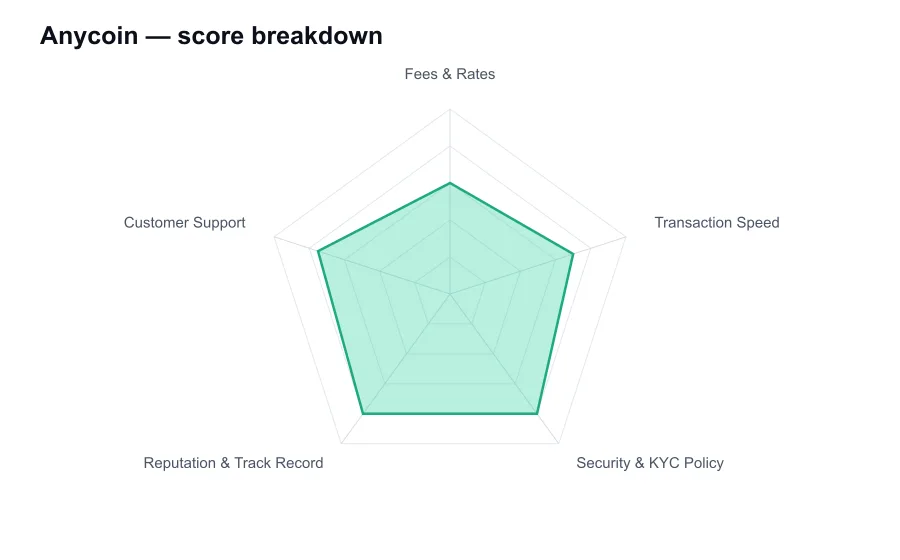
I would recommend Anycoin to European beginners and long-term buyers who want a recognized, compliance-first route from euros into mainstream crypto. Its scores reflect that role. It is not the cheapest venue, it will not satisfy privacy maximalists, and advanced traders can do better elsewhere. But the firm has a decade-plus record, a practical regional product, and a level of accountability that makes it easier to recommend than lightly documented instant exchangers.
My final judgment is that Anycoin succeeds by being sensible rather than flashy. The broker spread is its unavoidable weakness, and mandatory verification will rule it out for some readers. Yet those compromises buy a more credible European operation, established payment handling, and support built for ordinary customers. If your goal is a clean, occasional euro-to-crypto purchase and you are comfortable with KYC, Anycoin is a solid choice. If your goal is ultra-low fees or advanced trading, choose a true exchange.