Changelly is one of the oldest recognizable names in the instant crypto exchange business. Launched in 2015, it has survived several cycles that wiped out a lot of similar services, and that longevity is a real asset. Its main consumer product offers wallet-to-wallet swaps without a standard exchange account, while Changelly PRO provides a more conventional trading environment for users who want order books. That split makes it broader than a simple swap widget, though the instant service remains its public identity.
The basic pitch has barely changed because it works. Pick the asset you are sending, select the asset you want, enter a destination address, transfer the deposit, and wait for the output. Changelly aggregates liquidity rather than acting like a pure decentralized protocol. The experience is closer to using a broker than trading directly on an exchange. That is convenient for beginners, but it means the rate shown to you is a packaged price, not a transparent view of every underlying venue.
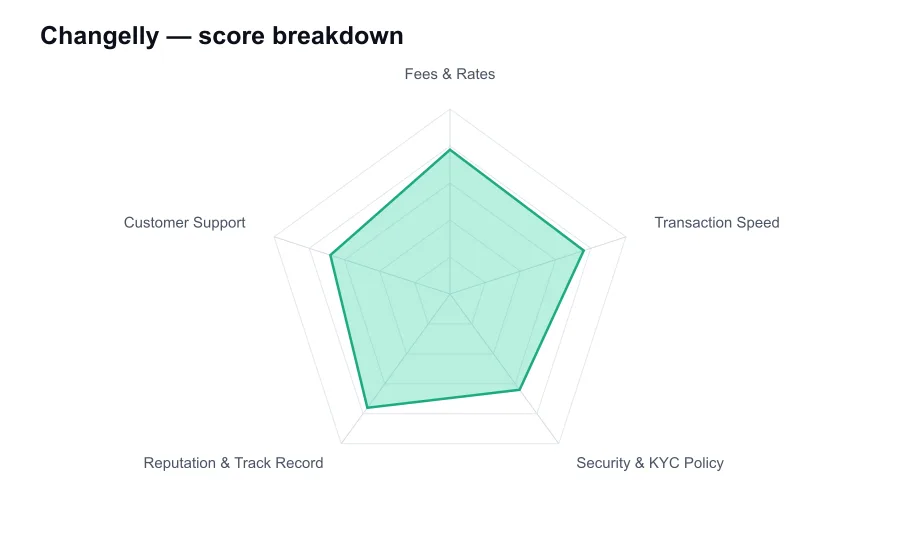
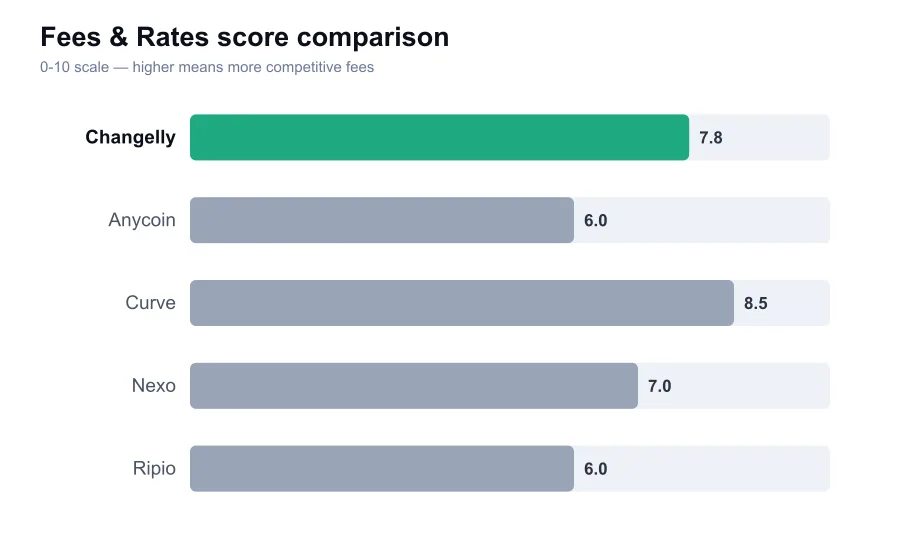
For floating exchanges, Changelly has long stated a 0.25 percent exchange fee. That is lower than the 0.5 percent headline commonly associated with ChangeHero, and it is a legitimate advantage. Still, it would be a mistake to declare Changelly the cheaper service based on that one number. The quote can include partner liquidity costs and market spread, while network fees are separate. Compare the actual amount you receive, not just the stated fee, especially on stablecoin pairs where small pricing differences are easy to spot.
Fixed-rate swaps are available for many routes and are the more sensible choice for users who need certainty. They carry a wider margin because Changelly is taking market-movement risk while your deposit confirms. That is not an unreasonable business model. It does mean you should not assume a fixed quote is automatically expensive or automatically safer. On a volatile pair, paying a little more for a guaranteed output can be rational. On a calm, liquid pair, the floating quote is often the better deal.
Changelly's speed is competitive for an instant exchanger. The interface generally gives a projected time, and common swaps can complete quickly after the deposit receives the required confirmations. The caveat is substantial. Changelly cannot control Bitcoin's mempool, Ethereum congestion, token contract problems, or the confirmation policies of its liquidity providers. A fast user interface does not make a blockchain transfer fast. Anyone swapping BTC during a fee spike should budget hours rather than expecting a payment-app experience.
The service supports a very broad menu of assets and networks, which is useful but can create more room for expensive mistakes. Tether and USD Coin exist across several chains, and the ticker alone is not enough. You must choose the correct network for both the deposit and withdrawal side. A wallet that shows USDT might mean TRC-20, ERC-20, BEP-20, Polygon, Solana, or another version. Changelly's form helps identify routes, but the user remains responsible for whether the destination wallet can receive that exact asset.
Security is where Changelly demands a more nuanced reading than its marketing shorthand suggests. The normal swap flow is noncustodial in the sense that it does not require you to keep an account balance on the platform. Yet the service takes custody of the input during conversion, and it works with third-party providers. This is not the same security model as an on-chain atomic swap or a trade executed from your own smart-contract wallet. You are trusting Changelly to complete a temporary custody process correctly.
Its KYC policy is also risk-based rather than absent. Many transactions proceed without identity documents, but its compliance systems can freeze a transfer and request verification. Changelly's terms and public support material make clear that suspicious or high-risk activity may be reviewed. That is common across centralized instant exchangers, but Changelly has attracted more criticism than some competitors because users have publicly reported surprise checks after sending funds. Whether each individual case was justified is impossible to judge from a complaint, but the pattern is important.
My criticism is not that Changelly screens transactions. Any service connected to banking rails, liquidity providers, and major blockchains has legal and fraud responsibilities. The problem is expectation management. A customer who hears "no registration" may reasonably infer a low-friction experience. If a transaction can be held for documents, the product needs to put that fact in front of users before they commit funds. People using privacy tools, receiving funds from unfamiliar sources, or moving unusually large amounts should assume scrutiny is possible.
Changelly's track record is both its strongest and most complicated category. It has been around since 2015, has well-known wallet and service integrations, and is far less anonymous than a newly launched swap site. It also carries years of public complaints, including disputes over delayed exchanges and compliance holds. A long operating history naturally creates more complaints, but that should not be used to wave them away. Reputation here is solid, not spotless. Kraken or Coinbase offer a stronger accountability framework, although at the cost of more intrusive onboarding.
Changelly PRO deserves separate mention. It offers spot trading features beyond the consumer swap form, and it may suit users who want a conventional interface after they have passed the required onboarding. It should not be confused with the instant exchanger, however. The fees, liquidity, custody arrangements, and verification experience can differ. A user looking for a quick self-custody conversion should judge the swap product on its own terms. A trader should compare Changelly PRO directly with other centralized exchanges rather than assuming the brand name settles the question.
Support is available through live chat and email, and Changelly maintains an extensive help center. For ordinary questions, that is enough. The difficult cases are compliance holds and complicated recovery requests. Those often involve several teams and can feel slow because support cannot simply override an AML decision. I would not send funds that I need on a fixed timetable unless I have already tested the route. The service is capable of fast execution, but its worst-case support experience is materially slower than its best-case swap experience.
Changelly remains a useful service, particularly for a user who wants a broad selection of assets, an established brand, and a fixed-rate option without setting up a full exchange account. It is not my favorite choice for someone whose chief concern is privacy certainty or execution transparency. Check the quote against ChangeNOW and ChangeHero, use the precise network requested, and keep every transaction reference. Those habits remove many of the avoidable problems that give instant exchangers a bad name.
My final view is that Changelly is good at what it is, but its age should not make users complacent. The 0.25 percent floating fee is attractive, the coverage is broad, and the consumer flow is polished. The catch is that a smooth small swap and a difficult compliance case can both be true parts of the same product. Use it for deliberate wallet-to-wallet exchanges, preferably after a small test. For large trades, price-sensitive execution, or funds that cannot be delayed, a liquid regulated exchange is usually the better tool.