LetsExchange is a non-custodial instant exchange aggregator that lets users swap cryptocurrencies without operating a conventional trading account. It is designed for people who already have crypto in a wallet or exchange and want to convert it into another asset quickly. The service sits in a crowded field with ChangeNOW, SimpleSwap, StealthEX, and other quote-driven swap platforms, so convenience alone is not enough to make it stand out.
Its strongest selling point is breadth. LetsExchange supports a large selection of coins, tokens, and networks, and it has built integrations that make cross-asset conversions much easier than manually moving through several exchanges. For common swaps such as BTC to ETH, USDT to SOL, or ETH to USDC, the flow is quick to understand. Choose the pair, enter the destination address, send the input amount, and wait for delivery.
The service does not function like a public centralised exchange order book. LetsExchange obtains quotes through liquidity partners and presents the user with a final estimated or fixed output amount. That makes the interface easier for non-traders, but it also means a user cannot inspect the route or negotiate execution. The quote is what matters, and comparison shopping is essential.
LetsExchange offers floating-rate and fixed-rate options on supported pairs. A floating swap tracks market movements during processing, so the received amount can differ from the first estimate. A fixed-rate swap gives more certainty for a limited time, though it can include a slightly less attractive quote because the provider is taking price risk. I prefer fixed quotes for larger transfers or volatile assets, provided the rate is competitive.
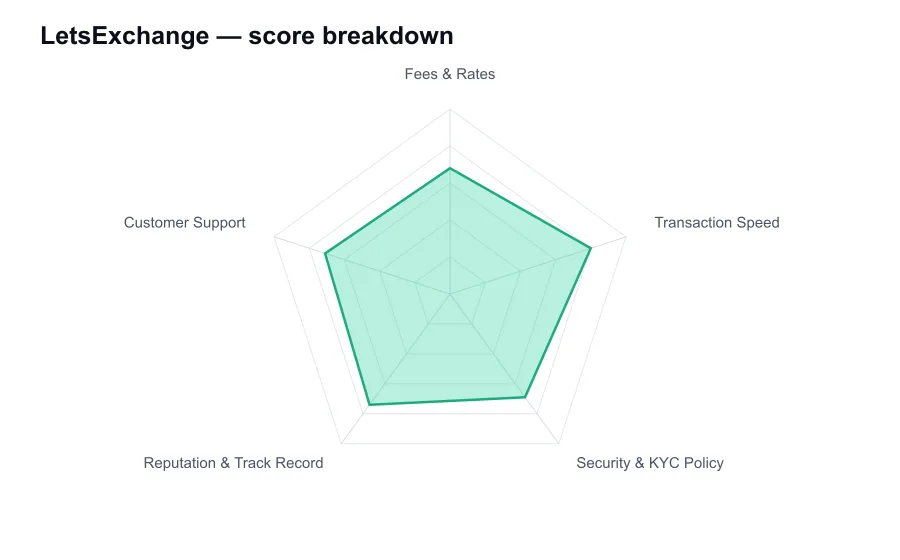
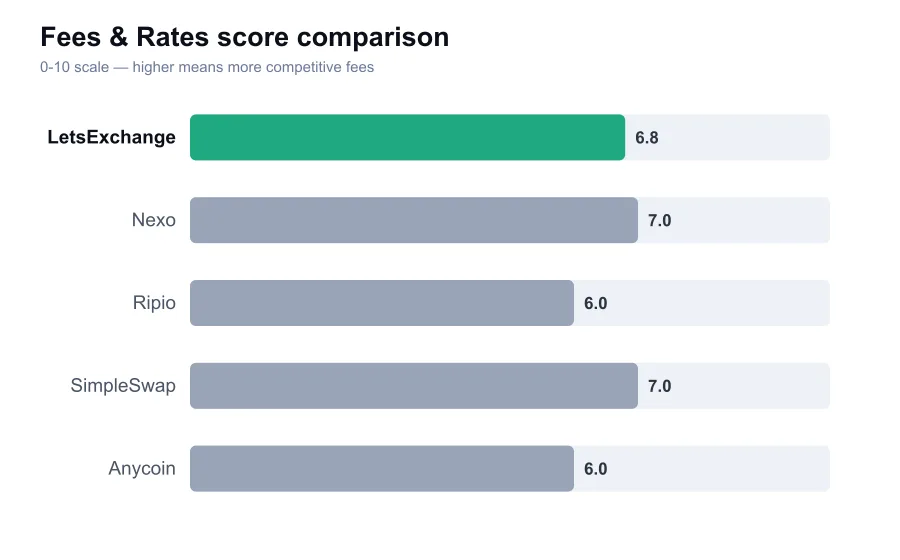
Fees are folded into the displayed exchange calculation rather than presented as a clean universal platform percentage. That is normal for instant exchangers, but it makes marketing comparisons difficult. The service may advertise competitive rates, yet network fees, provider spreads, and liquidity conditions can change the final result materially. Check the destination amount, not just a claim that there is no hidden commission.
Transaction speed is usually good for supported high-liquidity routes. LetsExchange can complete a simple swap rapidly once the incoming transfer is confirmed and a liquidity provider executes the trade. But it cannot bypass blockchains. Bitcoin confirmation time, Ethereum gas congestion, delayed exchange withdrawals, and wallet-side mistakes can all slow settlement. A fixed rate is also not a guarantee that the blockchain will move quickly.
The non-custodial label needs careful reading. LetsExchange does not ask customers to maintain a permanent platform balance in the manner of a centralised exchange. During an active swap, however, you send funds to an address used for settlement. That means you remain exposed to the service and its partners until the output arrives. It reduces standing custody risk, but it is not a trustless atomic swap.
KYC is not normally required for every order, which is a real attraction for users who value privacy and speed. Yet LetsExchange has an AML policy and can request verification for transactions flagged by compliance systems. This is common in the sector, but users should understand the practical consequence: a transfer can be paused while documents or source-of-funds information are requested. Never send funds you cannot afford to have temporarily held.
Security is reasonable for its category, especially because users can receive output directly into their own wallet. The weak point is still the user. A fake LetsExchange site, clipboard malware changing a wallet address, or a network mismatch can produce an irreversible loss. The service cannot protect someone who sends ETH to a Bitcoin address or selects USDT on an unsupported chain.
LetsExchange has been operating since 2020 and has built a visible presence through wallet integrations, affiliate relationships, API products, and review sites. That gives it a stronger public footprint than a brand-new swap widget. It is still not comparable to a regulated exchange with audited financial statements, formal customer asset segregation, or a long corporate history. I would regard it as an established convenience provider, not as a bank-like custodian.
The API and exchange widget are useful features for wallets, websites, and businesses that want swap functionality without building their own liquidity stack. This helps explain why LetsExchange has become more than a simple consumer website. For ordinary users, the benefit is indirect: broad routes and liquidity connections can produce better availability. It also means your transaction may depend on third-party execution beyond LetsExchange's direct control.
Customer support is available around the clock through online channels, and its order tracking system is genuinely useful. A clear status page and transaction ID can reduce anxiety while a transfer waits for confirmations. Support quality is still constrained by the underlying facts. It cannot force a blockchain to confirm faster, undo an outgoing wallet transaction, or guarantee an immediate resolution if a liquidity partner has paused a route.
LetsExchange works best for self-custody users who need an occasional conversion and are prepared to verify every detail before sending. It is less suitable for active traders who need limit orders, transparent market depth, and predictable percentage commissions. For large transfers, I would obtain quotes from several instant exchangers and compare them with the cost of using a reputable centralised exchange. The difference can be surprisingly large.
My final view is positive but disciplined. LetsExchange has a broad route catalogue, useful fixed-rate options, and a better-established presence than many anonymous swap sites. Its no-routine-KYC flow is convenient, yet the possibility of AML review remains real. Use it for well-understood swaps, keep records, and send a test transaction when the amount matters. It is a capable utility, not a substitute for self-custody discipline or exchange-grade transparency.