Report Chain logo Report Chain

Curve

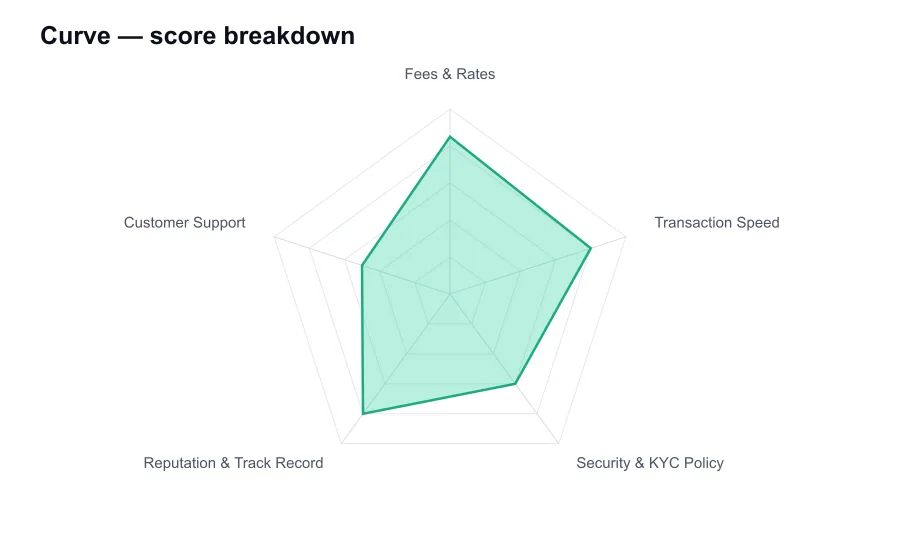
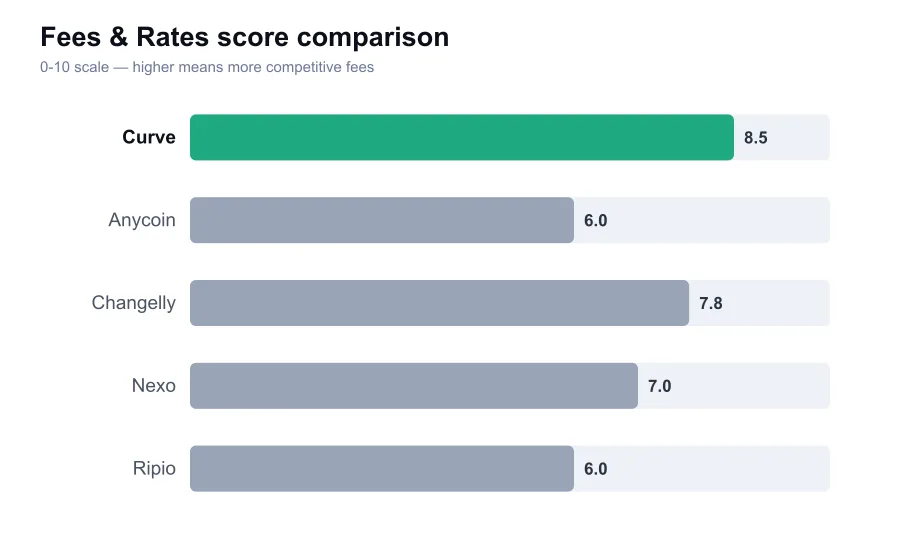
Curve scores 7.3/10 overall in our independent review, measured against every other provider we've compared, strongest on Fees & Rates (8.5/10) and weakest on Customer Support (5.0/10).

Visit official site
Status: active (checked 2026-10-13T18:02:00.268Z)

Editorial independence: our scores and rankings are produced using the fixed criteria above and are not influenced by advertisers. This is an independent ranking site and is not operated by, or affiliated with, any provider we list.

Affiliate disclosure: some links on this page may earn us a commission at no extra cost to you. This does not affect our rankings.

Quick Verdict
Curve remains one of the few DeFi protocols that has earned its importance through real utility rather than marketing. For stable swaps, its pool design and fees can be excellent. The 2023 Vyper exploit prevents a carefree security rating, and the protocol is unforgiving of user error. It is a strong tool in capable hands, but it deserves careful position sizing and a skeptical view of yield.
  • Best for: Efficient swaps for stable and correlated assets
  • Best for: Many classic pools charge 0.04%
  • Best for: Non-custodial wallet-based trading
  • Best for: Available across Ethereum and several rollups
  • Not for: July 2023 exploit exposed vulnerable Vyper pools
  • Not for: Interface and liquidity mechanics can confuse beginners
  • Not for: Gas costs can make small Ethereum mainnet trades uneconomic
  • Not for: Liquidity providers face depeg and smart contract risk
Market snapshot
AssetPrice (USD)24h change
Bitcoin (BTC)$81,809+0.87%
Ethereum (ETH)$2,396.01+1.27%
Tether (USDT)$0.9992+0.01%
BNB (BNB)$725.91+1.94%
Solana (SOL)$103.79+1.58%
XRP (XRP)$1.3+1.97%

Market data via CoinGecko, for informational purposes only. Not financial advice.

What is Curve?

Curve Finance is a decentralized exchange that uses smart contracts to swap stablecoins and other closely related crypto assets. Users connect a self-custody wallet rather than open a conventional exchange account. It also lets users provide liquidity to pools in return for fees and incentives.

How Curve Works

  1. Open the official Curve interface and connect a self-custody wallet
  2. Select the correct network and token pair
  3. Review the pool, quoted output, price impact, and gas cost
  4. Approve the token contract if the wallet has not approved it before
  5. Sign the swap transaction and wait for network confirmation
  6. For liquidity, deposit selected pool assets and monitor pool risk

Criteria Breakdown

Scoring breakdown for Curve
Criterion Score Note
Fees & Rates 8.5 Many classic pools use a 0.04% swap fee, plus network gas.
Transaction Speed 8.0 Fast on rollups, but confirmation timing depends on the selected chain.
Security & KYC Policy 6.0 Audited, non-custodial protocol with a serious 2023 Vyper exploit history.
Reputation & Track Record 8.0 A major DeFi venue since 2020 with deep stablecoin liquidity history.
Customer Support 5.0 Documentation and community channels, no personal transaction recovery.

Key Facts

Key facts for Curve
Fact Value Source
Launched 2020 Source
Typical classic pool fee 0.04% Source
Custody model Non-custodial smart contracts Source
Direct protocol KYC Not required Source
Vyper exploit July 2023 Source
Primary use Stable and correlated asset swaps Source

Review of Curve

Curve Finance is one of DeFi's foundational decentralized exchanges, built primarily for efficient swaps between assets that should trade close to the same price. Its original specialty was stablecoin liquidity. Trading USDC for USDT or DAI through Curve was often cheaper and less price-disruptive than using a conventional automated market maker. It later expanded into wrapped Bitcoin markets, ETH derivatives, crvUSD, and multi-chain deployments.

That niche is important. Curve is not designed to replace a broad spot exchange where someone discovers small-cap tokens and speculates all day. It is infrastructure for stable assets and correlated assets. If you need to swap USDC to DAI, move between liquid staking ETH tokens, or provide liquidity to a mature stable pool, Curve can still be extremely efficient. If you want the simplest possible interface, however, it can feel intimidating.

Curve's pricing model is one of its strongest features. Many classic pools use a 0.04% swap fee, although fee settings can differ by pool and newer pool designs have more flexible parameters. The user also pays the gas fee of the chain they are using. On Ethereum mainnet, gas may exceed the actual Curve fee for a modest trade. On networks such as Arbitrum, Optimism, Polygon, and Base, the transaction cost can be dramatically lower.

That does not make every Curve trade cheap. The visible pool fee is only one part of the price. Slippage increases when a pool is imbalanced or a trade is too large relative to available liquidity. Some front ends and aggregators can add their own routing cost. A stablecoin pair that appears equivalent can also carry depeg risk, so receiving a favorable rate is not much comfort if the asset you receive is losing its dollar peg.

The Curve interface can route a trade through several pools or connected protocols, which may improve execution. It also lets advanced users choose pools directly and inspect liquidity conditions. That power is valuable, but it creates room for expensive mistakes. A newcomer should not assume that the top result is always the safest pool or that every token sharing a familiar ticker is authentic. Contract addresses and network selection matter.

Transaction speed is good by decentralized exchange standards, although it is dictated by the chain rather than by Curve's servers. On an Ethereum rollup, a swap can usually be included quickly once the wallet signs and the network accepts it. On Ethereum mainnet, confirmation may take seconds to minutes depending on gas demand. Finality expectations vary by network, but the exchange action itself is generally completed as soon as the smart contract transaction confirms.

There are no conventional account withdrawals because Curve does not custody user deposits in a centralized account. You connect a wallet, approve a token contract, and submit a swap or liquidity transaction. Assets sit in your wallet until you interact with a pool. That is a major advantage for users who do not want exchange counterparty risk, but it changes the support model completely. There is no help desk that can undo an approved transaction.

Curve does not require KYC for direct use of its smart contracts or public interface. That is standard for permissionless DeFi, but it should not be read as a promise that every route is available in every jurisdiction. The interface, wallet provider, bridge, stablecoin issuer, or fiat on-ramp may apply their own restrictions. USDC and USDT are issued by centralized companies that can freeze specific addresses under their policies, even if the swap itself happened through a decentralized protocol.

Security is Curve's most difficult area. Its contracts have been audited and the protocol has operated at major scale for years, but it has suffered meaningful incidents. In July 2023, several Curve pools using vulnerable Vyper compiler versions were exploited. The event affected pools and led to losses measured in the tens of millions of dollars. A substantial portion was later recovered, but the incident proved that established DeFi code and audited systems are still exposed to dependency risk.

That episode should shape how users assess Curve. The protocol's response and community coordination showed resilience, while the fact that the exploit happened at all shows why DeFi yields are never free money. Liquidity providers face smart contract risk, token depeg risk, and impermanent loss or pool imbalance. Curve's stable-swap design can reduce slippage for correlated assets, but it does not remove economic risk from a pool holding assets that cease to be correlated.

Curve's reputation is substantial. It launched in 2020 and became a central venue in the so-called Curve Wars, where protocols accumulated or locked CRV to influence liquidity incentives. That system was innovative but also complicated, and it encouraged layers of governance, vote markets, and boosted rewards that a normal trader does not need to understand. The project has real DeFi importance, though its complexity has occasionally made it look more like infrastructure for specialists than a product for ordinary users.

Support is community-led. Documentation, Discord, governance forums, and public social channels are useful for checking known issues, but they are not personal transaction insurance. Fake Curve support accounts are common enough that users should treat unsolicited direct messages as hostile by default. No legitimate helper needs a seed phrase, private key, or token approval from you to investigate a problem.

The best way to use Curve is with discipline. Begin with the official curve.fi domain, connect a wallet with limited funds, inspect the exact token and pool, and make a small first swap. Revoke old approvals occasionally through a reputable allowance-management tool. If you are providing liquidity, understand why the pool exists, what assets it holds, and what happens if one asset trades below its expected peg.

For experienced DeFi users, Curve remains one of the best places to exchange stable and correlated assets efficiently. It has deep historical importance and often excellent execution. It is not beginner-friendly, and the 2023 exploit means nobody should describe it as low-risk. Curve is good infrastructure, not a savings account.

My verdict is favorable but guarded. Curve's fees and execution for the right asset pairs are genuinely strong, and its non-custodial architecture is preferable to trusting an obscure exchange. Yet complexity, smart contract exposure, and a serious past exploit demand respect. Use Curve for purposeful swaps, not blind yield chasing, and keep your position size aligned with the fact that DeFi failures can be permanent.
Pros & Cons

Pros and cons of Curve
Pros Cons
Efficient swaps for stable and correlated assets -
Many classic pools charge 0.04% -
Non-custodial wallet-based trading -
Available across Ethereum and several rollups -

Verdict

Curve remains one of the few DeFi protocols that has earned its importance through real utility rather than marketing. For stable swaps, its pool design and fees can be excellent. The 2023 Vyper exploit prevents a carefree security rating, and the protocol is unforgiving of user error. It is a strong tool in capable hands, but it deserves careful position sizing and a skeptical view of yield.

KYC

Requirement none
Notes Curve's smart contracts are permissionless and do not normally request identity documents. Connected services and asset issuers can impose separate restrictions.

Supported Assets

Notable Coins: USDC, USDT, DAI, crvUSD, ETH, wstETH, WBTC, CRV
Networks: Ethereum, Arbitrum, Optimism, Polygon, Base

How to Use Curve Safely

  • Use the official curve.fi domain and bookmark it
  • Check token contract addresses before approving or swapping
  • Start with a small transaction on a new network or pool
  • Review and revoke unnecessary token approvals
  • Do not treat stablecoin pool yield as risk-free income

Frequently Asked Questions

What is Curve's typical swap fee?

Many classic Curve pools use a 0.04% swap fee. The final cost also includes blockchain gas, and some pools use different parameters.

Was Curve Finance hacked in 2023?

Several Curve pools were exploited in July 2023 through vulnerable Vyper compiler versions. The event caused losses in the tens of millions of dollars, though part was recovered.

Does Curve require KYC?

No KYC is normally required to connect a wallet and use Curve's smart contracts. Wallet providers, bridges, token issuers, and fiat services can have separate rules.

Why can a stablecoin swap on Curve have slippage?

Slippage rises when a trade is large relative to pool liquidity or the pool is imbalanced. A stablecoin can also depeg, which changes the pool's economic risk.

Can Curve reverse a mistaken swap?

No. Curve is non-custodial and on-chain transactions are generally irreversible after confirmation. Check token addresses, network, and quote before signing.

Why are Curve trades cheaper on Arbitrum or Optimism?

Curve's pool fee may be similar, but rollups usually have much lower gas costs than Ethereum mainnet, making smaller swaps more practical.

What are the risks of providing liquidity on Curve?

Liquidity providers face smart contract risk, depegs, changing pool balances, and the chance of withdrawing more of an asset that has fallen in value.

Editorial independence: our scores and rankings are produced using the fixed criteria above and are not influenced by advertisers. This is an independent ranking site and is not operated by, or affiliated with, any provider we list.

Affiliate disclosure: some links on this page may earn us a commission at no extra cost to you. This does not affect our rankings.

About the Author

Yvette Saran Crypto Exchange Research Editor
  • 8 years in fintech and payments journalism
  • Crypto exchange testing and fee analysis
  • Former consumer finance reporter
  • Contributor to digital asset custody research

Yvette Saran is a crypto exchange researcher and former payments journalist with eight years of experience covering trading platforms, custody, and consumer finance. She reviews exchanges by testing the parts users actually feel, from order execution and withdrawal friction to fee disclosures and support quality.

Curve score breakdown by criterion, shown as a radar chart
Score breakdown
Curve fees score compared against similar providers
Fees vs. alternatives
Illustrative swap flow preview for Curve - not an actual product screenshot
Illustrative swap flow preview

Alternatives to Curve

Alternatives to Curve
AlternativeScore
Anycoin Review7.3/10
Changelly Review7.3/10
Nexo Review7.2/10
Ripio Review7.2/10
LetsExchange Review7.2/10
SimpleSwap Review7.2/10