Nexo is a centralized crypto financial platform that combines trading, borrowing, card spending and interest-bearing products in one polished account. It is aimed at users who want crypto services to feel more like private banking than DeFi. That positioning is clear in the app, where balances, credit lines, exchange functions and loyalty tiers sit together. It is convenient. It also means users are trusting one company with custody, compliance decisions and operational continuity.
The company's defining product has long been crypto-backed borrowing. Instead of selling eligible assets, a user can pledge them as collateral and draw a loan or credit line. This can be useful for holders who need liquidity and do not want to trigger a sale. It is still leverage. If collateral prices fall enough, Nexo can require more collateral or automatically repay debt using pledged assets under the account terms.
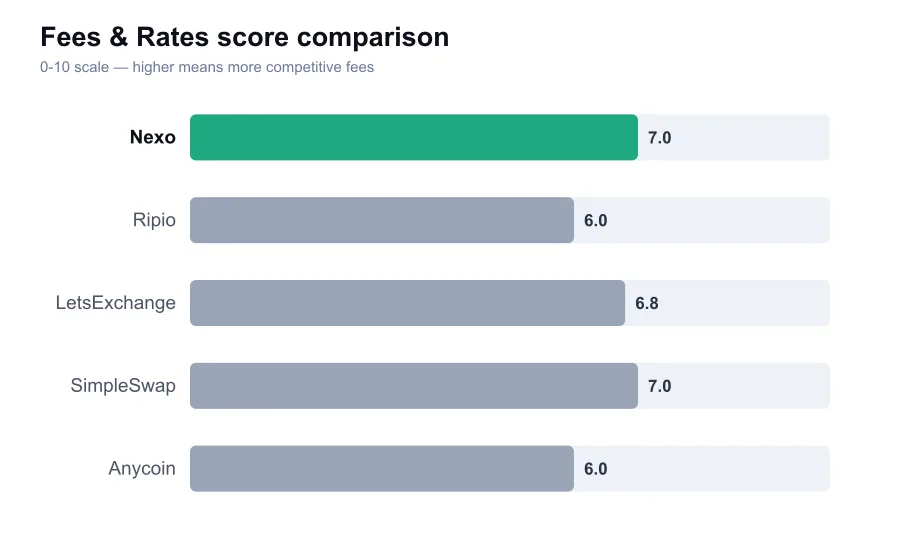
Nexo's exchange is simple and accessible, though serious traders should separate it from Nexo Pro. The standard in-app exchange uses an all-in quote rather than a familiar maker and taker fee schedule, which makes it easy to use but harder to compare precisely with a public order book. Nexo Pro has advertised spot fees beginning around 0.07 percent maker and 0.13 percent taker, before any applicable volume adjustments. That is more competitive, but it is a different experience from the main instant conversion tool.
Spread deserves attention. A zero-fee or low-fee sounding conversion can still be expensive if the quoted buy and sell price is wide. For a small convenience swap, this is rarely a major concern. For a sizeable conversion, compare Nexo's final quote with a liquid venue such as Kraken or Coinbase Advanced. Nexo is built to remove friction, not to be the first choice for price-sensitive market makers or active spot traders.
The loyalty program tied to the NEXO token can improve borrowing terms, earn rates and withdrawal allowances. That is attractive if a customer already understands the token exposure. I dislike treating loyalty-token holdings as a harmless fee discount. Holding a platform token to access better rates adds correlated risk, because the token may decline at the same time a customer most needs liquidity. The top-tier benefit is real, but so is the concentration risk.
Transaction speed is good for internal actions. Buying crypto in the app, moving collateral inside the account or drawing an approved credit line can happen quickly because Nexo controls the ledger. External withdrawals are slower and subject to internal processing plus blockchain confirmation. That is standard for centralized platforms. It becomes inconvenient if the market is moving quickly or if a withdrawal enters a security review.
Nexo requires identity verification. This is not a wallet-first product, and users should expect personal information, proof requests and jurisdiction checks. The platform's compliance model may frustrate privacy-focused crypto users, but it is more coherent than pretending to offer banking-like products without identifying customers. Account restrictions and additional document requests can still occur, especially with larger transfers or unusual activity, so users should not keep emergency funds solely inside the platform.
The company uses institutional custody and security partners, and has promoted measures such as cold storage, encryption, withdrawal controls and two-factor authentication. These are necessary features for a custodial service, not special proof that funds are immune from loss. Users should enable an authenticator app, withdrawal address controls where available, and strong email security. The weak point in many account takeovers is the customer's email or SIM card, not necessarily the exchange's core storage.
Nexo has a meaningful but mixed public record. It survived the broad 2022 lending crisis while several prominent crypto lenders collapsed, which counts in its favor. Yet survival should not erase regulatory pressure. In 2023, Nexo agreed to pay US regulators $45 million to settle allegations concerning its Earn Interest Product, and it stopped offering that product to US investors. That episode shows why yield products should never be treated as ordinary insured deposits.
The company also faced a high-profile investigation involving its Bulgarian offices in 2023. The case generated damaging headlines, though the investigation was later dropped by Bulgarian authorities. It is fair to say that Nexo has been tested by scrutiny and did not simply disappear. It is equally fair to say that a customer choosing Nexo is accepting company, regulatory and jurisdictional risk that does not exist in the same form with self-custodied DeFi.
Nexo's public communications and app experience are much stronger than those of a small offshore exchange. Support is available through in-app and web channels, and the help center covers common product questions. Response quality is generally more relevant than the existence of a chat button when an account is restricted or a withdrawal is pending. Like most centralized providers, the company retains discretion under its terms, so support cannot be assumed to override a compliance decision.
The product range is both a strength and a hazard. Users can trade, borrow, earn and spend from one account, but that convenience encourages people to stack risks they may not fully see. Borrowing against volatile crypto while holding NEXO for loyalty benefits and earning yield through the same company is a concentrated bet on one platform. Keep separate mental accounts for each risk rather than being seduced by a tidy dashboard.
Nexo works best for verified users outside restricted jurisdictions who want a straightforward credit line, card or managed crypto account and accept custody trade-offs. It is less compelling for low-cost active trading, anonymous use or people who insist on controlling private keys. The best use is measured: collateralize conservatively, withdraw surplus assets to self-custody, and treat promised yield as compensation for real counterparty risk.
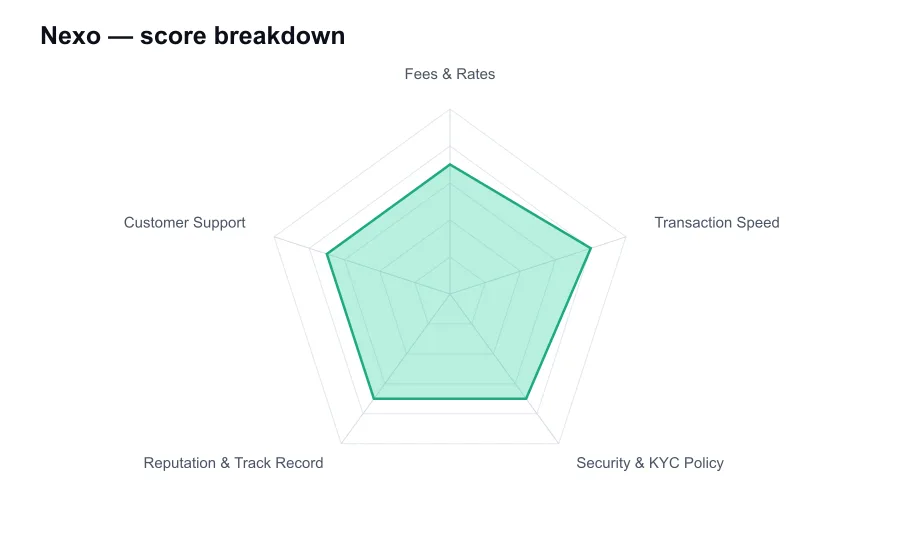
My view is that Nexo is more credible and usable than many crypto lending brands, but it is still a centralized lender operating in a sector with painful history. Its product design is slick, its Pro trading fees are respectable, and its record is more durable than several failed peers. The regulatory settlement and custody dependence stop it from being a set-and-forget home for a major portfolio. Use it as a financial service, not as a replacement for a self-custody strategy.