Moneta365 is presented as an online cryptocurrency exchange service rather than a conventional global trading platform. Its name suggests a simple always-available conversion tool, and that is the lens through which it should be judged. A customer is likely looking for a quick purchase, sale, or exchange rather than advanced charting, derivatives, or institutional custody. The basic proposition is familiar, but the trust standard should be high because an exchange transaction involves sending assets to a third party.
The service sits in a crowded segment of the market. There are large centralized exchanges with extensive compliance systems, instant exchangers that prioritize a short form and rapid settlement, and peer-to-peer venues that put buyers and sellers in direct contact. Moneta365 appears closer to the instant-exchange end of that spectrum. That can be useful for someone who wants a straightforward conversion, but it also means the user should focus on the final quoted payout and service terms rather than expect an order book.
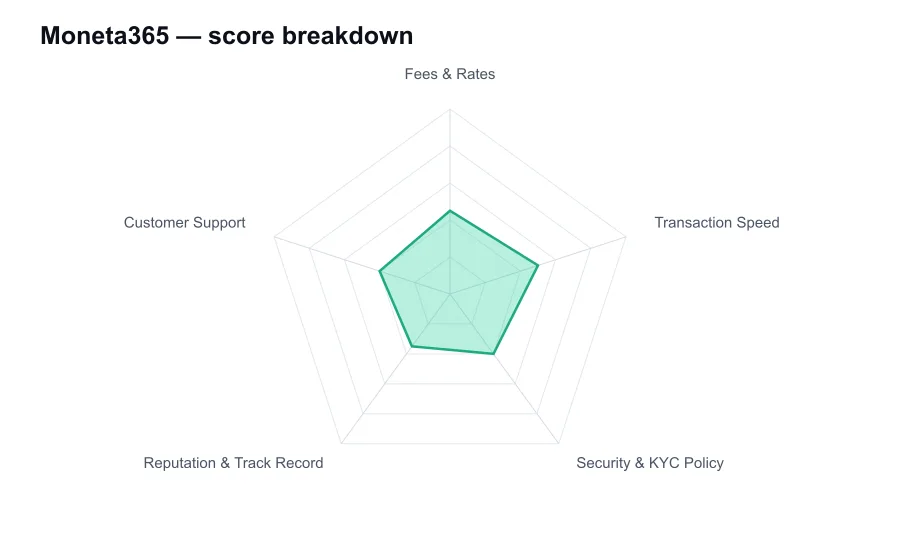
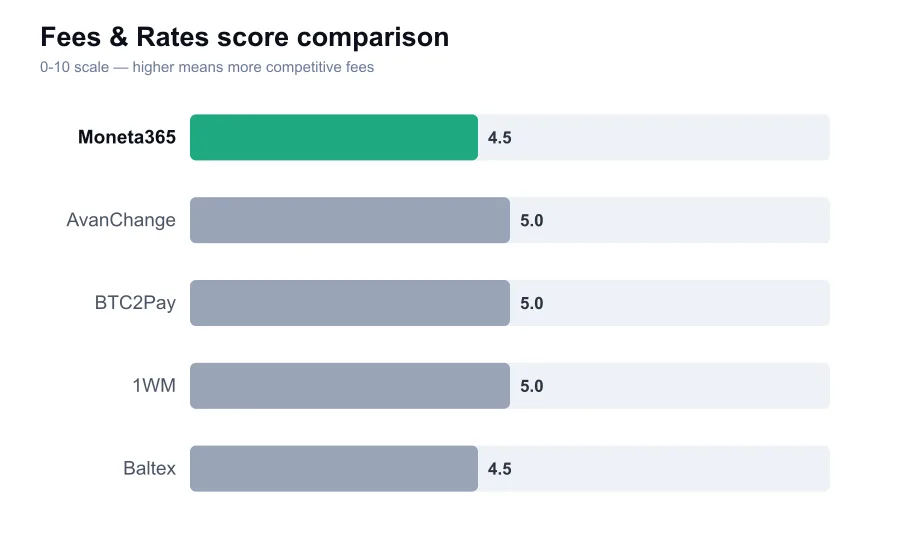
Price is the first issue I would investigate before using Moneta365. Small exchange services often charge through the spread between the market price and the rate offered to the customer instead of through a plainly separated trading commission. That is not inherently deceptive. It becomes a problem when the provider does not clearly show whether the rate is fixed, how long it is valid, and whether network fees or payment fees reduce the final amount. A customer should be able to answer those questions before entering a deposit address.
For small transactions, convenience can justify a somewhat wider effective spread. For large transactions, it rarely does. A one or two percent difference in the final output can matter far more than a fast checkout screen. I would compare Moneta365's final receive amount with at least two established alternatives at the same time, using the same amount and network. Do not compare a headline exchange rate with another provider's final quote. That is how an apparently cheap service wins a comparison it has not actually earned.
Speed is also dependent on the transaction type. An internal card or bank-payment step, where offered, may introduce review or settlement time before crypto is released. A crypto-to-crypto order is driven by blockchain confirmations, liquidity, and the provider's processing queue. The word 365 suggests continual availability, but no exchange should be judged by branding. What matters is whether orders are actually processed outside business hours and whether the provider publishes status information during technical interruptions.
Users should distinguish a pending blockchain transaction from a provider-side delay. If the deposit has not reached the required confirmations, customer service cannot legitimately accelerate the chain. If confirmations are complete and the order is still unresolved, the issue is more likely operational, liquidity-related, or compliance-related. Save the transaction hash and compare it with the order details. That basic recordkeeping makes support conversations far more productive and reduces the chance of being misled by an impersonator.
Security disclosure is the category where Moneta365 needs to earn confidence rather than receive it automatically. An exchange service should state how customers can recognize official communications, how it handles failed deposits, and what documentation may be requested for a flagged transfer. It should also provide an obvious way to report a suspected phishing page. A service dealing with irreversible crypto payments has a duty to make its processes visible. A generic contact form and optimistic marketing copy are not enough.
KYC is especially important because many customers interpret a quick exchange interface as proof that no verification will ever be requested. That assumption can be expensive. Risk-based checks are common across the industry, and they can appear after a deposit is received. Moneta365 should be evaluated on whether it explains this possibility in advance and whether it gives a coherent process for resolving a hold. Customers should never send additional funds merely because an alleged support agent promises to unlock an earlier order.
The provider's reputation is harder to assess than that of household-name exchanges. A smaller service may have satisfied customers, but a credible track record requires more than scattered review-site comments. I look for consistent public terms, operating history, a traceable company identity, responsive support, and evidence that the service resolves difficult cases in a way customers can verify. Moneta365 does not have the public profile or independently documented resilience of exchanges such as Kraken or Bitstamp, so it deserves more caution by default.
That does not mean it should automatically be dismissed. Regional and specialist exchangers can offer useful payment routes or local-language service that large platforms neglect. The problem is that a smaller provider must compensate for its lower name recognition with greater transparency, not less. The exact legal entity, fee mechanics, supported networks, refund policy, and support process should be clear before a customer sends money. If those items are difficult to locate, the prudent response is to use another provider.
Support can determine whether a basic exchange experience feels acceptable or disastrous. A customer who simply receives a payout may never need help. A customer whose bank transfer is delayed, crypto deposit uses the wrong network, or transaction triggers a review needs an answer that is specific, documented, and timely. Moneta365 should provide a ticket trail and identify official support routes. I would not rely on messages from Telegram, WhatsApp, or social media unless the exact channel is linked from the official site.
There is also a consumer-protection issue around payment methods. Card purchases, bank transfers, and crypto deposits are not interchangeable. Banks can delay or reject transfers, card processors can impose limits, and on-chain transfers are usually irreversible. A user should know which payment rail is being used and whether the quoted rate changes while payment clears. If the service accepts a local transfer, check the beneficiary name carefully. A mismatch between the stated company and payment recipient is a reason to pause.
My practical recommendation is to approach Moneta365 as a transaction service, not as a place to park assets. Create an order only after confirming the exact asset, the network, the destination address, and the final expected amount. Start with a modest sum. If the first transaction is clean, that is useful evidence, though it is not a guarantee that a future larger transaction will receive identical treatment. Crypto exchange risk rises sharply with size.
Moneta365 may suit a user who values a simple conversion flow and is willing to do careful pre-transaction checks. It does not yet inspire the level of confidence I would demand for substantial holdings or urgent large trades. The service's potential convenience is real, but convenience is not a substitute for proven transparency, deep liquidity, or a long public record. My final advice is conservative: compare quotes, document every step, and choose a more established venue whenever the amount is meaningful.