BTC2Pay presents itself as a quick crypto exchange service aimed at people who want to swap coins without opening a full trading account. It sits in the small instant-exchange end of the market, closer to a conversion desk than a conventional exchange. That distinction matters. You are not getting a deep order book, advanced trade controls, or the disclosure standards expected from a large centralized platform.
The service is built around a familiar form: choose the asset you are sending, choose the asset you want to receive, enter a destination wallet, and transfer funds to a generated deposit address. For a simple one-off swap, that can be less annoying than registering at Binance, Kraken, or Coinbase. It is also less transparent than those venues in several important ways.
BTC2Pay's appeal is speed of access rather than price leadership. There is little friction in the basic exchange path, and users who already control their own wallet can get from one asset to another without handing over a passport during ordinary transactions. That is useful, but it should not be confused with a guarantee that identity checks will never occur.
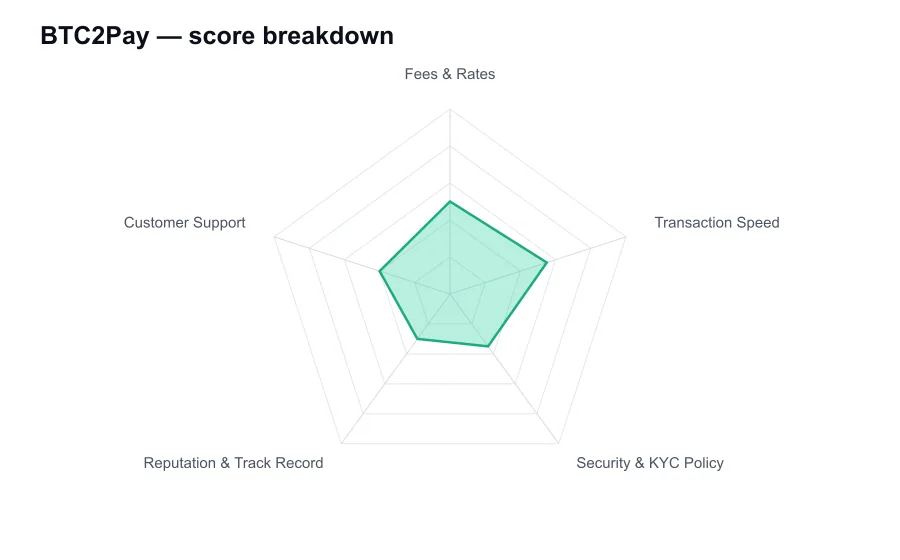
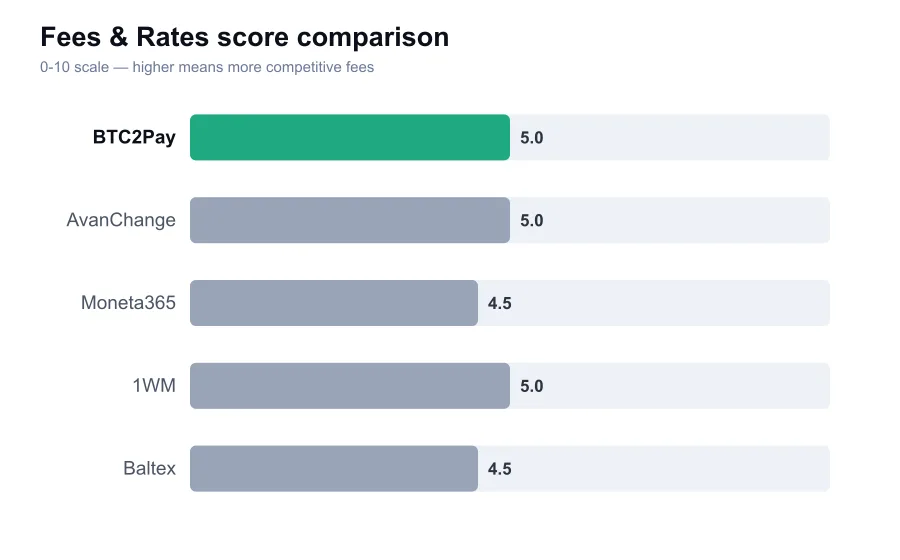
The fee picture is the weak point. BTC2Pay does not have the kind of clear public maker and taker schedule that lets a buyer compare costs in advance. Its economics are instead reflected in the exchange quote and the spread between market pricing and the offered amount. That is common among instant exchangers, but it makes disciplined comparison shopping essential.
A quoted rate can look reasonable until you compare it against a live reference price from a liquid exchange. On large pairs such as BTC to USDT or ETH to USDT, the spread may matter more than any stated processing charge. On thin tokens or awkward network combinations, the effective cost can become materially higher. BTC2Pay is not a service I would use blindly for a large conversion.
The platform appears designed for floating-rate swaps, where the final result can move while the incoming transaction is waiting for confirmations. This is normal operationally, especially for Bitcoin and Ethereum transfers, but it puts rate risk on the customer. A user expecting an exact payout should confirm whether the quote is fixed or merely indicative before sending anything.
Speed depends heavily on the asset being sent. A fast chain transfer can be processed relatively quickly once confirmations arrive, while Bitcoin deposits can take longer during congestion. BTC2Pay cannot make a slow blockchain fast. What it can control is internal processing, and the service gives limited public detail about its processing targets or service-level commitments.
That lack of operational disclosure is a recurring concern. Established exchange brands publish system status pages, maintenance notices, security documentation, legal entities, and incident histories. BTC2Pay gives a much thinner public record. A smaller service does not automatically deserve distrust, but customers should recognize that limited transparency reduces the amount of independent due diligence available.
Security is also about custody. During the swap, BTC2Pay temporarily controls the funds you send. That makes address verification crucial. Check the destination wallet character by character, use the right network, and do not send an unsupported token to a generic deposit address. A successful transaction on the wrong chain is not automatically recoverable.
The KYC position appears flexible rather than absolute. A routine exchange may be possible without an account or document upload, yet anti-money-laundering checks can still be triggered by transaction patterns, source-of-funds concerns, sanctions screening, or compliance flags. Anyone treating BTC2Pay as an anonymous cash substitute is taking an unnecessary risk.
BTC2Pay's reputation is difficult to rate highly because it lacks the long, independently documented operating history of the better known instant-swap providers. ChangeNOW, FixedFloat, and SideShift have their own limitations, but they have a far broader public footprint. BTC2Pay has less material for a prospective customer to assess, which lowers confidence even if a particular swap works fine.
Support appears to be centered on online contact rather than the extensive account support infrastructure offered by large exchanges. That can be adequate for simple questions, but the real test is a delayed exchange, a disputed rate, or a transfer sent on the wrong network. Those are the moments where a small provider's support capacity becomes visible.
I would start with a small test transaction. Do not make BTC2Pay the first destination for funds you cannot afford to have delayed. Save the order reference, screenshots of the quoted amount, transaction hash, receiving address, and any support conversation. Those records are basic protection if an order needs manual review.
BTC2Pay can be useful for a modest wallet-to-wallet conversion when convenience matters more than execution precision. It is not persuasive as a primary exchange for regular trading, high-value transfers, or users who need predictable pricing and mature compliance support. The service's biggest problem is not that it is necessarily unsafe. It is that too much depends on trust in a relatively opaque intermediary.