1Mile appears to operate in the small instant-exchange segment, where a customer submits a single conversion request rather than trades on an open order book. That market has room for useful specialist services, especially where local bank transfers, e-wallets, or less common crypto routes are involved. It is also a market where superficial trust signals can mislead people.
A small exchanger does not need a polished mobile app or a huge token list to be useful. It needs to do three things well: quote a realistic final rate, move funds within the promised time, and handle exceptions honestly. The trouble is that those qualities are hard to establish from a website alone. A clean interface tells you very little about reserves, internal controls, or the operator's ability to resolve a disputed payment.
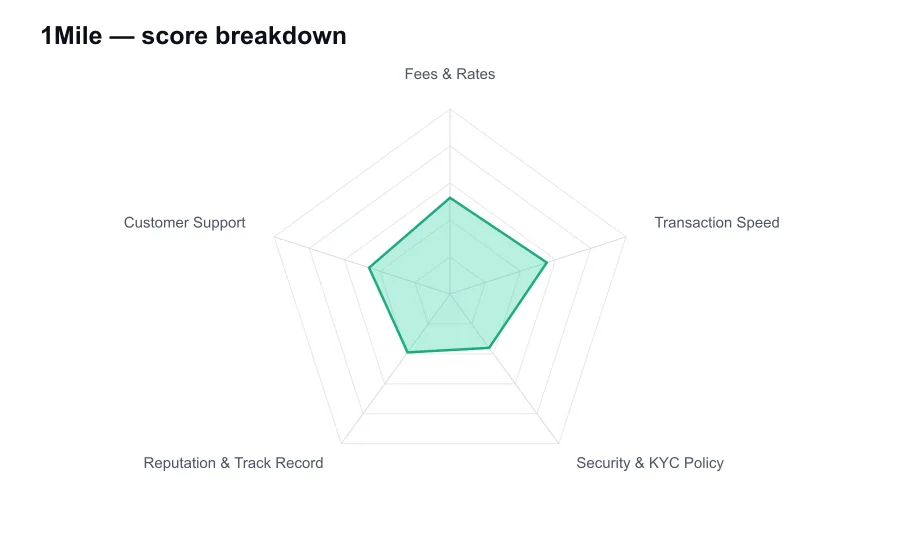
I could not independently confirm a detailed corporate history, named leadership, audited financial information, or a broad record of reporting from major industry sources for 1Mile. That should influence the amount of trust a user extends. It is reasonable to use caution with any small exchanger. It is not reasonable to treat a limited public footprint as proof that the service has the same safeguards as a large exchange.
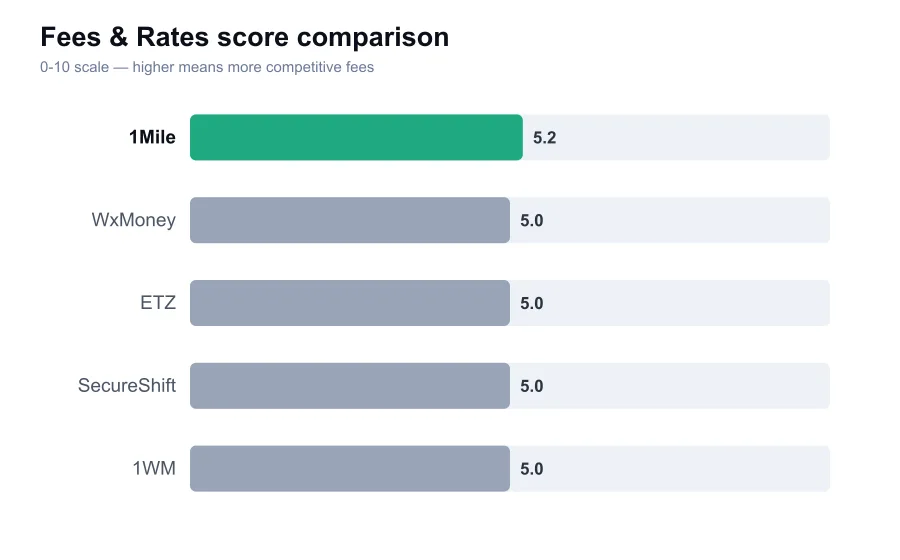
The pricing model is likely quote-led. In practical terms, that means the fee is reflected in how much you receive, rather than presented as a transparent trading commission. This is common and not inherently unfair. The real test is whether the final payout remains competitive after you include blockchain fees, card or payment-service costs, and any spread charged because the route requires manual handling.
People often make the mistake of choosing an exchanger from the first rate shown on a monitoring page. A better approach is to open the order form, enter the real amount, and compare the exact destination payout with two or three services. Check whether the rate is fixed and how long it is protected. A floating quote can move between order creation and the time the payment is credited.
Speed is another area where a small provider's marketing needs translation. Crypto transfers are constrained by the source chain, confirmation requirements, and the operator's processing queue. Fiat-linked routes can be slower still, especially outside local banking hours. A provider may process an order promptly and still be unable to make a bank transfer arrive instantly.
For a normal on-chain conversion, the main question is whether 1Mile begins processing after the required confirmations or waits for manual review. For a bank-linked order, the key question is whether the payment reference and sender information match the order. A mismatch can turn a short exchange into a long support case. Never improvise the payment instructions, even if you think the difference is trivial.
Security disclosures are limited from what can be independently confirmed. That puts 1Mile in a weaker position than exchanges that disclose licensing, custodial arrangements, proof-of-reserves work, security architecture, and incident procedures. The service may ask for relatively little information in its normal order flow, but low-friction onboarding should never be confused with a contractual promise that verification will never be requested.
A bank payment that looks suspicious, a transaction linked to a high-risk wallet, or an inconsistent sender name can all trigger checks. If you need predictable compliance treatment, use a platform with published account tiers and a clear review process. If privacy is more important, understand that the trade-off may be less certainty about how a difficult case will be handled.
Reputation is where I am most reserved. User feedback can offer useful clues about whether routine orders settle, but it is easy to overread a small collection of reviews. Strong reputation means more than positive comments. It includes an established history, transparent ownership or registration, a demonstrated response to public problems, and enough independent scrutiny that customers can make an informed decision.
Support may be perfectly adequate for routine questions, yet that is not the difficult test. The difficult test is a delayed bank payment, a wrong-network deposit, or an order marked complete when the customer believes the payout is short. Before using 1Mile, locate its official support channel and send a precise pre-sale question. The quality and speed of the answer are useful evidence.
I would not send a large initial amount to test whether a service responds well under pressure. Start with a sum small enough that a delay would be annoying, not damaging. Confirm the receiving address twice, preserve screenshots of the quote, and avoid sending funds from a third party. These habits are basic, but they are far more valuable than a decorative security badge.
1Mile may have a place for an experienced user who has identified a competitive quote on a specific route and is prepared to test it carefully. It is less appealing for people who need a wide product range, margin trading, formal reporting tools, advanced account controls, or predictable 24-hour institutional support. Those users should look toward established exchanges or specialist OTC providers.
My final view is guarded rather than hostile. I see no reason to assume that every small instant exchanger is unsafe, but I also see insufficient independently verifiable information to recommend 1Mile as a primary venue. Use it only if the final quote clearly wins and the amount is controlled. For larger transfers, the modest saving from a better displayed rate rarely compensates for uncertainty around support and transparency.