Baltex is a lesser-known exchange service operating in the broad instant conversion and electronic-payment exchange niche. That is a crowded corner of crypto, full of sites that can complete routine swaps perfectly well but offer little certainty about pricing, corporate accountability, or dispute handling. Baltex should be approached as a small transactional service, not as a place to store funds or build a trading relationship.
Its core proposition is easy to understand. A customer selects a payment direction, provides a receiving address or payment details, sends the required amount, and waits for the service to complete the exchange. For people moving between crypto and payment systems, that can feel much more convenient than opening an account at a major exchange, passing verification, placing a trade, and arranging a withdrawal.
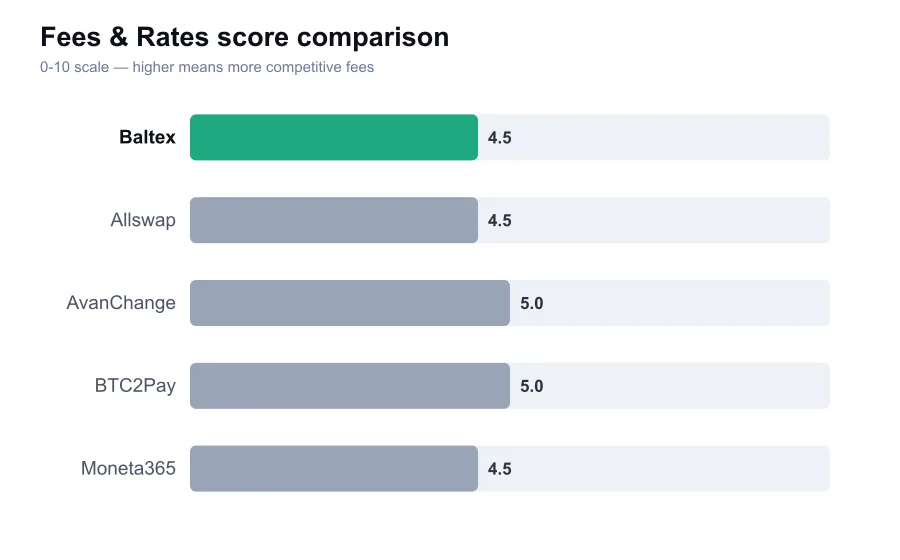
Convenience does not mean cheap. Baltex's pricing is primarily visible through its quoted rate, which is common among exchangers but poor for clean comparison. A customer sees what they will send and what they are expected to receive, yet may not see a separate line for platform margin, partner costs, network fees, or payment-processing costs. The only sensible comparison is the final amount delivered, not the advertised exchange rate alone.
This is especially important on routes involving stablecoins or popular assets with deep liquidity. On those pairs, a large difference from the mid-market rate is hard to justify. A smaller exchange can have legitimate costs, but customers should not reward opacity. Check the same amount on a liquid centralized exchange and at least one established instant-swap provider. If Baltex is materially worse, the faster-looking route is simply expensive.
Payment method changes the risk level. Card-linked balances, bank transfers, e-money wallets, and crypto deposits all have different reversal and fraud rules. Crypto deposits are final, while some fiat rails can be reversed or reviewed. That can lead an exchanger to delay the outgoing side until it is satisfied the incoming payment is settled. If Baltex handles such routes, users should expect processing time to vary considerably rather than assuming an immediate settlement.
Speed claims should therefore be read carefully. A completed on-chain deposit may be converted rapidly, while an electronic-payment route can take longer because it needs manual review or provider confirmation. The frustrating cases are not the quick swaps, they are the exceptions. A customer needs clear notice of whether a transaction is pending, undergoing payment verification, awaiting blockchain confirmations, or being reviewed for compliance.
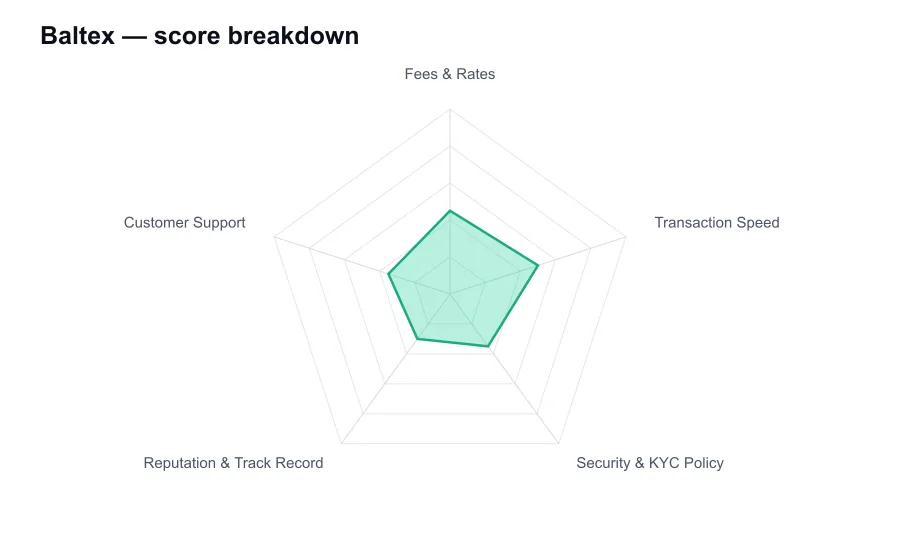
Baltex does not have the public operating record that would let me confidently score its speed or reliability alongside the major brands. There is little broad, independently documented evidence showing how it performs during wallet outages, volatile markets, or disputed payments. That lack of data is not an accusation. It is, however, a reason to keep transaction size small until you have personally tested the service.
Security questions are more significant here because exchange services temporarily sit between the sender and the recipient. The customer has to trust that the destination details are recorded correctly, that the operator controls its wallets securely, and that staff can detect fraud without creating arbitrary holds. Baltex does not provide the kind of detailed security architecture, external audit material, proof-of-reserves program, or mature incident reporting that would warrant a strong security score.
A lack of prominent KYC at the beginning of a transaction should not be confused with a right to remain anonymous. Financial services can screen transactions and request documents if a payment, address, amount, or pattern triggers a compliance review. That possibility is most painful after funds have already been sent. Before using Baltex, read the current terms and ask support what documents might be required if a transaction is flagged.
Reputation is the central weakness. A credible exchange earns trust over years through visible operators, stable rules, independent coverage, and a body of customer experience that includes more than promotional listings. Baltex does not appear to have that depth of public scrutiny. It may be active and capable of completing ordinary exchanges, but a reader cannot infer resilience from a working website.
Support is likely to be adequate only if the transaction follows the expected path. Small providers often answer basic pre-sale questions quickly, then struggle when a blockchain transaction is underpaid, sent on the wrong chain, caught by a payment review, or delayed by a third-party wallet. The real test is whether there is a documented escalation channel and someone empowered to resolve an exception. Public evidence on that point is thin.
If you are considering Baltex for the first time, send the minimum practical amount. Confirm the recipient details before paying. Take screenshots of the quote and order page, then monitor the deposit on the relevant blockchain explorer. That is not paranoia. It is normal operational discipline whenever you use a service without the transparency and recovery options of a regulated exchange.
Baltex can make sense for an experienced user who has found a genuinely competitive rate on a small conversion and accepts the operational risk. It is a poor fit for recurring business payments, payroll, large stablecoin conversions, or anyone who needs robust compliance paperwork. Those jobs call for a provider with published policies, established banking relationships, and an easier-to-audit record.
My judgement is that Baltex belongs in the use-with-care category. There may be a legitimate use case for small, carefully checked transactions, especially where its route is unavailable elsewhere. Still, its limited public footprint, opaque all-in pricing, and uncertain support depth mean it should not be trusted merely because the quote page is easy to use.