Allswap is positioned as an instant crypto exchange, a service that tries to remove the account creation and trading-screen complexity associated with centralized exchanges. A visitor selects two assets, receives an estimated conversion, sends a deposit, and waits for a payout to a personal wallet. That is a familiar proposition. It competes in a crowded group where the core product is easy to copy, and where the meaningful differences are liquidity quality, transparency, support, and whether the operator can be trusted when something goes wrong.
The service is not a decentralized exchange in the strict sense. A user does not sign a smart-contract trade from their wallet and settle directly against an automated pool. Instead, an order is created and crypto is sent to an address used for that conversion. Allswap then arranges the outgoing transaction. That distinction matters. The customer does retain their own wallet outside the order, but they are still relying on a centralized intermediary to receive, process, and return funds.
Allswap's design favors a quick one-time transaction. For a person who simply needs to convert Bitcoin into Ethereum, or exchange one supported token for another, that can be more approachable than depositing to an exchange, passing account checks, navigating a market pair, and withdrawing. The convenience is real. It also makes the product easy to overtrust. Simple screens can hide complex execution, including price spread, liquidity sourcing, transaction monitoring, and manual exception handling.
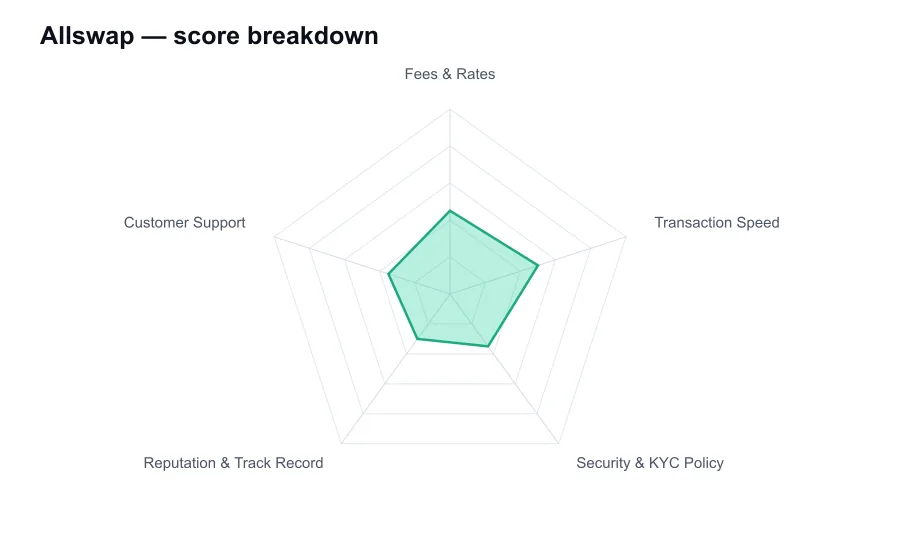
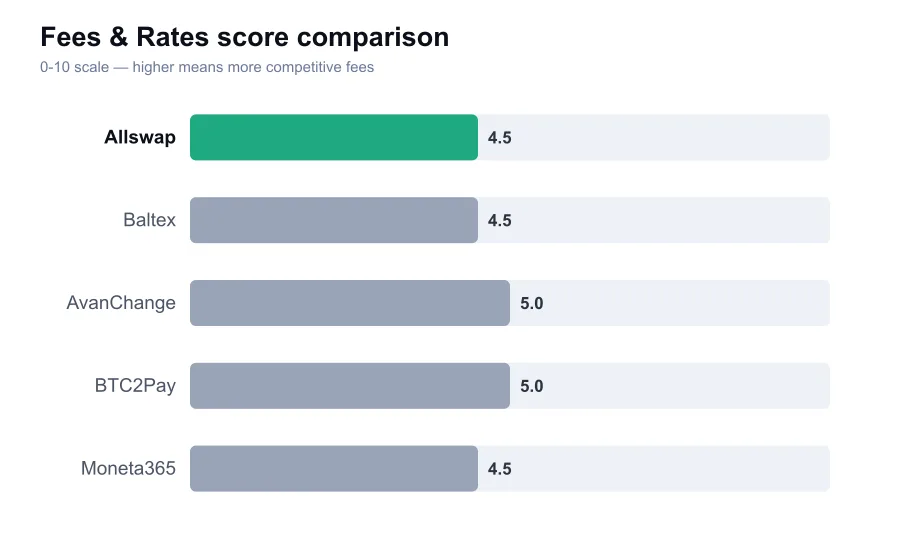
The first issue I would examine is the final quote. Like many instant exchangers, Allswap does not operate with the fee clarity of a maker-taker exchange schedule. The customer is shown an expected output, while the provider's compensation may be reflected in the rate. That can be acceptable for a small convenience swap. It is not acceptable to send blindly. Compare the exact output for the same amount and network against at least two established alternatives before committing.
A quote should be read as a live offer, not a promise detached from market conditions. Floating-rate conversions may change between the time the screen is loaded and the time the deposit is credited. Fixed-rate orders, if offered for a pair, commonly have a short payment window and can be subject to conditions. Crypto markets can move sharply in ten minutes. A user who sends late, sends an incorrect amount, or chooses a thinly traded asset can discover that the final result differs from the number they first saw.
Transaction speed has the same caveat. The website may generate an order immediately, but it cannot make blockchains settle instantly. Bitcoin deposits need confirmation. Ethereum and token transfers depend on gas conditions. An output transaction may then need to be assembled and broadcast by the provider or its liquidity partner. Common pairs on healthy networks can complete in a relatively short period after confirmation. Less common assets, volatile periods, and compliance checks can introduce substantial delays.
Allswap has not built the kind of widely documented public operating record that would let me treat it like a top-tier exchange. This does not automatically mean every order is unsafe. It does mean users should assign it a higher counterparty-risk premium. In practice, that means smaller order sizes, a test transaction first, and no reliance on the service for time-sensitive payments. A provider's marketing language is less useful than a long history of independently verifiable customer outcomes.
Security disclosure is another weak spot for smaller instant services. Good providers explain their corporate identity, terms, privacy practices, sanctions controls, support escalation, and what happens if an order is held. They make it easy to find that information before funds are sent. Where those details are incomplete or difficult to verify, a customer has to assume the risk of ambiguity. That is especially uncomfortable with crypto because the deposit cannot be recalled after confirmation.
No-account services are frequently described as anonymous, but that is an oversimplification. Blockchain analytics, anti-fraud tools, sanctions screening, and banking or liquidity-provider requirements can all lead to a request for information. Allswap users should expect that a transaction may be paused for review, especially if it involves an unusual amount, a flagged address, or a payment pattern the operator considers risky. If privacy is essential, do not assume a website's light onboarding removes legal or compliance constraints.
Support quality becomes decisive in those edge cases. For a successful ordinary order, the service can appear seamless. For a delayed order, a wrong-chain deposit, or a verification request, the customer needs a named case, a clear explanation, and a realistic timeline. Allswap does not have the extensive, public support reputation of a large exchange, so I would not award it trust simply because a chat or email address exists. Responsiveness needs to be demonstrated, and smaller operators have less room for error.
There are also basic network hazards that Allswap cannot fix for you. Sending an ERC-20 token through a non-Ethereum network, using an address that needs a destination tag without supplying one, or sending the wrong token to an address can lead to lost or manually recoverable funds. Stablecoin names are particularly dangerous because USDT and USDC are issued on several chains. Before starting an order, confirm the chosen network at both ends, then verify the receiving address character by character.
Compared with major centralized exchanges, Allswap offers less friction but fewer safeguards. Kraken, Coinbase, and Bitstamp offer published fees, account controls, established compliance processes, and usually deeper liquidity, though their onboarding can be much heavier. Compared with prominent instant exchangers, Allswap offers the same basic convenience but does not have their depth of third-party visibility. This is a market where reputation is a product feature, not mere branding.
The sensible way to use Allswap is as a fallback for a small, non-urgent conversion only after its quote proves competitive. Do not use it as a long-term wallet. Do not treat it as a private trading venue. Do not send a deposit before checking that the amount, coin, and network are exactly right. Those cautions might sound conservative, but they are proportionate to the service's limited track record and the final nature of blockchain settlement.
I cannot recommend Allswap for large transfers, business payments, or anyone who needs reliable support with a clear escalation route. The fee opacity and uncertain execution quality are manageable only at a small scale. A more established instant exchanger may cost a little more in some cases, while a regulated exchange may require KYC, but either can be a better choice when a delayed or disputed transaction would matter.
Allswap's proposition is understandable, and it may function adequately for ordinary swaps. Still, it has not earned the confidence reserved for providers with transparent operations and a substantial independent history. Convenience should be judged by the full experience, including what happens after an order fails to proceed normally. On that standard, Allswap remains an option to test cautiously rather than a service I would confidently recommend.