BtcChange24 is a small crypto exchange service built around direct conversions rather than conventional spot trading. It occupies a part of the market where convenience can look attractive, especially to someone who wants to exchange a coin quickly without building an account profile. The trade-off is a thin public record and far less visibility than major exchanges provide.
The core process is simple. A user picks an exchange direction, provides payout details, receives payment instructions, and waits for the operator or automated system to complete the order. That is a familiar model among exchange-monitoring listings and independent conversion sites. It is not the same thing as using a highly liquid marketplace.
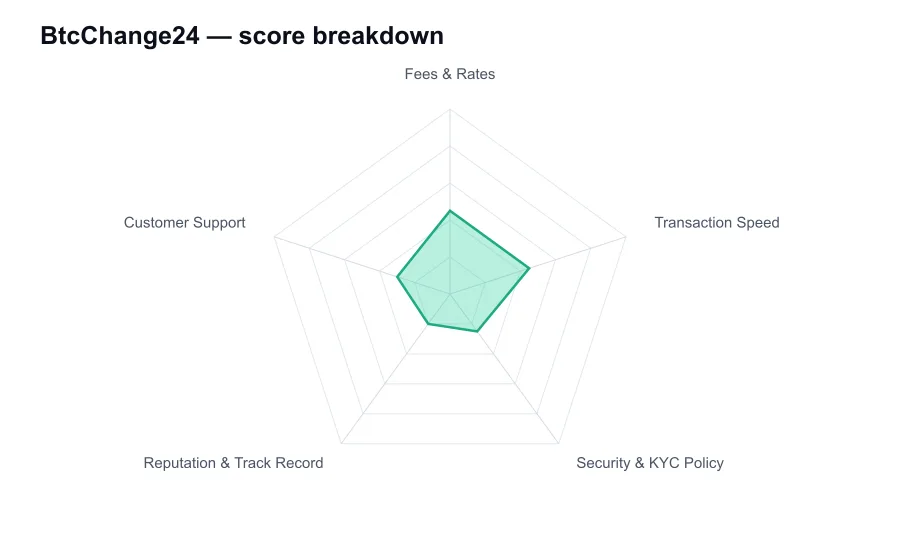
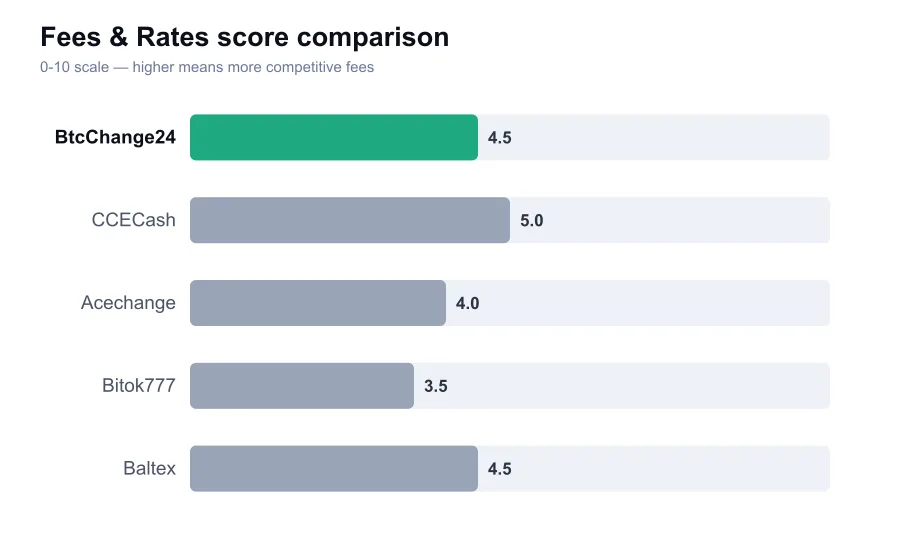
BtcChange24 does not offer the depth of information serious customers should expect before sending a substantial amount. There is no widely recognized, transparent trading fee schedule that allows users to calculate a cost before entering a specific order. The quoted rate is therefore the number that matters, not any assumption about a cheap service.
This is where smaller exchangers often disappoint. A visible quote may include provider margin, network costs, volatility protection, and an operational buffer. There is nothing inherently improper about that model, but it makes comparisons essential. Check at least two competing services and compare the amount actually delivered, rather than comparing a headline exchange rate.
For ordinary transfers, BtcChange24 may be quick if the chosen asset is liquid and the blockchain is moving normally. The customer still carries several sources of delay. A deposit can wait for confirmations, a manual processor may need to verify payment, and an operator can pause an order if the received amount differs from the requested amount.
That last point deserves attention. These services generally expect an exact amount or an amount within a stated tolerance. Sending too little, too much, or using an unsupported network can force manual intervention. The recovery process can be slow, and there is no reason to assume that a small exchanger has a large specialist support team available around the clock.
Security confidence is constrained by the amount of independently verifiable information available. BtcChange24 is not a household exchange brand with public proof-of-reserves reporting, long-term regulatory disclosures, audited financial statements, or a broad incident record. A clean search result is not equivalent to a well documented security history.
The practical custody risk is real even though the service does not function like a long-term hosted wallet. The customer sends coins first. Until the swap completes, the provider controls that incoming transfer. This is why a customer should never leave funds sitting in an exchange order and should not treat a pending swap address as a reusable wallet.
KYC should be understood as conditional. A service may market convenient exchanges with limited onboarding, but anti-fraud and anti-money-laundering reviews can still interrupt an order. If you are unable or unwilling to provide source-of-funds information, do not assume the service will be able to complete every transfer without questions.
BtcChange24's reputation score is low because the public trust base is narrow. That does not prove misconduct. It means the evidence needed to give it the benefit of the doubt is missing. There is a large difference between a service that has existed online and a service that has earned broad confidence through years of independently visible customer outcomes.
Customer support is likely to be adequate only if the transaction proceeds normally. The meaningful question is how the company handles a stuck order, a disputed calculation, a delayed network, or a compliance hold. Publicly accessible escalation procedures, named support channels, and resolution statistics are not prominent enough to make me comfortable recommending it for urgent transfers.
A cautious user should also consider the destination asset before using BtcChange24. Stablecoins can share the same ticker while operating on incompatible networks. USDT sent on one chain may not be accepted where USDT on another chain is expected. That mistake is far more common than people think, and small providers are not always equipped to recover it.
There are legitimate reasons to use a compact exchanger, including a one-time conversion where privacy from a large account database matters. Still, that use case does not justify skipping due diligence. The smaller the operator, the more important it is to test the service, read the exchange terms, and keep records from the moment an order is created.
My view is blunt: BtcChange24 should be approached as a high-caution convenience service. It may complete a simple exchange without trouble, but its limited transparency, unclear all-in pricing, and modest public reputation leave it behind stronger alternatives. I would reserve it for a small test transaction, not a time-sensitive or financially important conversion.