Acechange presents itself as a straightforward instant cryptocurrency exchange, built for people who want to convert one coin into another without opening a trading account or learning an order book. That puts it in the same broad category as ChangeNOW, SimpleSwap, StealthEX, and dozens of smaller swap sites. The idea is attractive: choose a pair, send funds, and receive the output asset at a wallet you control. The trouble is that Acechange has never established the public footprint or operational transparency expected from a provider handling irreversible crypto transfers.
The site is aimed at convenience rather than active trading. There is no visible spot market, no advanced charting, no recurring-buy system, and no obvious reason for a serious trader to use it instead of a large exchange. Its appeal is supposed to be speed and minimal friction. That can suit a small one-off conversion, particularly for users who already hold crypto in a personal wallet. It is a poor substitute for a regulated broker, a liquid centralized exchange, or a transparent decentralized protocol.
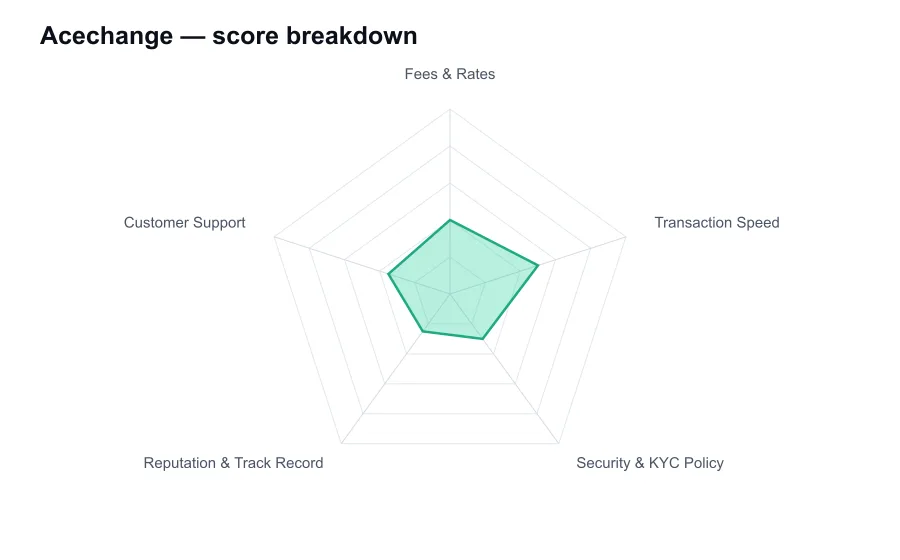
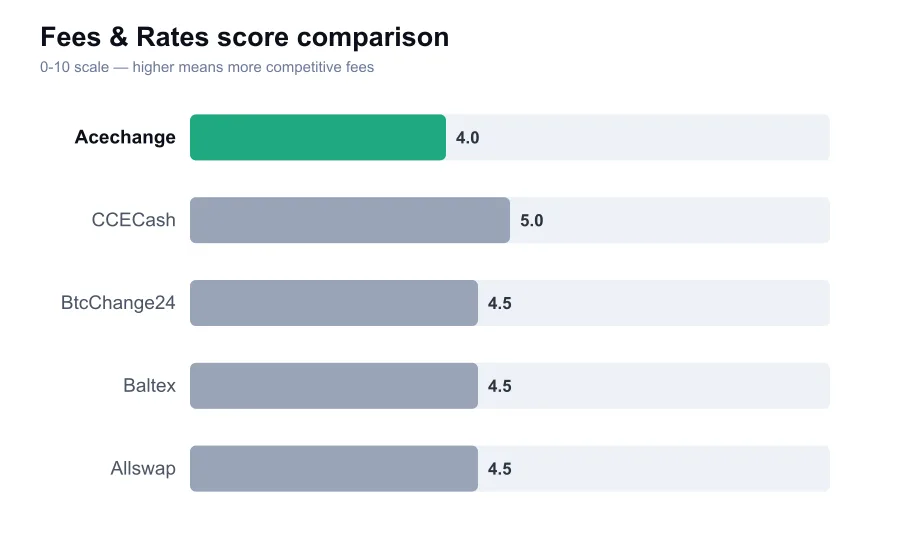
Pricing is difficult to assess with confidence, and that is itself a problem. Instant exchangers rarely charge a single line-item trading commission. Instead, their revenue is commonly embedded in the quoted rate, along with a network fee and, sometimes, a liquidity-provider spread. Acechange does not provide the sort of detailed, durable public fee schedule that lets a customer calculate the margin before starting. If a provider cannot explain how its rate is built, users should assume the quote needs checking against at least two competitors.
That lack of price disclosure makes comparisons essential. Before sending anything, obtain a quote from Acechange and compare the exact received amount against ChangeNOW, FixedFloat where available, SimpleSwap, and a liquid venue such as Kraken or Binance. Do not compare just the headline coin price. Compare the final number of coins delivered after the provider's spread and the blockchain fee. A swap that looks free can still cost several percentage points more than a transparent exchange trade and withdrawal.
Acechange advertises the familiar instant-swap flow, but actual speed depends on factors outside the website's control. Bitcoin deposits may need several confirmations. Ethereum and token transfers can be delayed by congestion or an underpriced transaction. The service then has to route the order through whichever liquidity source it uses. For a normal, well-funded pair, a completed swap may take minutes after confirmation. During volatility, low-liquidity pairs and network congestion can turn that into much longer.
Fixed-rate orders deserve particular caution. A fixed quote can be useful because it tells a buyer what they should receive, but only if the provider explains the time window and the conditions that can void it. If the deposit arrives late, short, on the wrong network, or after the market moves beyond a tolerance threshold, many instant exchangers recalculate. Acechange does not have the level of public documentation and support history that would make me comfortable using a fixed quote for a large transfer.
The service's non-custodial framing should not be confused with a guarantee of safety. You send crypto to an address controlled by the exchange process, then wait for a separate payout. For that period, the provider has control of your funds. There is no account balance in the conventional sense, but there is still counterparty risk. If its liquidity partner fails, a compliance check is triggered, or its support team is unresponsive, the supposedly simple exchange becomes a dispute with limited practical recourse.
Acechange appears to operate without the account-heavy onboarding found at major regulated exchanges, but no-KYC marketing is never an absolute promise. Transaction-monitoring tools can flag a deposit, and the provider may request identity documents or source-of-funds information before releasing a payout. That possibility needs to be clear before a customer sends money, especially because a user who cannot or will not provide documents can face a long delay. The site's public policy material has not earned enough confidence to treat its privacy claims as a dependable guarantee.
Security information is similarly thin. A serious exchange should give customers a clear legal entity, jurisdiction, security model, incident process, contact channels, and candid explanation of how compliance holds are handled. Acechange does not offer the depth of independently verifiable material that established operators provide. There is no strong body of public evidence of reserves, regulated custody arrangements, mature security certifications, or a long-running record of handling incidents openly. That does not prove misconduct, but it materially raises the risk bar.
Reputation is Acechange's weakest area. It has a far smaller independent review trail than established instant exchangers, and it is difficult to separate genuine customer experience from promotional listings and affiliate-driven pages. A thin review record matters more in crypto than it would for a normal online shop. With blockchain transactions, the usual remedy for a poor service experience is limited to support correspondence, because card chargebacks and bank-transfer reversals are not part of the transaction.
I would not send an amount to Acechange that I could not afford to have delayed. Start with the smallest practical test, keep screenshots of the quoted rate, transaction ID, receiving address, and order reference, then wait until the test is fully settled. Do not split a large purchase into multiple simultaneous orders until the first one completes. If the service asks for verification after receiving funds, preserve every message and avoid sending further deposits to solve the problem.
Customer support is another reason to stay conservative. Smaller instant exchangers often offer a web form, email, or chat widget, but availability is not the same as effective support. The important question is whether an agent can identify a transaction, explain a delay, and release or refund funds promptly. Acechange has not built the visible support reputation that lets me give it the benefit of the doubt. A support page is not a substitute for a proven record of resolving exceptions.
There may be a narrow use case here for technically confident users swapping a modest amount between common assets, who have checked the live quote and accept elevated provider risk. Even then, Acechange does not stand out on cost, liquidity, or credibility. A small provider needs to compensate for its limited name recognition with unusually clear fees, public policies, and excellent service. I do not see enough evidence that it does.
My view is blunt. Acechange may complete ordinary small swaps, but it has not supplied the transparency or track record needed to recommend it for meaningful sums. Better-known instant exchangers are not perfect, and regulated exchanges impose more onboarding, but both categories usually provide a clearer basis for trust. Treat Acechange as an unproven option, test carefully if you choose to use it, and keep your primary trading or conversion activity elsewhere.