Bitok777 is a very small and lightly documented crypto exchange name, apparently aimed at users looking for direct conversion rather than a mainstream trading account. It sits at the far end of the trust spectrum from established exchanges. A working quote page and a list of currencies are not enough to establish reliability, particularly where deposits are irreversible and the operator's public accountability is difficult to verify.
The basic attraction of a service like Bitok777 is obvious. It promises a direct path from one asset or payment method to another, often without the friction of a full exchange interface. For someone making a tiny conversion, that can look efficient. The customer does not need to learn order books, establish a trading strategy, or manage a portfolio dashboard. They simply need a destination wallet and funds to send.
That ease creates a dangerous false sense of safety. With an instant or manual exchanger, the user normally transfers funds before receiving the output asset. There is no escrow controlled by the customer, no chargeback for an on-chain payment, and no guarantee that a support request will be resolved quickly. The operator is trusted with the entire transaction during its most vulnerable stage.
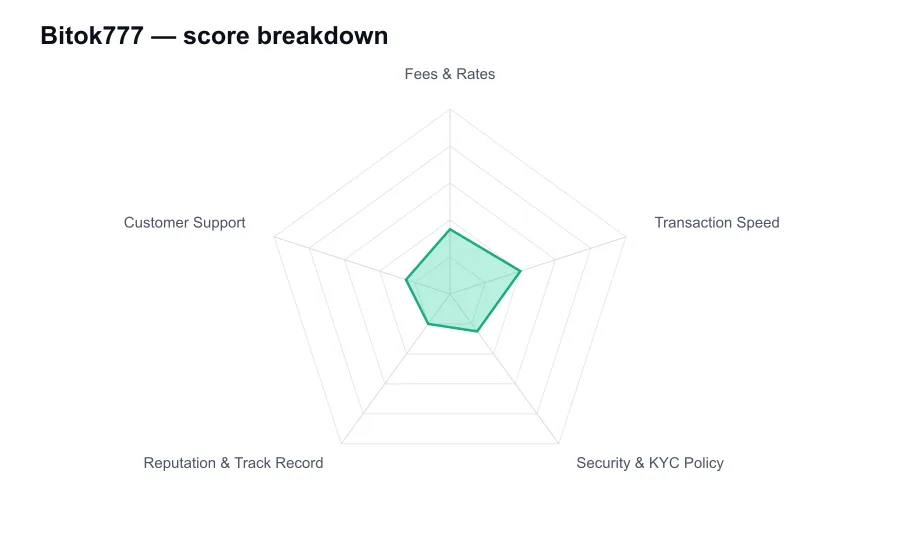
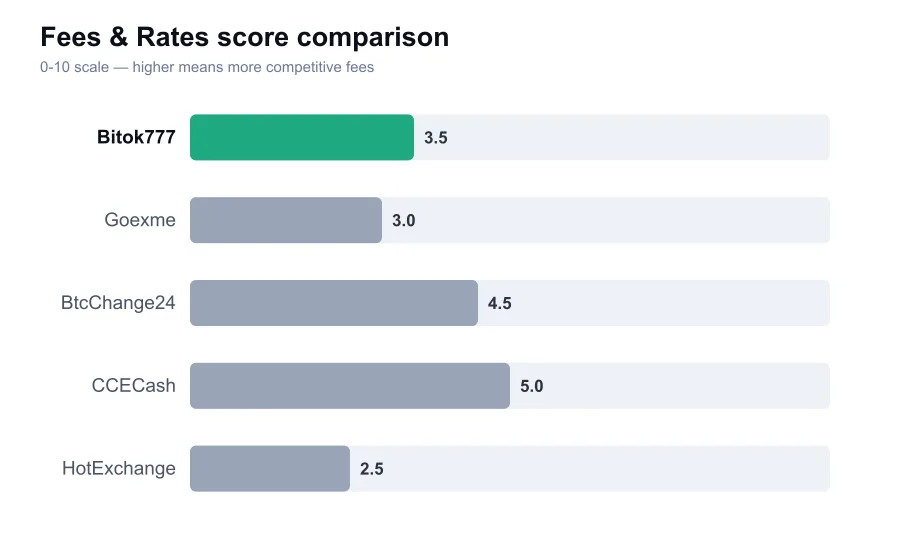
Fees are difficult to evaluate because Bitok777 does not have the kind of transparent, standardized fee schedule expected from a serious exchange. A quote can contain a platform margin, network fee allowance, liquidity-provider cost, and risk premium. Any of those may be legitimate in isolation. The problem is that customers cannot easily separate them or determine whether the final rate is fair.
My advice is not to use Bitok777 unless the final output has been compared carefully with recognized alternatives. Check a liquid exchange's spot price, then compare at least two instant-swap quotes for the same amount and network. If the difference is more than a small convenience premium, walk away. There is no reason to pay a large hidden spread to a provider that has not earned exceptional trust.
Speed claims are also hard to credit without a public operational record. A simple swap may finish after the incoming transaction has enough confirmations. But a transaction can become much slower if the provider needs to source liquidity, its payout wallet is under maintenance, its staff performs a manual review, or the deposit arrives on an unexpected network. The customer needs status visibility during those moments, not a generic promise of fast exchange.
Bitcoin and Ethereum network conditions can complicate expectations further. A low-fee Bitcoin transaction may wait in the mempool. An Ethereum token transfer may become expensive or delayed in congestion. Stablecoins exist on multiple chains, and sending USDT or USDC over the wrong one can turn a simple conversion into a recovery dispute. Bitok777's low public visibility makes it especially unwise to assume it can solve these edge cases.
Security is where I have the least confidence. I could not identify the depth of publicly available information expected from a provider handling customer funds, such as audited controls, identifiable ownership, reserve evidence, insurance terms, detailed security policy, or a meaningful history of disclosed incidents and remediation. Absence of this material does not establish that the service is fraudulent. It does establish that a customer has limited grounds for trust.
KYC can become a problem even for people who choose a small exchanger specifically to avoid account opening. A provider may screen a wallet address or transaction pattern and ask for ID, proof of payment, or source-of-funds information after receiving the deposit. If you are unwilling or unable to provide those documents, do not use a service that can hold funds during review. That is a basic compatibility issue, not a minor inconvenience.
Reputation is exceptionally weak compared with recognizable brands. There is not enough independent public reporting, long-term media coverage, regulatory visibility, or customer-service evidence to build a strong confidence case. In crypto, obscurity is not proof of bad faith, but it removes the useful signals that let users distinguish an honest small operator from an unreliable one. That uncertainty should be reflected in transaction size.
Support deserves a low score for the same reason. A contact channel may exist, but availability is not the same as proven resolution quality. What happens if the output address is technically valid but unsupported? What happens if the customer sends an underpayment, a token on the wrong chain, or a transaction that triggers screening? Strong providers answer those questions in detailed policies. Bitok777 offers too little public basis for confidence.
If you still decide to test it, make the test genuinely small. Use a receiving wallet under your own control, not an exchange deposit address that could reject or miscredit the asset. Send the exact requested amount, including attention to decimals and network. Do not split an order into several deposits unless the provider explicitly permits it. Save the order page and blockchain evidence before the payout is due.
Bitok777 is not a platform I would choose for savings, recurring conversions, or any amount that would be painful to lose or have frozen. Better-known instant exchangers are not risk-free, but they usually provide more visible policies, more user history, and more dependable operational information. A regulated exchange may require more setup, yet that setup buys clearer records and usually better recourse.
My final assessment is severe because the burden of proof sits with the custodian, not with the customer. Bitok777 has not provided enough publicly verifiable substance to justify meaningful trust. It may be capable of processing a small swap, but capability and credibility are different things. Unless it offers an unusually compelling route that you have tested cautiously, choose a provider with a longer and more inspectable record.