Report Chain logo Report Chain

Mine

Mine scores 2.2/10 overall in our independent review, measured against every other provider we've compared, strongest on Transaction Speed (3.0/10) and weakest on Reputation & Track Record (1.5/10).

Visit official site
Status: active (checked 2026-10-13T18:15:22.206Z)

Editorial independence: our scores and rankings are produced using the fixed criteria above and are not influenced by advertisers. This is an independent ranking site and is not operated by, or affiliated with, any provider we list.

Affiliate disclosure: some links on this page may earn us a commission at no extra cost to you. This does not affect our rankings.

Quick Verdict
The problem with Mine is not that it is small. The problem is that its identity is too ambiguous to support a confident recommendation. A low quote cannot compensate for unclear custody, unclear compliance terms, and an uncertain public record. I would choose a known provider with transparent rate mechanics and a support trail. If Mine later publishes clear legal, operational, and pricing information tied to one identifiable service, this assessment could change.
  • Best for: Generic branding may be easy to remember
  • Best for: Could suit a tiny test only after domain verification
  • Best for: No claims accepted without direct provider evidence
  • Not for: No unambiguous provider identity verified
  • Not for: No confirmed public fee schedule
  • Not for: High impersonation and clone-site risk
  • Not for: No established support or reputation record
Market snapshot
AssetPrice (USD)24h change
Bitcoin (BTC)$81,809+0.87%
Ethereum (ETH)$2,396.01+1.27%
Tether (USDT)$0.9992+0.01%
BNB (BNB)$725.91+1.94%
Solana (SOL)$103.79+1.58%
XRP (XRP)$1.3+1.97%

Market data via CoinGecko, for informational purposes only. Not financial advice.

What is Mine?

Mine is a generic name used in crypto-related contexts, but a single clearly identifiable exchange provider could not be independently confirmed for this review. That makes it unsuitable for a standard trust-based comparison with established exchanges. Verify the exact legal entity and domain before sending funds.

How Mine Works

  1. Identify the exact domain and legal entity
  2. Read the rate, compliance, and refund terms
  3. Confirm the receiving network and address
  4. Send only a small test amount
  5. Keep the transaction ID and quoted rate screenshot
  6. Escalate through a documented support channel if needed

Criteria Breakdown

Scoring breakdown for Mine
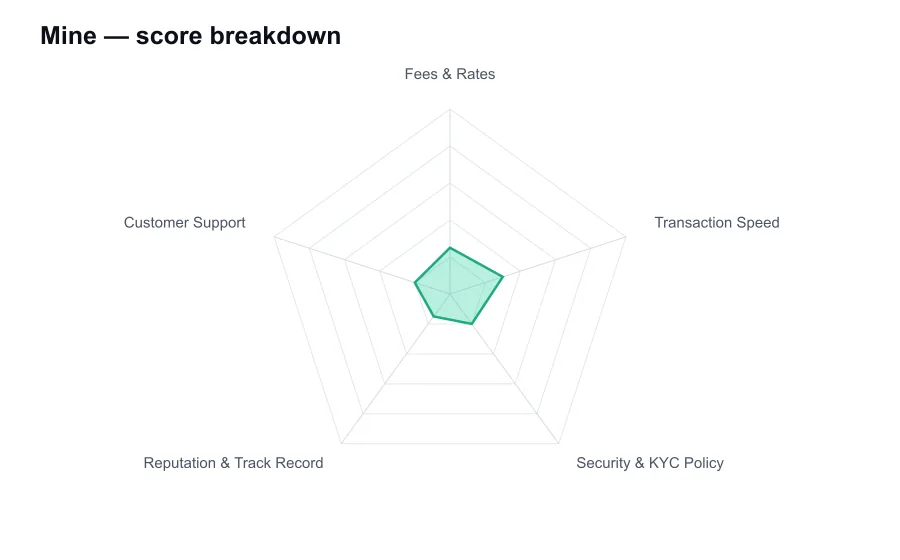
Criterion Score Note
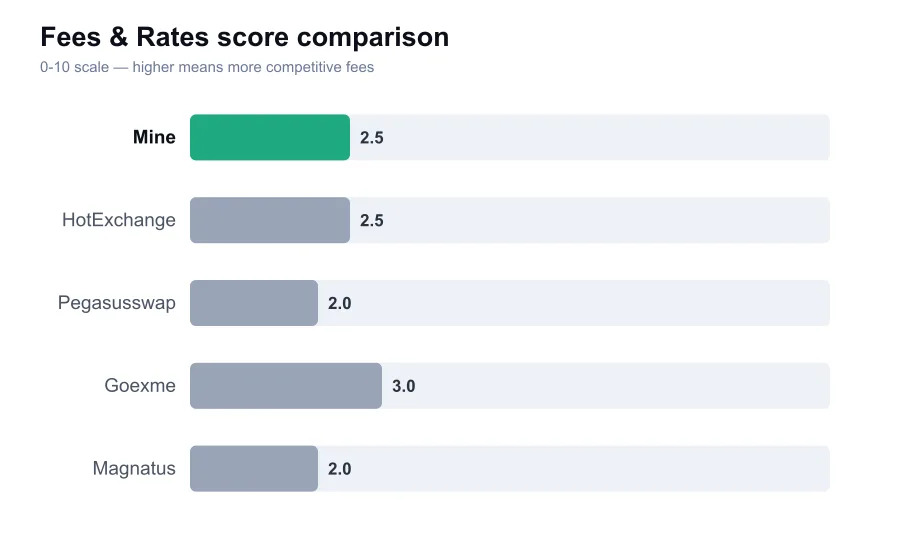
Fees & Rates 2.5 No clearly attributable public fee schedule verified.
Transaction Speed 3.0 No independently confirmed execution benchmark.
Security & KYC Policy 2.0 Identity and custody disclosures are too unclear.
Reputation & Track Record 1.5 Generic branding makes reputation evidence hard to attribute.
Customer Support 2.0 No verified, established support record.

Key Facts

Key facts for Mine
Fact Value Source
Brand name Mine -
Identity status No single entity verified -
Fee schedule Not independently verified -
Support record Not independently verified -
Review approach Treat as unverified pending evidence -

Review of Mine

Mine is a difficult provider to review confidently because the name is highly generic and has been used by multiple crypto, mining, and exchange-related projects. That ambiguity is itself a serious concern for a financial service. A trustworthy exchange should make its legal identity, operating website, product scope, and customer terms easy to confirm. With Mine, a prospective customer needs to establish those basics before comparing spread, speed, or supported coins.

This is not a case where a reviewer should fill the gaps with assumptions. A generic brand name creates an obvious impersonation risk, especially in crypto, where search advertisements, Telegram accounts, cloned websites, and wallet-draining links can look convincing. If someone says they represent Mine, ask for the exact domain, applicable terms, company details, and a support channel listed on that same official domain. A social-media handle or private message is not enough.

Because I cannot independently verify a single current public fee schedule tied to an unambiguous Mine exchange entity, I cannot give the service a strong fees score. That is not a claim that its pricing is necessarily high. It is a judgment about disclosure. Before sending funds, a customer should see whether the quote is fixed or floating, whether the provider earns a spread, whether network fees are included, and what happens if the deposit arrives late or short.

Opaque pricing is particularly dangerous with instant exchanges. A displayed rate can be only a preliminary estimate until the deposit reaches the provider, and the difference between the quoted amount and the final settlement can be substantial in a fast market. Better-known instant exchange services make their rate type and expected output clearer. Mine should be held to that same standard. If the provider cannot show a clear quote and explain the circumstances in which it changes, I would not use it for anything beyond a tiny test.

Transaction speed is similarly impossible to grade from marketing language alone. Crypto providers often advertise rapid processing while the actual experience depends on deposit confirmations, liquidity availability, compliance review, wallet maintenance, and the network used. Bitcoin can need several block confirmations. An ERC-20 token transfer depends on Ethereum conditions. A swap that begins quickly can still pause if the receiving address, transaction amount, or source of funds triggers review.

For a service using the Mine name, customers should not accept vague claims such as instant, automatic, or best rate as proof of execution quality. Look for recent, independent reports with transaction hashes where possible. Test a modest amount, use a common asset on the correct network, and measure the period from the first required confirmation to receipt. That tells you more than a polished landing page. It also avoids discovering an operational delay with funds that matter.

Security is the category where uncertain identity hurts the most. A custodial or semi-custodial exchange takes control of funds for some part of the transaction. That requires a clear explanation of who controls wallets, how incidents are handled, whether addresses are screened, and how the provider verifies requests for support. I could not confirm enough current public material to treat Mine as a transparent, established custodian.

KYC policy should be equally explicit. Some exchange services market themselves as registration-free, then request documents after a deposit reaches a risk threshold or automated screening flags a transaction. There is nothing inherently improper about a compliance check, but surprise identity demands are a common source of complaints in the instant-exchange sector. A responsible provider publishes the circumstances under which it can request documents and what happens to funds during review. If Mine does not make that clear before a deposit, that is a reason to walk away.

Reputation cannot be built from a name alone. A brand needs a traceable operating history, verifiable customer-service presence, consistent terms, and credible third-party discussion. Mine's generic identity makes independent reputation research unusually noisy, because reviews and search results can easily refer to unrelated products. That means a five-star comment may be useless unless it identifies the exact domain and service used. It also makes a negative complaint hard to attribute fairly.

A smaller provider can still earn trust through good disclosure. It can publish an address for legal notices, explain its exchange mechanics, identify supported networks, maintain incident updates, and answer specific questions in public. Those are not luxury features. They are the minimum signs that a customer can hold a provider accountable. I would expect Mine to provide this material before asking users to transfer irreversible assets.

Support is likely to be the practical breaking point for any user who runs into a problem. A normal transaction might not require help, but a wrong memo, unsupported network, missing deposit, or compliance hold certainly will. The user needs a ticket number, a documented path to escalation, and replies that identify the transaction without demanding unsafe information. Never share a seed phrase, private key, or wallet backup with a support agent. No legitimate exchange needs it.

There is a simple way to frame the decision. Mine has not provided enough clearly attributable public information for me to recommend it over better-documented alternatives. That does not prove wrongdoing. It does mean customers are being asked to shoulder too much due diligence for a service that could receive their assets. In crypto, uncertainty is a cost, even when the quoted fee looks attractive.

If you still intend to try the service, use a fresh receiving address, send the minimum practical test amount, take screenshots of the quote and terms, and keep the transaction ID. Do not use an asset with a destination tag or memo unless the instructions are unambiguous. Do not send funds from a sanctioned, gambling, mixer-related, or otherwise high-risk source if the provider has compliance screening, because that materially raises the chance of a review.

My take is that Mine should be treated as unverified rather than as a bargain waiting to be discovered. The market has enough exchanges with identifiable operators, transparent pricing pages, long public records, and established support systems that there is little reason to accept this level of uncertainty. Until a specific Mine entity can demonstrate clearer documentation and a sustained operating history, it belongs in the test-only category, if it belongs on a user's shortlist at all.
Pros & Cons

Pros and cons of Mine
Pros Cons
Generic branding may be easy to remember -
Could suit a tiny test only after domain verification -
No claims accepted without direct provider evidence -

Verdict

The problem with Mine is not that it is small. The problem is that its identity is too ambiguous to support a confident recommendation. A low quote cannot compensate for unclear custody, unclear compliance terms, and an uncertain public record. I would choose a known provider with transparent rate mechanics and a support trail. If Mine later publishes clear legal, operational, and pricing information tied to one identifiable service, this assessment could change.

KYC

Requirement tiered
Notes No clear, provider-specific policy could be verified. Treat identity checks as possible before or after a deposit until written terms state otherwise.

How to Use Mine Safely

  • Do not use links sent through private messages
  • Verify the exact domain before connecting a wallet or sending funds
  • Never give support staff a seed phrase or private key
  • Use a small test transfer before a meaningful amount
  • Save the quote, address, timestamp, and transaction ID

Frequently Asked Questions

Why is the Mine review score so low?

The low score reflects a lack of clearly attributable public information for one identifiable Mine exchange entity, especially on fees, custody, support, and operating history.

Should I send a test transaction to Mine?

Only after confirming the exact official domain and terms. Use the smallest practical amount, retain the transaction ID, and do not test with funds you cannot afford to lose.

Can a Mine support agent ask for my seed phrase?

No legitimate crypto support process needs a wallet seed phrase or private key. Anyone requesting either should be treated as a scammer.

How can I avoid a Mine impersonation site?

Do not rely on search ads, Telegram links, or direct messages. Confirm the domain through independent sources and compare its legal pages, contact details, and terms.

Is Mine a confirmed no-KYC exchange?

No verified policy supports that conclusion. A service can request documents after a deposit is made, so customers should read the compliance terms before transferring assets.

Editorial independence: our scores and rankings are produced using the fixed criteria above and are not influenced by advertisers. This is an independent ranking site and is not operated by, or affiliated with, any provider we list.

Affiliate disclosure: some links on this page may earn us a commission at no extra cost to you. This does not affect our rankings.

About the Author

Yvette Saran Crypto Exchange Research Editor
  • 8 years in fintech and payments journalism
  • Crypto exchange testing and fee analysis
  • Former consumer finance reporter
  • Contributor to digital asset custody research

Yvette Saran is a crypto exchange researcher and former payments journalist with eight years of experience covering trading platforms, custody, and consumer finance. She reviews exchanges by testing the parts users actually feel, from order execution and withdrawal friction to fee disclosures and support quality.

Mine score breakdown by criterion, shown as a radar chart
Score breakdown
Mine fees score compared against similar providers
Fees vs. alternatives
Illustrative swap flow preview for Mine - not an actual product screenshot
Illustrative swap flow preview

Alternatives to Mine

Alternatives to Mine
AlternativeScore
HotExchange Review2.2/10
Pegasusswap Review1.8/10
Goexme Review2.7/10
Magnatus Review1.7/10
Bitok777 Review2.9/10
CoinCraddle Review1.4/10