HotExchange is presented as a crypto exchange service, but it has the same central problem as many low-profile brands in this part of the market: the public evidence needed to assess it is limited. A name, a trading or swap interface and a broad claim of cryptocurrency access are not enough. Before customers send funds to any exchange, they should be able to identify the operator, understand its fee model and find a credible record of handling problems.
That threshold is especially important for a provider called HotExchange because the name is generic and easy to confuse with unrelated websites, promotions or social media accounts. Customers need to confirm the exact domain and legal entity before doing anything. A copied interface, cloned logo or sponsored search result can lead to funds being sent to an entirely different destination, and crypto transactions rarely offer a practical reversal.
I could not establish a strong, independently verifiable operating history for HotExchange comparable to the record available for major centralized exchanges or established instant swap services. That sharply limits the confidence any reviewer can reasonably assign. A provider can be legitimate and still have a small public footprint, but users should not be expected to supply trust where the service has not supplied evidence.
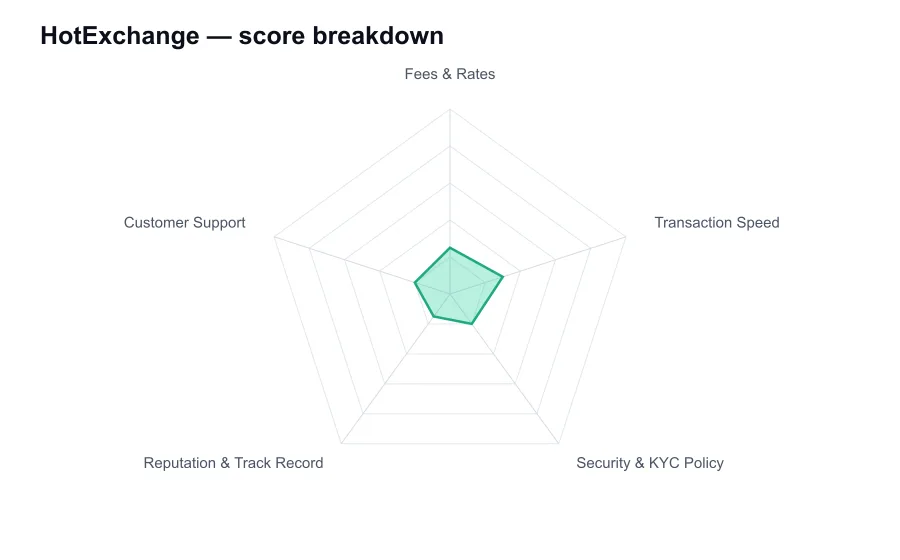
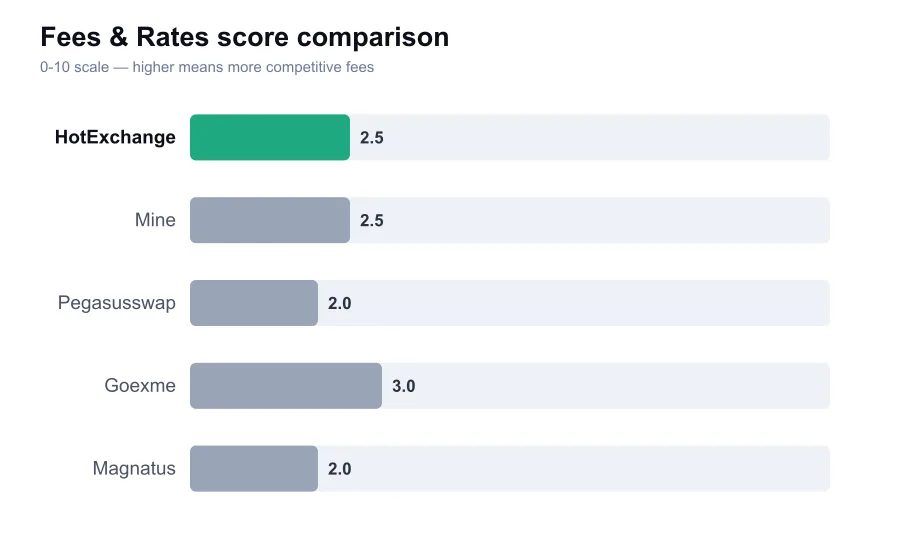
Fees are the first area where clarity is required and where HotExchange does not give prospective users enough dependable information. I could not verify a stable public maker-taker schedule, a fixed instant-swap commission, withdrawal fee table or explanation of how quoted spreads are calculated. That leaves a customer unable to estimate the true cost before funding an account or beginning a transaction.
This is more serious than a minor disclosure gap. Fees on crypto services can be hidden in the spread, raised during withdrawals, or altered by chain conditions. A transparent platform gives customers a documented schedule and shows the received amount before confirmation. Without that baseline, users cannot distinguish a competitive route from one that merely looks convenient. I would not transfer funds simply to discover the actual charge afterwards.
Speed is equally difficult to assess. If HotExchange operates an internal account system, an on-screen balance change may be fast while actual blockchain withdrawal is slower. If it functions as an instant exchanger, deposit confirmations and liquidity routing will govern delivery. Neither scenario can be scored highly without a verifiable operational record, clear status reporting and real customer evidence across normal and congested conditions.
Security should be treated as unproven, not assumed. I could not verify whether HotExchange has meaningful account protections such as two-factor authentication, withdrawal address controls, device alerts, cold-storage practices or a public security program. For a custodial exchange, those details are fundamental. For an instant exchanger, the comparable question is whether its temporary custody and routing controls are sound. In either case, silence is not reassuring.
The same caution applies to KYC. Some low-profile crypto providers advertise easy access without making clear whether identity checks can later be imposed, what documents may be required, or how long a review can take. That can create the worst possible customer experience: an account or transaction is accepted, then restricted once funds are already under the provider's control. HotExchange should publish explicit rules if it expects customers to accept that risk.
Reputation is not just a matter of star ratings. I look for a traceable company identity, longstanding independent discussion, a consistent product history, documented incident response and clear terms. HotExchange does not offer enough easily verified material on those points to justify a strong reputation score. Sparse feedback cuts both ways. It does not prove wrongdoing, but it also gives customers little basis to predict how the company behaves under pressure.
Support is where unknown exchanges often fail their users. A live-chat bubble is not a support system if it does not lead to a human who can explain a hold, trace a deposit or authorize a recovery. I could not verify a mature escalation process, reliable support hours or an established complaint-handling record for HotExchange. That makes it unsuitable for anyone who may need help after the transaction starts.
The practical danger is not limited to outright theft. A small or opaque provider can leave a customer with a stuck withdrawal, an unexplained verification request, a token sent on an unsupported chain, or a quote that changed in a way the user cannot challenge. With a large exchange, these problems are frustrating but there are often formal tickets, public status pages and a visible company to pressure. With HotExchange, the route to resolution is uncertain.
If someone is determined to investigate it, the correct method is a tiny test, not a meaningful deposit. Verify the precise website from multiple trusted references, inspect terms and contact details, compare any quote with known alternatives and send only an amount you would be comfortable losing. Never leave a balance on an unproven service, and do not accept a request to move funds to a new address through unofficial support messages.
HotExchange could improve this assessment by publishing a named operator, a complete fee table, explicit KYC rules, security controls, supported-network documentation and transparent incident procedures. These are not extravagant demands. They are the basic disclosures users should expect before handing crypto to an intermediary. Until that evidence is present and tested over time, skepticism is the only responsible stance.
My recommendation is clear: avoid HotExchange for material funds. There are too many known exchanges and instant swap providers with better-documented policies, more public history and clearer support routes. The limited verifiable information does not justify the added counterparty risk. A bargain price, if one appears, would not compensate for the possibility of being unable to resolve a problem after sending irreversible crypto.