Report Chain logo Report Chain

Trocador

Trocador scores 7.6/10 overall in our independent review, measured against every other provider we've compared, strongest on Security & KYC Policy (8.0/10) and weakest on Customer Support (7.0/10).

Visit official site
Status: active (checked 2026-10-13T18:29:18.403Z)

Editorial independence: our scores and rankings are produced using the fixed criteria above and are not influenced by advertisers. This is an independent ranking site and is not operated by, or affiliated with, any provider we list.

Affiliate disclosure: some links on this page may earn us a commission at no extra cost to you. This does not affect our rankings.

Quick Verdict
Trocador is a serious aggregator, not just another anonymous swap form. Its 0.5 percent charge is defensible because it exposes partner choice and can improve the final payout. The non-custodial design is a real plus, while the dependence on third-party executors remains the unavoidable tradeoff. I would happily use it for well-researched self-custody swaps, but I would never select a route on price alone.
  • Best for: Compares quotes from multiple exchange partners
  • Best for: No standing custodial balance
  • Best for: Fixed-rate and floating-rate route choices
  • Best for: Optional charitable fee donation
  • Best for: Useful support for partner-order issues
  • Not for: Charges a 0.5% platform fee
  • Not for: Partner exchanges can still impose KYC checks
  • Not for: A stalled partner order cannot always be fixed quickly
Market snapshot
AssetPrice (USD)24h change
Bitcoin (BTC)$81,809+0.87%
Ethereum (ETH)$2,396.01+1.27%
Tether (USDT)$0.9992+0.01%
BNB (BNB)$725.91+1.94%
Solana (SOL)$103.79+1.58%
XRP (XRP)$1.3+1.97%

Market data via CoinGecko, for informational purposes only. Not financial advice.

What is Trocador?

Trocador is a crypto swap aggregator that compares offers from third-party instant exchanges. It does not work like a traditional trading platform with an order book and customer balances. You select a route, send funds to the relevant exchange order, and receive the output in your own wallet.

How Trocador Works

  1. Choose the asset you are sending and receiving
  2. Enter an amount and compare partner quotes
  3. Select a fixed-rate or floating-rate route
  4. Enter your receiving wallet address
  5. Send the exact deposit amount to the generated address
  6. Track confirmations and receive the output asset

Criteria Breakdown

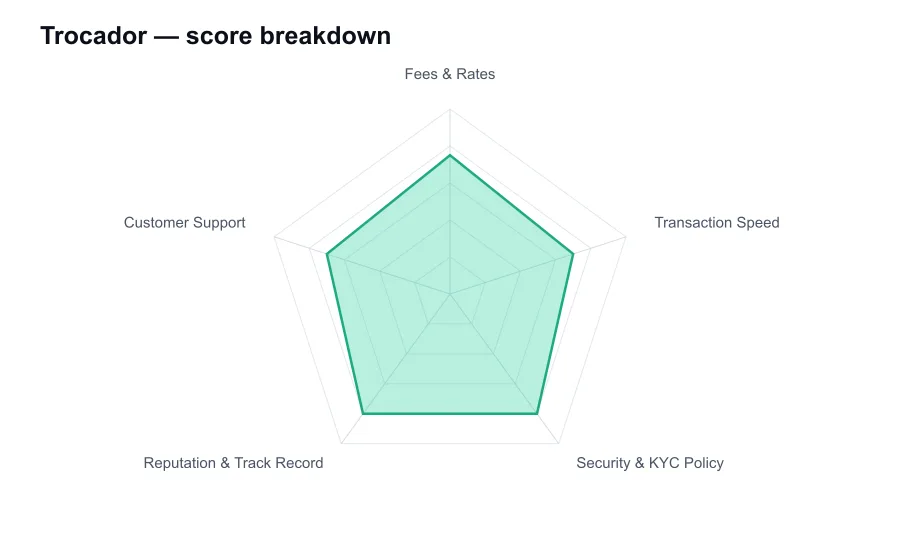
Scoring breakdown for Trocador
Criterion Score Note
Fees & Rates 7.5 0.5% platform fee, with partner spreads still relevant.
Transaction Speed 7.0 Fast routes exist, but partner and chain speed decide.
Security & KYC Policy 8.0 Non-custodial flow, though partner screening can occur.
Reputation & Track Record 8.0 Established since 2019 among swap and privacy users.
Customer Support 7.0 Helpful mediator, but execution remains partner-dependent.

Key Facts

Key facts for Trocador
Fact Value Source
Founded 2019 Source
Platform fee 0.5% Source
Service model Non-custodial swap aggregator Source
Account requirement No standard account required Source
Rate types Fixed and floating Source
Charity option Optional donation from fee Source

Review of Trocador

Trocador is a non-custodial crypto swap aggregator. It does not operate like a conventional centralised exchange with an order book, balances, and a permanent account. Instead, it collects quotes from partner exchange services, lets the customer select a route, and directs the swap through that provider. That puts it closer to a comparison engine with execution plumbing than to Coinbase or Kraken.

That role is valuable. Instant exchangers can quote wildly different payouts for the same pair because their liquidity, inventory, fee structure, and network handling differ. Trocador makes those differences visible in one place. For a user swapping BTC for XMR, ETH for USDT, or one of many less liquid combinations, the ability to compare routes is more useful than a single-provider quote.

The platform's stated service fee is 0.5 percent. That is transparent, but it is not the whole cost of a swap. Each partner's rate includes its own spread and network expenses, while the sending wallet may charge a separate network fee. A 0.5 percent platform charge can still produce a better result than a supposedly free competitor if the underlying quote is stronger. It can also make Trocador uncompetitive on a highly liquid major pair. Look at the received amount.

Trocador's comparison screen is its best feature. It lets customers distinguish fixed-rate routes from floating-rate routes and see who is actually fulfilling the exchange. Fixed-rate options reduce the risk of price movement between deposit and payout, though they may cost more. Floating-rate routes can be cheaper, but a volatile asset or a delayed confirmation can materially change the final amount.

The service also has an option to donate part of its fee to charity. I like that it is presented as an option rather than forced marketing. It should not affect a buyer's basic decision, though. First choose a safe route with an acceptable payout, then decide whether the extra donation suits you.

Speed is mostly determined by the chosen partner and the chains involved. A simple swap involving fast, inexpensive networks can settle in minutes once the incoming transaction confirms. BTC deposits, congested Ethereum transactions, privacy-coin operations, and manual compliance checks can take far longer. Trocador cannot make a partner release funds before that partner receives and processes the deposit.

That is the crucial limitation in its model. If a partner exchange pauses an order, Trocador is a mediator and interface, not the party holding every operational lever. Its support team can help chase a partner and provide order context, but it cannot always resolve a compliance hold instantly. I would select partners with established names and strong visible ratings, even if another route pays a fraction more.

Privacy is one reason people use Trocador. The site itself does not require a standard account for an ordinary swap. Still, no-account use is not an unconditional promise that a partner will never ask for information. Partner services can apply their own AML screening, block sanctioned destinations, or request KYC on an order they flag. This is clearly safer than pretending every route is equally anonymous.

Trocador's security design has a genuine advantage over keeping funds on a centralised exchange. The customer sends funds directly into an individual exchange order and receives the output to a wallet address they control. Trocador is not meant to retain a standing customer balance. The remaining risks are address errors, malicious lookalike sites, a compromised browser, and the reliability of the selected partner.

The company has developed a recognisable reputation among privacy-oriented crypto users since its 2019 launch. Its public position against invasive data collection and its support for Monero-related swap routes have given it a clear identity. That is more substantial than a generic swap widget with no public personality. Still, it is not a regulated custodian and should not be assessed as if it were one.

Support is better described as involved than instant. The team has a reputation for engaging with difficult order cases, especially where a partner needs nudging. That is useful. But an aggregator support channel is inherently one layer removed from the exchange executing the trade. Keep the order ID, deposit transaction hash, chosen provider, and screenshots of the quote from the moment you create the swap.

Trocador is strongest for users who value choice, privacy-conscious design, and direct control of wallet addresses. It is less attractive for people buying crypto with a card, needing a bank-account cash-out, or expecting regulated customer protections. Those users should use a licensed on-ramp or a mainstream exchange in their jurisdiction.

The disciplined way to use it is to start with a small swap, choose the correct network with obsessive care, and decide whether price certainty matters more than a slightly higher advertised payout. Avoid routing a large amount through an unfamiliar partner merely because it occupies the first line of a quote table. Cheap can become expensive very quickly if an order enters a prolonged review.

Trocador is one of the better swap aggregators because it gives the user real agency rather than concealing execution behind a single glossy quote. The 0.5 percent service fee is fair if the comparison saves more than that, and its non-custodial flow is a meaningful security benefit. Its weak spot is structural: partner quality determines much of the actual experience. Choose the route thoughtfully, and Trocador is a strong tool. Treat it as a guarantee of instant anonymous settlement, and you will be disappointed.
Pros & Cons

Pros and cons of Trocador
Pros Cons
Compares quotes from multiple exchange partners -
No standing custodial balance -
Fixed-rate and floating-rate route choices -
Optional charitable fee donation -
Useful support for partner-order issues -

Verdict

Trocador is a serious aggregator, not just another anonymous swap form. Its 0.5 percent charge is defensible because it exposes partner choice and can improve the final payout. The non-custodial design is a real plus, while the dependence on third-party executors remains the unavoidable tradeoff. I would happily use it for well-researched self-custody swaps, but I would never select a route on price alone.

KYC

Requirement tiered
Notes Trocador does not use a standard account flow for swaps, but selected partners may apply their own AML checks or request documents for flagged transactions.

Supported Assets

Notable Coins: Bitcoin, Ethereum, Monero, Tether, Litecoin, Bitcoin Cash

How to Use Trocador Safely

  • Verify you are on trocador.app before creating an order
  • Choose the network that matches your receiving wallet
  • Prefer established partner routes for larger swaps
  • Use a fixed-rate route if price certainty matters
  • Save the order ID and deposit transaction hash
  • Never send more than the exact requested deposit

Frequently Asked Questions

What fee does Trocador charge?

Trocador states a 0.5% service fee. The final swap cost can also include the chosen partner's spread and blockchain network fees.

Does Trocador require KYC?

Trocador does not require a standard account for an ordinary swap, but partner exchanges may request KYC or conduct compliance screening on flagged transactions.

What is the difference between fixed and floating rates?

A fixed-rate route aims to lock the quoted payout within its stated terms. A floating route settles at the market rate after the partner receives the deposit, so the final amount can move.

Who receives my deposit during a swap?

The deposit is sent to the selected exchange partner's order address. Trocador aggregates the route and quote rather than operating a conventional customer balance.

Why can a Trocador swap be delayed?

Delays can come from blockchain confirmations, network congestion, the selected partner's processing queue, or a partner compliance review.

Can I donate through Trocador?

Yes. Trocador offers an optional charity donation connected to its fee model. It is separate from choosing the partner route and payout.

What evidence should I save if an order stalls?

Save the order ID, deposit transaction hash, receiving address, selected provider, and a screenshot of the original quote. Those details let support trace the transaction.

Editorial independence: our scores and rankings are produced using the fixed criteria above and are not influenced by advertisers. This is an independent ranking site and is not operated by, or affiliated with, any provider we list.

Affiliate disclosure: some links on this page may earn us a commission at no extra cost to you. This does not affect our rankings.

About the Author

Yvette Saran Crypto Exchange Research Editor
  • 8 years in fintech and payments journalism
  • Crypto exchange testing and fee analysis
  • Former consumer finance reporter
  • Contributor to digital asset custody research

Yvette Saran is a crypto exchange researcher and former payments journalist with eight years of experience covering trading platforms, custody, and consumer finance. She reviews exchanges by testing the parts users actually feel, from order execution and withdrawal friction to fee disclosures and support quality.

Trocador score breakdown by criterion, shown as a radar chart
Score breakdown
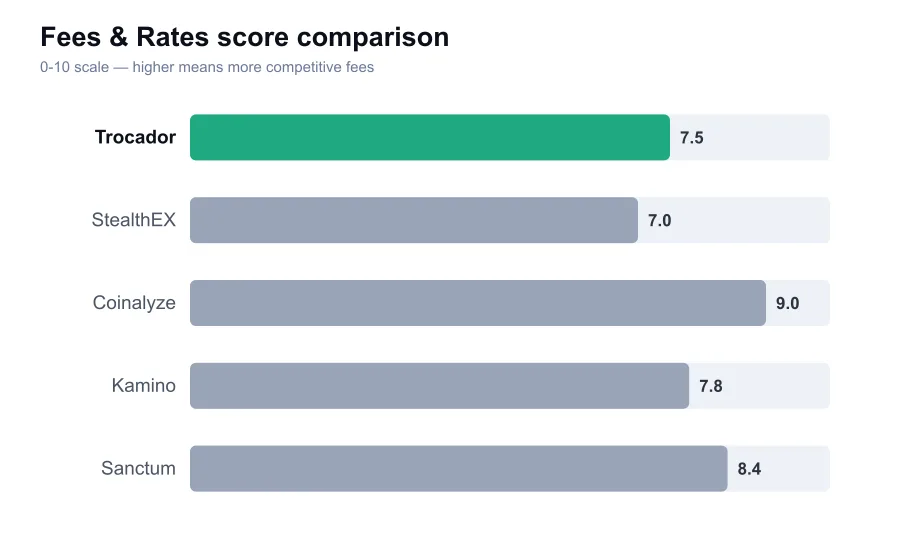
Trocador fees score compared against similar providers
Fees vs. alternatives
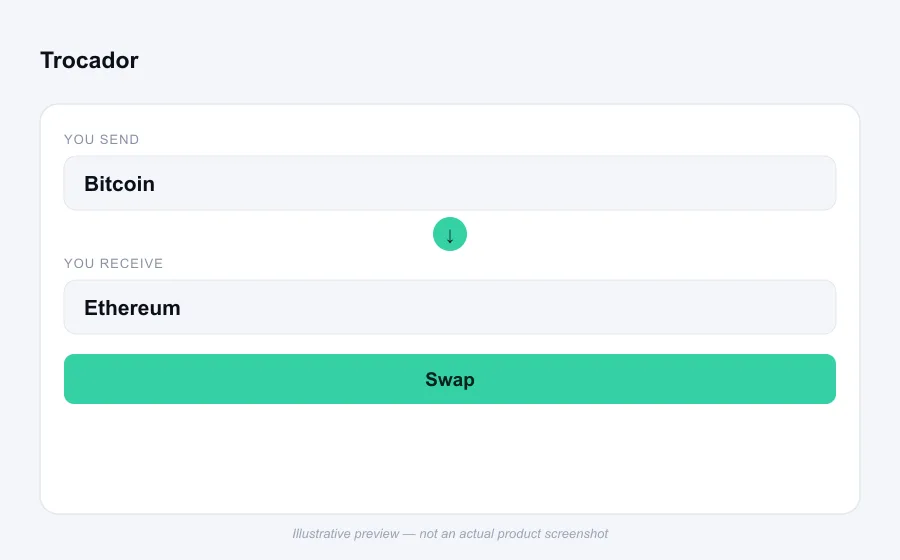
Illustrative swap flow preview for Trocador - not an actual product screenshot
Illustrative swap flow preview

Alternatives to Trocador

Alternatives to Trocador
AlternativeScore
StealthEX Review7.6/10
Coinalyze Review7.5/10
Kamino Review7.7/10
Sanctum Review7.7/10
Spark Review7.7/10
ChangeNOW Review7.4/10