Report Chain logo Report Chain

Sanctum

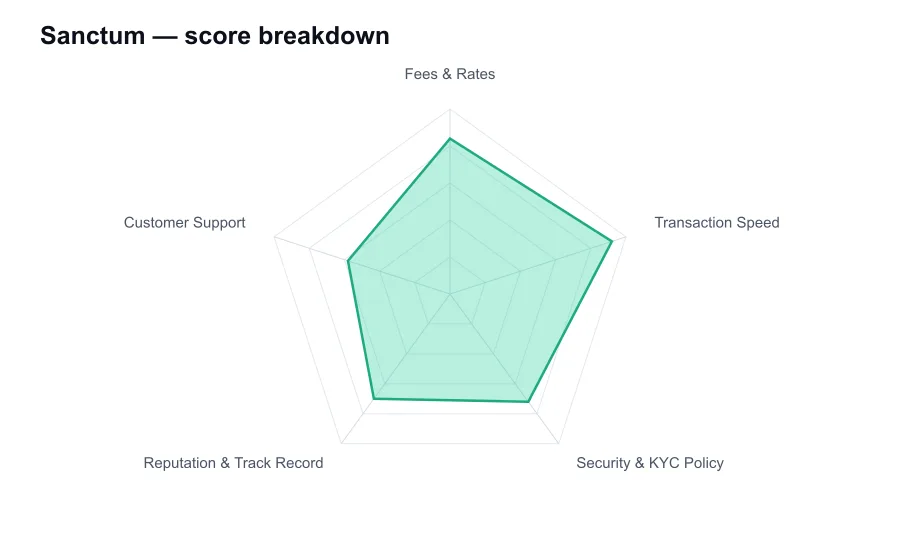
Sanctum scores 7.7/10 overall in our independent review, measured against every other provider we've compared, strongest on Transaction Speed (9.2/10) and weakest on Customer Support (5.8/10).

Visit official site
Status: active (checked 2026-10-13T18:20:32.956Z)

Editorial independence: our scores and rankings are produced using the fixed criteria above and are not influenced by advertisers. This is an independent ranking site and is not operated by, or affiliated with, any provider we list.

Affiliate disclosure: some links on this page may earn us a commission at no extra cost to you. This does not affect our rankings.

Quick Verdict
Sanctum is one of the more purposeful pieces of Solana DeFi infrastructure because it tackles liquidity fragmentation rather than adding another generic swap screen. Its speed and self-custodial design are real strengths. The protocol cannot make LST risk disappear, and it cannot rescue a user from a bad wallet approval or mistaken transaction. Used by someone who understands those boundaries, it is powerful. Used casually, it can be more complicated than the problem it solves.
  • Best for: Fast on-chain LST swaps on Solana
  • Best for: Self-custodial wallet-based use
  • Best for: Can avoid normal stake deactivation waits
  • Best for: Useful liquidity layer for fragmented LST markets
  • Not for: Only relevant to Solana and liquid staking users
  • Not for: Smart-contract and wallet-signing risks remain
  • Not for: No conventional customer service or reversal process
Market snapshot
AssetPrice (USD)24h change
Bitcoin (BTC)$81,809+0.87%
Ethereum (ETH)$2,396.01+1.27%
Tether (USDT)$0.9992+0.01%
BNB (BNB)$725.91+1.94%
Solana (SOL)$103.79+1.58%
XRP (XRP)$1.3+1.97%

Market data via CoinGecko, for informational purposes only. Not financial advice.

What is Sanctum?

Sanctum is a Solana protocol that provides liquidity tools for liquid staking tokens. It lets users interact with SOL and supported LSTs from their own wallets rather than depositing assets into a traditional exchange account. Its main use is improving access to LST swaps and liquidity.

How Sanctum Works

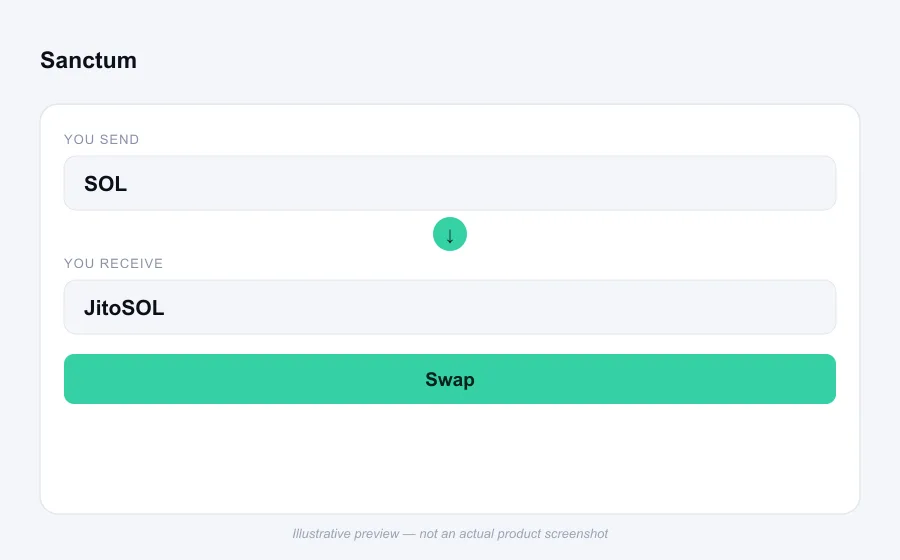
  1. Connect a compatible Solana wallet
  2. Choose SOL or a supported liquid staking token
  3. Review the quoted output and price impact
  4. Approve the transaction in your wallet
  5. Wait for Solana confirmation and verify the received asset

Criteria Breakdown

Scoring breakdown for Sanctum
Criterion Score Note
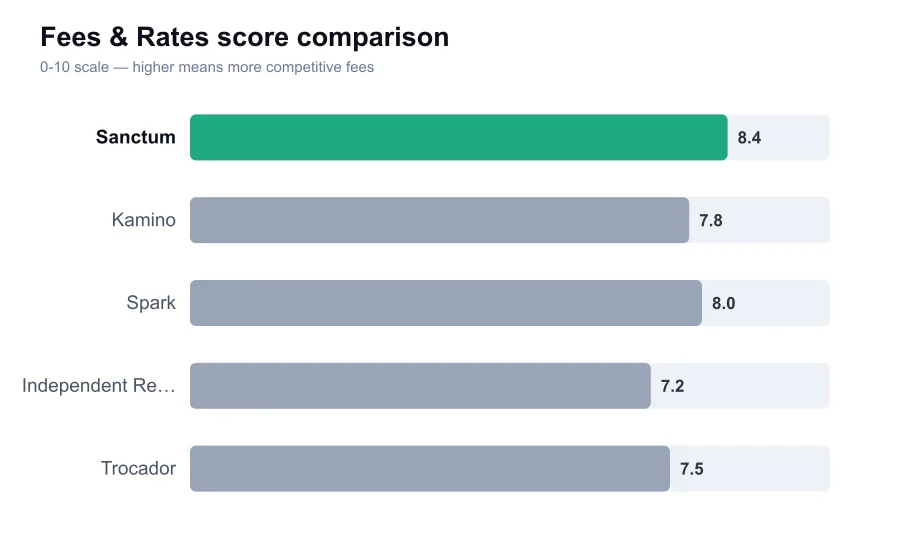
Fees & Rates 8.4 Low Solana costs, but LST pricing still matters.
Transaction Speed 9.2 Solana settlement can take seconds.
Security & KYC Policy 7.2 Self-custody, with material smart-contract risk.
Reputation & Track Record 7.0 Recognized Solana specialist, still relatively young.
Customer Support 5.8 Community-led DeFi support, no transaction reversals.

Key Facts

Key facts for Sanctum
Fact Value Source
Primary network Solana Source
Product category Liquid staking liquidity protocol Source
Access model Connected self-custody wallet Source
Custody Non-custodial Source
Core assets SOL and Solana LSTs Source

Review of Sanctum

Sanctum is not a conventional crypto exchange, and treating it as one leads to bad comparisons. It is a Solana DeFi protocol built around liquid staking tokens, often called LSTs. Its purpose is to make those tokens easier to trade, redeem, and use across Solana without forcing every user through the usual wait and friction of staking and unstaking SOL.

The basic problem Sanctum addresses is real. Solana has many liquid staking tokens, including JitoSOL, mSOL, bSOL, INF, and others. Each represents staked SOL through a different provider or validator approach. Before protocols such as Sanctum, moving between these assets could involve fragmented liquidity pools, variable slippage, or a long unstaking period. Sanctum tries to make that fragmented market feel more connected.

Its central mechanism is an on-chain liquidity system that supports LST swaps and redemptions. Users connect a Solana wallet, select an asset, inspect the expected output, and approve a transaction. There is no email-password account and no company-held customer balance in the conventional sense. The trade happens through smart contracts, so the risks are fundamentally different from sending coins to a centralized exchange.

Fees need a more nuanced reading here than a simple percentage score suggests. Sanctum may facilitate low-cost or no-protocol-fee routes in some parts of its system, but a user still faces Solana network fees, liquidity conditions, price differences between LSTs, and any costs built into a particular staking product. A near-zero transaction fee does not guarantee a near-zero economic cost. The quoted output is the number that matters.

For popular LST routes, Sanctum can be extremely efficient. Solana fees are generally tiny, and the protocol's liquidity design can reduce the slippage users would otherwise face in scattered automated market maker pools. That makes it useful for someone who wants to rotate a liquid stake position or exit an LST without waiting for a standard unstake process. In this narrow job, it can be much better than manually hopping between pools.

The limits appear on less liquid assets. An LST may be technically supported yet trade at a less attractive rate if the relevant reserves are thin or market demand has moved. That is not a hidden flaw, it is the underlying economics of liquidity. Still, users should not see a long list of supported LSTs and assume every route has the same depth as SOL, JitoSOL, or mSOL.

Speed is excellent by the standards of on-chain finance. Solana transactions often confirm in seconds, and Sanctum can turn what might otherwise be a multi-day stake withdrawal into an immediate market-based exit. Immediate does not mean risk-free. The user is exchanging into available liquidity rather than waiting for validator stake to deactivate. If market conditions are stressed, the price of that immediacy may show up in the quote.

Sanctum's security profile has two sides. The good side is that it is self-custodial. A user signs from a wallet such as Phantom or Solflare and retains control of assets except during the approved contract interaction. There is no central login database to compromise and no routine KYC collection. The hard side is that smart-contract risk, interface risk, wallet-drainer risk, and Solana network risk cannot be outsourced to customer support.

Audits and public technical documentation are useful signals, but they are not insurance. DeFi history is full of audited protocols that still encountered failures caused by logic errors, integrations, oracle issues, or economic attacks. Sanctum's design is more specialized than a simple token swap, because it handles a collection of LSTs and liquidity relationships. That complexity is exactly why users should avoid treating it like a savings account.

There is also a conceptual risk around LSTs themselves. Holding an LST means taking exposure to the staking provider, validator arrangements, smart contracts, and the token's market liquidity. Sanctum can improve the route between assets, but it cannot erase the risk embedded in the asset being traded. A user moving from SOL into a lesser-known LST should research that LST independently, not assume Sanctum's interface is an endorsement.

Reputation is promising rather than settled. Sanctum has become a recognizable name in Solana liquid staking and has attracted attention through its Infinity liquidity concept and ecosystem activity. It is still much younger than the major exchanges or the oldest DeFi protocols. Its reputation benefits from a clear product focus, but it has not endured enough full market cycles to deserve the blind confidence some users reserve for battle-tested infrastructure.

Support follows the usual DeFi model of documentation, community channels, and social support rather than a conventional help desk capable of reversing transactions. That can be perfectly adequate for an experienced Solana user who knows how to inspect a signature and troubleshoot a wallet prompt. It is a poor fit for someone who expects a bank-style agent to cancel a mistaken transfer. Once a transaction is signed and confirmed, there is generally no undo button.

Sanctum is particularly attractive to users already active in Solana staking. If you hold LSTs, want to compare their exchange value, or need rapid liquidity without a delayed deactivation process, its tools make sense. If you merely want to buy your first Bitcoin with cash, Sanctum is completely irrelevant. This is infrastructure for an existing on-chain user, not an entry point into crypto.

My verdict is favorable, with a firm warning against casual use. Sanctum solves a specific Solana liquidity problem elegantly and can save users time, slippage, and operational hassle. It also asks users to understand wallet permissions, liquid staking, and smart-contract exposure. For informed SOL stakers, that is a fair trade. For beginners, the fastest route is often still the one they should avoid.
Pros & Cons

Pros and cons of Sanctum
Pros Cons
Fast on-chain LST swaps on Solana -
Self-custodial wallet-based use -
Can avoid normal stake deactivation waits -
Useful liquidity layer for fragmented LST markets -

Verdict

Sanctum is one of the more purposeful pieces of Solana DeFi infrastructure because it tackles liquidity fragmentation rather than adding another generic swap screen. Its speed and self-custodial design are real strengths. The protocol cannot make LST risk disappear, and it cannot rescue a user from a bad wallet approval or mistaken transaction. Used by someone who understands those boundaries, it is powerful. Used casually, it can be more complicated than the problem it solves.

KYC

Requirement none
Notes Sanctum is accessed through a self-custody Solana wallet and does not use a conventional customer onboarding process at the protocol level.

Supported Assets

Notable Coins: SOL, JitoSOL, mSOL, bSOL, INF
Networks: Solana

How to Use Sanctum Safely

  • Use the official Sanctum domain and verify it before connecting
  • Read the full wallet transaction prompt before signing
  • Check the LST mint and token symbol carefully
  • Start with a small swap on an unfamiliar route
  • Keep your wallet recovery phrase offline and private

Frequently Asked Questions

Is Sanctum a centralized crypto exchange?

No. Sanctum is a Solana DeFi protocol for liquid staking token liquidity and related swaps. Users interact through a connected self-custody wallet.

Does Sanctum require KYC?

Sanctum's on-chain protocol does not use a conventional KYC account flow. Your wallet interaction remains subject to the rules of any wallet or fiat provider you use separately.

Why would I use Sanctum instead of waiting to unstake SOL?

A liquid staking token can be exchanged through available liquidity without waiting for validator stake to deactivate. The trade-off is that the market quote may differ from the underlying SOL value.

Can Sanctum reverse a confirmed Solana transaction?

No. Confirmed blockchain transactions are generally irreversible. Check the wallet prompt, token, amount, and destination before signing.

What does an LST represent?

An LST is a token representing a staked SOL position and its rewards under a particular protocol or validator arrangement. It has its own smart-contract and liquidity risks.

Why can two LSTs have different exchange values?

Their value can reflect accrued staking rewards, redemption mechanics, liquidity depth, demand, fees, and market conditions. Do not assume all LSTs trade at identical values.

Editorial independence: our scores and rankings are produced using the fixed criteria above and are not influenced by advertisers. This is an independent ranking site and is not operated by, or affiliated with, any provider we list.

Affiliate disclosure: some links on this page may earn us a commission at no extra cost to you. This does not affect our rankings.

About the Author

Yvette Saran Crypto Exchange Research Editor
  • 8 years in fintech and payments journalism
  • Crypto exchange testing and fee analysis
  • Former consumer finance reporter
  • Contributor to digital asset custody research

Yvette Saran is a crypto exchange researcher and former payments journalist with eight years of experience covering trading platforms, custody, and consumer finance. She reviews exchanges by testing the parts users actually feel, from order execution and withdrawal friction to fee disclosures and support quality.

Sanctum score breakdown by criterion, shown as a radar chart
Score breakdown
Sanctum fees score compared against similar providers
Fees vs. alternatives
Illustrative swap flow preview for Sanctum - not an actual product screenshot
Illustrative swap flow preview

Alternatives to Sanctum

Alternatives to Sanctum
AlternativeScore
Kamino Review7.7/10
Spark Review7.7/10
Independent Reserve Review7.8/10
Trocador Review7.6/10
StealthEX Review7.6/10
Coinalyze Review7.5/10