Coinalyze is not an exchange in the usual sense. It does not take custody of customer coins, convert your euros into Bitcoin, or give you a withdrawal address. It is a derivatives-market analytics service built around futures data, open interest, liquidations, funding rates, long and short ratios, and historical charting. That distinction matters before scoring it beside trading platforms.
Its audience is active traders who already use venues such as Binance, Bybit, OKX, Bitget, and Hyperliquid. Coinalyze tries to put fragmented derivatives information in one place. For somebody tracking whether Bitcoin's price rise is supported by expanding open interest or driven by short liquidations, that can be genuinely useful. For a first-time buyer, it is almost entirely the wrong product.
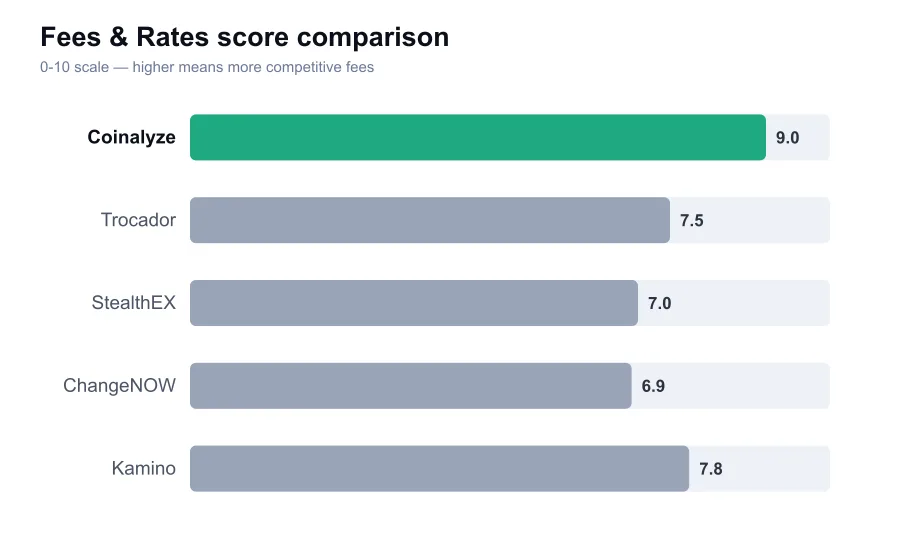
The core site has historically offered a substantial amount of data without a subscription charge. That is a strong point. A trader can inspect perpetual futures markets, funding histories, liquidation maps, and exchange-specific positioning without paying the sort of monthly fee charged by some professional charting and data terminals.
Free access does not mean every use case is free. Coinalyze has offered API access and data plans for users who want systematic access, automated dashboards, or larger request allowances. The practical fee question is less about a visible trading commission and more about whether the free interface is enough for your process. For many discretionary traders, it probably is.
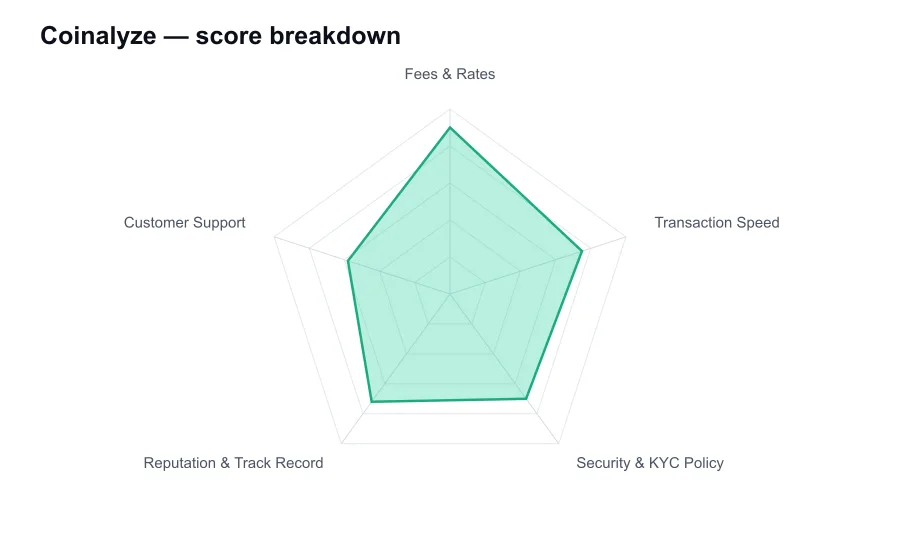
There is no spread markup because Coinalyze does not execute your order. There are no blockchain withdrawal fees, card charges, or conversion costs either. That makes its fee score look excellent at a glance, but readers should not confuse zero trading fees with cheap trading. You will still pay the fees and spreads of the exchange where you place the actual trade.
Speed is also a different question here. Coinalyze's value rests on data freshness rather than settlement speed. The charts and market tables are designed for monitoring live futures conditions, and they are usually responsive enough for research and intraday context. I would not rely on any third-party dashboard as the sole trigger for a fast liquidation trade, though.
Data feeds can lag, symbols can be mapped differently across exchanges, and individual exchanges occasionally report unusual prints or temporarily degraded data. That is normal in aggregated market data, not proof of misconduct. Still, the right habit is to verify an extraordinary funding rate, liquidation burst, or volume spike against the originating exchange before acting on it.
The security story is comparatively simple because Coinalyze is not holding retail balances. You are not asked to deposit coins to use the public charts. That removes the biggest failure mode associated with small crypto exchanges, namely an operator controlling customer custody with unclear reserves and weak operational discipline.
A free Coinalyze account, where one is required for a particular feature, is still an online account. Use a unique password and do not hand an API key with trading or withdrawal permissions to a charting service unless that permission is absolutely necessary. For standard site use, there is no sensible reason to share exchange credentials.
Its reputation is solid within the derivatives-trading niche, although it is not a household consumer brand like Coinbase or Kraken. Traders tend to know it for open-interest charts and liquidation data rather than for editorial research, customer protection, or regulated brokerage services. That is a fair description of its role.
The site is particularly good at helping traders avoid simplistic narratives. A price move with falling open interest can tell a very different story from a move with rapidly rising open interest and overheated positive funding. Coinalyze makes those comparisons easier. It does not make interpretation automatic, and inexperienced users can still read too much into a single metric.
Support is adequate for a data tool, not a major selling point. Documentation and on-site contact routes matter more here than phone support, because the usual problem is a symbol, data feed, chart, or API question rather than an urgent missing withdrawal. Users expecting concierge help should choose a paid institutional data provider instead.
The biggest criticism is that the product can encourage false precision. Liquidation estimates, long-short ratios, and exchange-reported open interest are useful signals, but they are not a complete view of the market. Spot flows, options positioning, OTC activity, and the quality of exchange reporting all remain outside a single dashboard.
My take is positive, with a clear boundary. Coinalyze is a valuable, low-cost research layer for a trader who already understands perpetual futures and keeps assets at a separate exchange or self-custody wallet. It should not be presented as a place to buy crypto, and it should never replace risk controls, exchange-native order data, or independent judgment.