ChangeNOW is a noncustodial instant exchange service that has become one of the more visible alternatives to Changelly. It launched in 2017 and markets a straightforward proposition: no account for a routine crypto swap, a large selection of supported assets, and quotes that can be completed from one wallet to another. It is built for convenience rather than active trading. If you need to move from one coin to another without depositing into a conventional exchange, it is a sensible service to have on your shortlist.
The distinction between an instant exchanger and an exchange matters here. ChangeNOW does not ask a user to manage bids, asks, maker orders, or a permanent custodial balance for its standard flow. Instead, it provides a quote, creates a deposit address, receives the input asset, then sends the output to the wallet address supplied by the customer. That is less intimidating than Coinbase Advanced or Kraken Pro. It is also less transparent, because the user cannot see the full execution path behind the quote.
ChangeNOW has put considerable effort into asset and network coverage. That is one reason it has become popular with people moving stablecoins, ecosystem tokens, and smaller-cap assets that their preferred exchange does not list. Breadth is useful, but I would not confuse an available pair with deep, dependable liquidity. A token can appear in a selector while the actual quote is poor, the minimum is high, or an execution route is temporarily unavailable. Always look at the output amount before treating support as meaningful access.
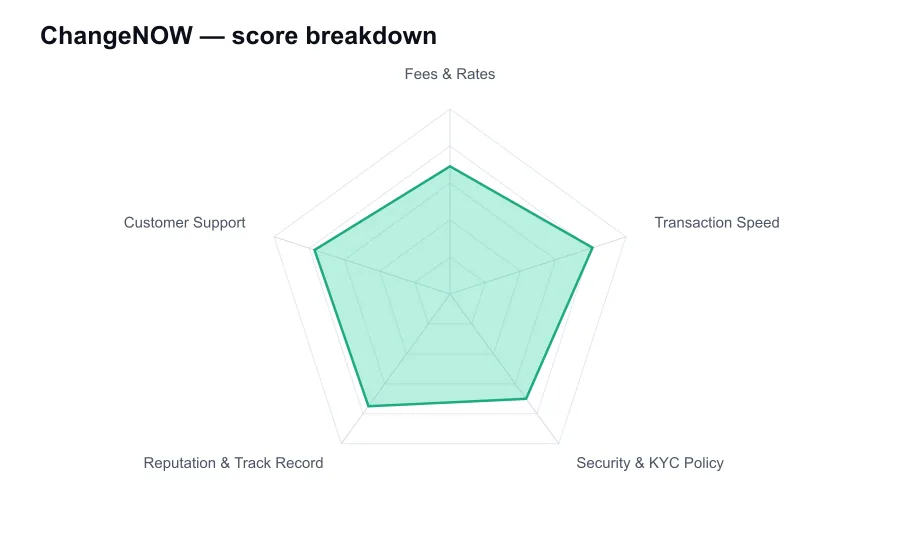
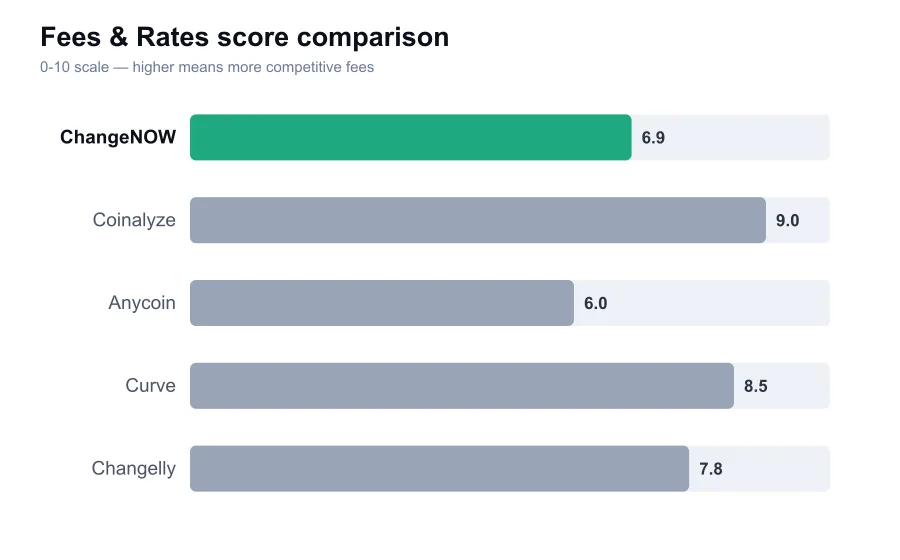
Its fees are integrated into the quoted rate rather than presented as one simple flat percentage across every transaction. ChangeNOW says there are no hidden fees, but that language should be interpreted sensibly. The service must account for liquidity-provider costs, blockchain fees, market risk, and its own margin. A user may not see a separate line item, yet the economic cost is still in the quote. This makes direct comparison essential. I like ChangeNOW's convenience, but I do not like pretending that an all-in quote is the same thing as zero fee.
For common liquid pairs, ChangeNOW can price competitively against other instant exchangers. Its floating-rate option is often attractive when the market is stable and the source chain confirms quickly. Its fixed-rate option is better for users who need a predictable received amount. Compare both modes. Fixed pricing will often deliver fewer coins because the service is absorbing volatility risk, while floating pricing can leave you with a disappointing result if the asset moves sharply during the confirmation window.
Speed is one of ChangeNOW's stronger areas in normal conditions. The service has a polished status page, a transaction tracker, and an interface built around getting a customer from quote to payout with little friction. On fast networks, settlement can feel close to immediate once the deposit is seen. That does not remove blockchain reality. Bitcoin deposits can take time, Ethereum transactions with insufficient gas can wait, and output-side network issues can delay a transfer after the exchange itself has already been completed.
The best use case is a routine conversion where timing is helpful but not mission-critical. I would happily consider ChangeNOW for swapping a modest amount of ETH, USDT, SOL, LTC, or BTC after comparing the quote. I would not use an instant exchanger for a large rebalancing trade during a violent market move. A centralized exchange with deep order books may require more setup, but it gives you execution control. A decentralized exchange may provide on-chain transparency if you understand the smart-contract and slippage risks.
ChangeNOW's security model is noncustodial only in a limited and useful sense. It does not require customers to leave a balance on an exchange account before or after a swap. During conversion, though, customers transfer their input asset to an address used by ChangeNOW or a partner. The service has custody during that process. This reduces account-balance exposure, but it does not eliminate counterparty risk. If a transaction is delayed, the customer is depending on ChangeNOW's systems and support to finish or refund it.
KYC is not a standard upfront step for ordinary swaps. That feature attracts people who do not want to submit documents for every wallet conversion. Yet ChangeNOW operates AML monitoring and can request verification or hold a transaction where risk controls are triggered. This is the same practical compromise found at most serious instant exchangers. It is not accurate to call it guaranteed anonymous exchange. If source-of-funds history, sanctions exposure, or chain analytics present a concern, a no-registration checkout page will not override compliance procedures.
The company has a more developed public presence than many small instant-exchange brands. It runs wallet and business integrations, has built a recognizable identity, and has been operating through several difficult crypto market cycles. That gives it a respectable reputation score in its category. Still, it should not be placed in the same trust bracket as a heavily regulated, publicly scrutinized exchange. Private-company opacity, third-party liquidity dependencies, and complaint-driven uncertainty are structural features of this type of service, not uniquely ChangeNOW problems.
Its public reviews are broadly positive for easy swaps and simple navigation, while negative cases tend to cluster around delayed payouts, price changes on floating transactions, and AML-related holds. That pattern is unsurprising. What matters is not whether complaints exist, because every exchange has them. It is whether ChangeNOW provides transaction records, makes status visible, and responds with specific information rather than vague reassurances. On that test, it performs better than anonymous swap sites, although difficult cases can still take patience.
Support is available 24 hours a day through live chat and email, and the transaction tracker gives users a way to see whether a deposit has arrived, is being exchanged, or has been sent. I consider that a meaningful practical advantage. It lets customers distinguish a slow blockchain from a service issue. The weak point is escalation. A frontline chat team can help with a missing memo, an incorrect amount, or a delayed route, but an AML review or a partner-liquidity issue may sit outside its immediate control.
Before using ChangeNOW, check every address and network twice. This advice sounds basic until somebody sends USDC through the wrong chain or omits a destination tag for an exchange wallet. Use a self-custody destination when possible, preserve the transaction hash, and never send a second payment to "speed up" a swap unless support has given verified instructions through the official site. Also, avoid using an old deposit address from a previous transaction. These services generate instructions for a specific swap, not a reusable personal account.
ChangeNOW is one of the better instant exchangers for users who value coverage, a polished flow, and no routine account setup. Its hidden-in-the-quote pricing model is the main reason I would not call it an automatic default. It can be excellent on one route and merely average on the next. Use it like a smart shopper, not like a bank. For small and medium wallet conversions, it is a capable service. For large amounts, deadline-sensitive payments, and price-critical trades, choose a venue with more visible execution.