Spark is not an instant exchange, even though it is often encountered by people looking for places to move crypto. It is a DeFi lending and savings protocol associated with the Sky ecosystem, formerly MakerDAO. Its core purpose is to let users supply approved collateral, borrow stablecoins and access on-chain savings products. Judging it beside SimpleSwap or StealthEX purely as an exchange would miss the point. Spark is closer to a transparent, smart-contract-based money market.
The protocol's central products include SparkLend, Spark Savings and liquidity facilities connected to USDS, DAI and other Sky ecosystem assets. A user is not sending Bitcoin to a service and receiving Ethereum in return. They are interacting with contracts, supplying collateral such as ETH, borrowing against it, or depositing supported stablecoins into a savings mechanism. The risk profile is therefore fundamentally different.
That difference starts with custody. Spark does not take custody through a customer-service account. Your wallet signs transactions directly with smart contracts. This removes the classic exchange risk of a company freezing a conventional account or losing a hot wallet balance. It replaces it with smart contract risk, oracle risk, governance risk and the possibility of liquidation if collateral falls below required thresholds.
For sophisticated DeFi users, that trade is often attractive. Spark's positions and contract balances are visible on-chain, and protocol parameters can be inspected rather than taken on faith. But transparency is not simplicity. A borrower who does not understand health factors, collateralization ratios and variable interest rates can lose money faster on a lending protocol than they would through a mediocre exchange spread.
SparkLend has concentrated heavily on high-liquidity Ethereum assets, especially ETH and stablecoins such as DAI and USDC. This is a strength, not a weakness. Restricting a money market to a smaller group of deeply liquid collateral types helps risk management. It also means Spark is not a destination for someone hoping to borrow against an obscure altcoin. Aave has a broader multi-chain and multi-asset offering, while Spark is more focused.
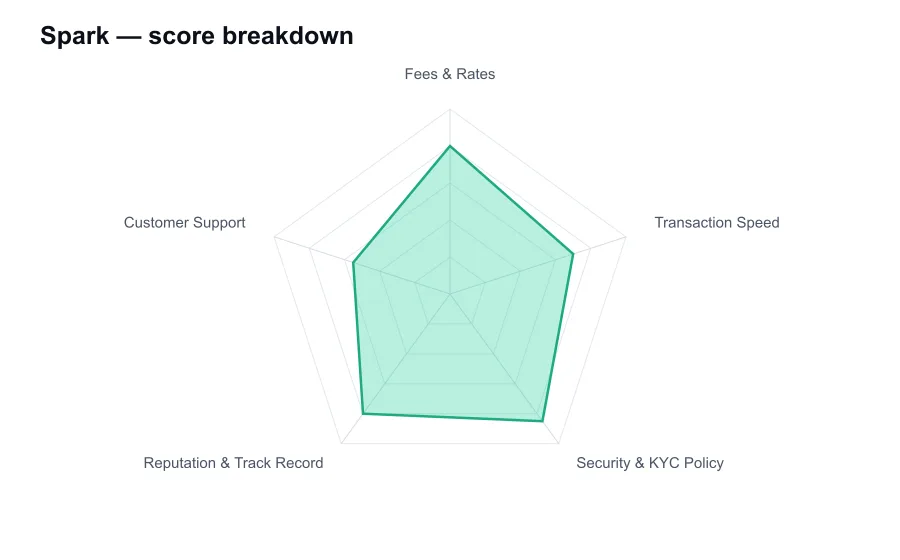
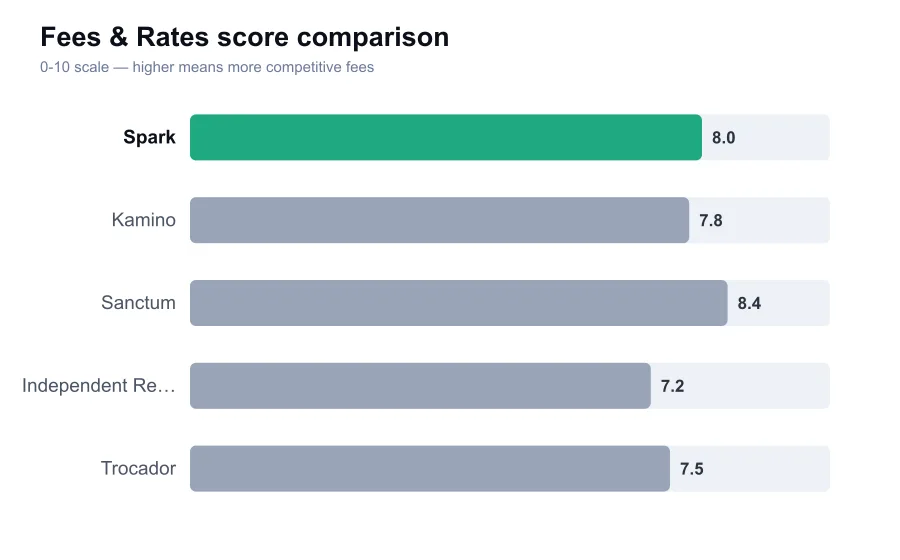
Fees and rates must be discussed differently here. There is no simple exchange commission. Borrowers pay variable interest determined by the reserve and protocol parameters. Depositors earn variable yield after the protocol's reserve factor and market conditions are accounted for. Every action on Ethereum also carries gas. During busy periods, gas can dominate the economics of small deposits, withdrawals and repayments.
Spark Savings has been particularly attractive to users seeking stablecoin yield tied to the Sky Savings Rate framework. Still, the displayed rate is not a permanent contract with the user. Savings rates can change through governance and related protocol mechanisms. A user should read the current rate at the moment of depositing, understand what stablecoin they hold, and avoid treating a percentage paid in a stablecoin as equivalent to an insured bank return.
Borrowing can be efficient, particularly for users who already hold ETH and want stablecoin liquidity without selling. It is also where the greatest danger lies. If ETH drops sharply, the position can approach liquidation. Spark's liquidation rules are not a theoretical footnote. They are an automatic economic mechanism that can sell collateral at a penalty once risk thresholds are breached. Keeping a generous buffer is far more sensible than borrowing to the maximum the interface permits.
Transaction speed is governed by Ethereum. A position update can appear after a block confirmation, but congestion and gas settings determine how quickly it is included. There is no help desk that can reverse a signed approval or rescue a transaction sent with an inadequate fee. For routine lending activity, that is acceptable. For a borrower near liquidation during a volatile market, it can be brutal.
Security is a serious area for Spark, and it compares well with many retail crypto products. The protocol has undergone audits and is built in a lineage connected to MakerDAO's long-running DAI infrastructure. Its contracts and governance processes receive more technical scrutiny than a typical instant exchange site. That does not justify complacency. Smart-contract systems can contain vulnerabilities, governance decisions can alter parameters, and external dependencies such as price oracles can fail under stress.
Spark's reputation benefits from this association with the Sky ecosystem. MakerDAO, now Sky, has operated one of crypto's most consequential decentralized stablecoin systems for years. Spark itself is newer, so it does not have the same independent age as DAI, but it is not an anonymous protocol that appeared without context. The team and governance environment are visible enough for users to investigate, and that matters.
Support is the weak score, although that is normal for DeFi. Spark has documentation, community channels and a user interface, but no traditional support desk can safely take control of your wallet or repair a bad transaction. If you approve a malicious token allowance, deposit into the wrong contract or let a loan reach liquidation, documentation and community replies may be the only assistance available. This is self-directed finance in the literal sense.
The protocol also has a geographic and regulatory dimension. Access to a public smart contract is technically different from being accepted as a customer by a centralized exchange, but front ends can impose terms or restrictions, and users remain responsible for local legal and tax obligations. Do not confuse permissionless contract access with an assurance that every use case is legally uncomplicated.
Spark makes most sense for an ETH or stablecoin holder who already understands DeFi mechanics and wants transparent borrowing or on-chain yield. It is poor fit for a beginner seeking a quick token conversion, a user with small amounts that cannot justify Ethereum gas, or someone who needs phone support before committing funds. The interface may be approachable, but the product is not beginner-safe merely because it looks clean.
My judgment is strongly positive for the right user. Spark is a well-regarded DeFi lending product with serious infrastructure, focused assets and a clearer technical foundation than many yield platforms. Its risks are real and cannot be delegated away. Use it conservatively, understand liquidation before borrowing one dollar, and treat the savings rate as variable compensation for protocol exposure rather than effortless income.