Swapuz is an instant crypto exchange built for quick asset conversions without the account-heavy experience of a centralized exchange. It offers a familiar form: choose the sending coin, choose the receiving coin, enter a wallet address, and fund the generated order. The company competes for the same customer as SimpleSwap, ChangeNOW, Exolix, and dozens of smaller aggregators. Its biggest selling point is convenience. Its biggest problem is that convenience is easy to imitate.
The platform is not a traditional exchange in the Kraken sense. There is no public order book where a trader can see depth, place a maker order, or manage a portfolio. Swapuz acts as the intermediary for a one-off conversion and pays the output to an external address. That design is friendly to self-custody users and frustrating for anyone who wants rich execution data. You receive an estimated or fixed result, rather than a transparent view of the route used to achieve it.
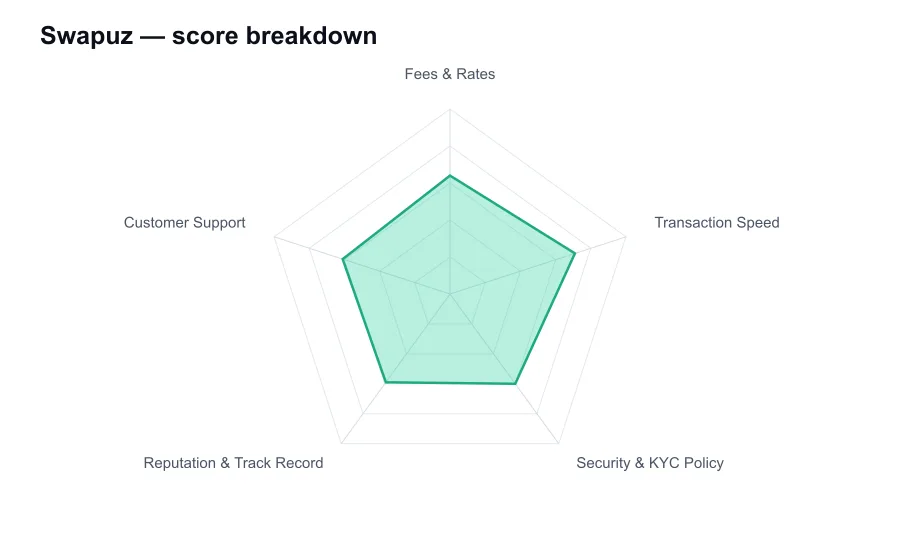
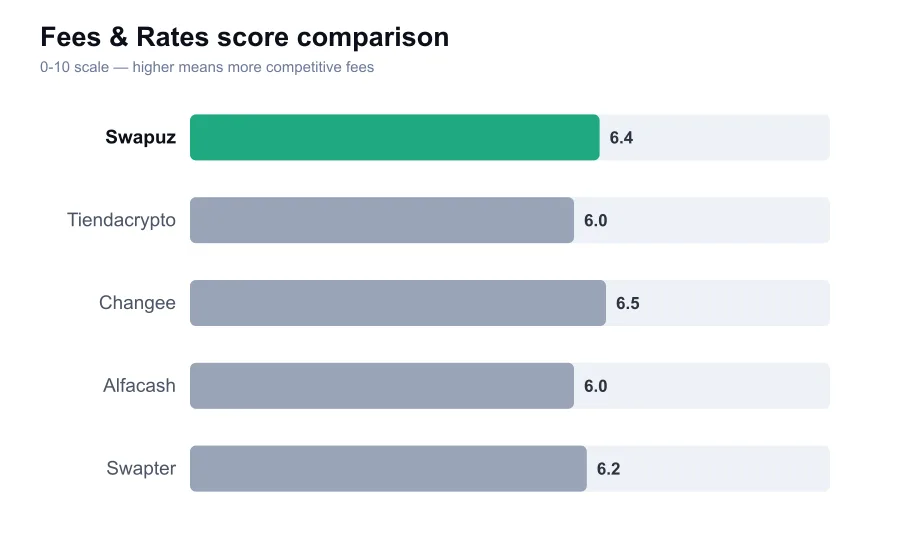
Its fee model needs more scrutiny than its clean interface suggests. Swapuz describes floating and fixed-rate swap choices, but the customer should focus on the final quantity received. The effective cost is generally embedded in the quoted exchange rate, alongside network costs and any liquidity spread. That model is common and not automatically unfair. Still, it makes a claim such as low fees hard to test without opening identical quotes on competing services at the same moment.
Floating exchanges are usually the cheaper-looking option and the less predictable one. Your incoming transaction takes time to confirm, during which the market can move and the eventual payout can change. Fixed rate locks an amount for a stated period if the deposit arrives within the conditions of the order. The price difference is the insurance premium. For volatile assets, that premium is often worthwhile. For a small stablecoin conversion, it may be unnecessary if the source network is moving normally.
Swapuz can make sense for a modest swap where the all-in quote is competitive. It becomes less compelling for frequent trading. A recurring trader will generally get better control, fee clarity, tax records, and liquidity from a well-run spot exchange. Even someone committed to self-custody can use a decentralized exchange on a supported chain when on-chain liquidity is deep enough. Swapuz earns its place by removing steps, not by replacing every type of exchange.
Settlement speed is respectable in the best-case scenario, but instant exchange is an industry label, not a contractual guarantee. A transaction cannot be paid out until the deposit reaches the required confirmation level. Bitcoin and Ethereum congestion can slow that stage. Swaps involving less liquid assets can take longer because the underlying execution is more complicated. If the destination asset is on a different network, additional operational steps may affect the final timeline.
The service's no-registration approach is attractive, particularly to users who don't want another password database or a custody account. But it should never be described as anonymous in an absolute sense. Blockchains are public, and exchange providers routinely apply risk screening to deposits. Swapuz can request verification if its controls identify an order as suspicious or if it must satisfy compliance obligations. That possibility matters most to users who send funds they need urgently.
Non-custodial is another term that needs careful handling. Swapuz does not invite users to deposit funds for long-term storage, and the destination address can be a wallet under the customer's control. Yet the exchanged funds pass through a process managed by the service. If an order fails or is reviewed, the user cannot simply cancel it from an on-chain smart contract. Support and operational procedures then matter a great deal.
I would rate Swapuz's security posture as adequate for a small transactional service, rather than unusually strong. There is no widely established public security program, proof-of-reserves framework, or long institutional history that would justify treating it like a major custodian. The less a company reveals about its internal operations, the more a user should reduce the amount of trust placed in it. That is not cynicism. It is sensible risk sizing for irreversible transfers.
Reputation is the harder category for Swapuz. The brand has visibility through review sites and affiliate listings, but it does not have the deep, independently tested record of older exchange names. Online ratings can help spot recurring problems, especially complaints about KYC holds or delayed refunds, but they are not proof that an operation will perform well in the next market spike. The useful question is whether the company explains exceptions and resolves them, not whether its homepage contains praise.
Support is central to this type of service because there is no account dashboard with full trading controls. Swapuz provides support channels through its website, and users should approach an issue with the order number, deposit hash, asset, network, and destination address prepared. The quality of the answer matters more than a marketing promise of availability. An agent who can identify a missing tag, confirmation delay, or failed payout route is valuable. A generic reply asking a user to wait is not.
The most likely user error is not a mysterious hack. It is selecting the wrong chain. USDT, USDC, ETH-wrapped assets, and network-specific versions of popular tokens create plenty of opportunities to send a valid transaction to an incompatible address. Another problem is sending a deposit after a fixed quote has expired. Before sending, read the order screen, confirm the minimum amount, and ensure the receiving wallet can accept the exact asset.
Compared with ChangeNOW, Swapuz has less established name recognition. Compared with a decentralized exchange, it offers a simpler cross-asset user experience but less on-chain transparency. Compared with Coinbase or Kraken, it has fewer identity hurdles for an ordinary swap but far fewer safeguards and features. Those distinctions matter. Calling every platform an exchange hides real differences in counterparty risk, support quality, and control.
My opinion is that Swapuz is a practical backup option, not a service I would make the center of my crypto activity. It can do the job cleanly for a small, carefully checked conversion, especially where the quote is strong. I would not use it blindly for a large transfer, a complex token route, or money that cannot tolerate a compliance delay. The sensible customer tests the rate, starts small, and expects the service to prove itself transaction by transaction.