Alfacash is one of the older names in the instant-exchange category. It has operated since 2013 and offers crypto-to-crypto conversions, alongside payment methods and cash-out options that have varied by region and time. The company is not trying to be a full trading venue like Coinbase or Kraken. Its product is a conversion desk: pick what you have, pick what you want, accept a quote, and settle to an external wallet. That focus makes the service easy to understand, even if it comes with the usual instant-exchange compromises.
Longevity is Alfacash's strongest card. In an industry filled with short-lived swap sites, more than a decade of operation is meaningful. It does not erase the need to check a live rate or read the terms, but it gives the firm a deeper operating record than many anonymous competitors. The service has also had time to develop a recognizable identity among users who prefer wallet-to-wallet exchanges over keeping funds on a centralized platform.
The site is designed for conversions rather than speculative trading. You will not find deep charting tools, limit-order strategy, derivatives, margin, or the kind of market data a frequent trader expects. That is fine for its intended customer. Someone who has Litecoin and wants Bitcoin, or who needs to swap a token into a more practical asset for withdrawal, may prefer a single quote over moving funds onto an exchange, placing trades, and withdrawing again.
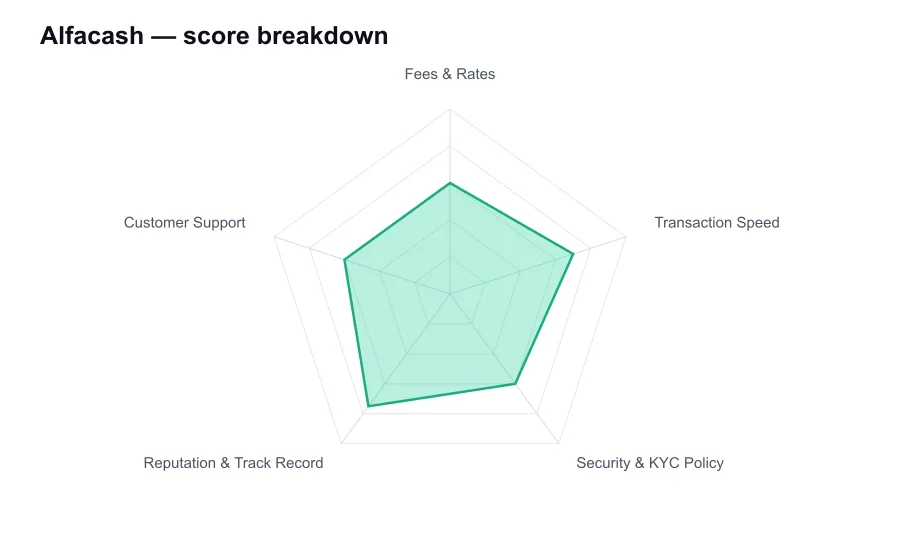
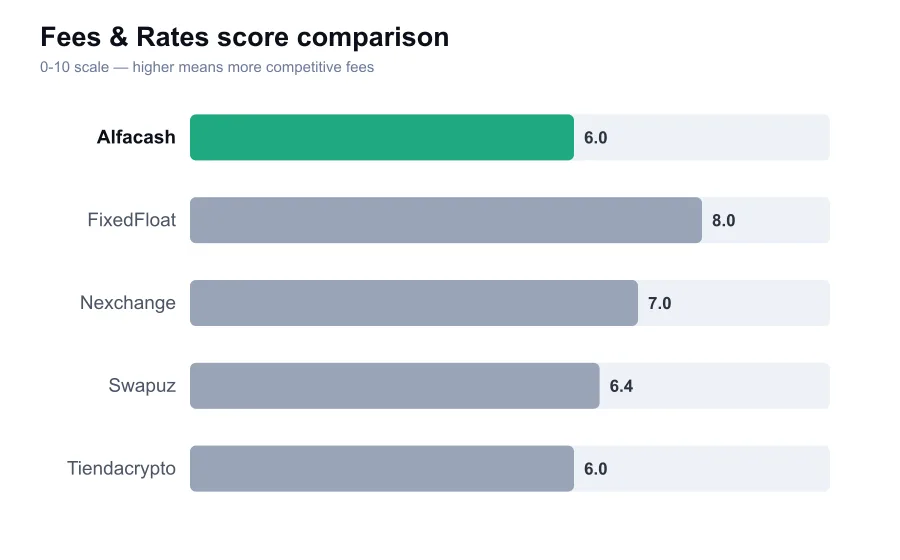
Alfacash's pricing is quote-based. The amount shown to the customer reflects the market rate available to Alfacash, its own margin, and relevant network costs. This is normal in the instant-exchange business, but it means users should resist the temptation to call it cheap or expensive based on a headline price. The real comparison is the final output. On liquid pairs, its quote can be acceptable for convenience. On smaller assets, or during a sharp move, the spread can be noticeably less attractive than a trade on a major exchange.
There is a practical fee advantage in knowing the full receive amount before sending, especially for a fixed-rate order. The catch is that a fixed price is only useful if a customer meets the payment instructions precisely and sends during the stated validity window. Sending too little, using an unsupported network, or allowing the quote to expire can result in a recalculation. Read the order screen carefully. Crypto conversion is unforgiving of casual errors, and a support ticket is a poor way to learn which chain a token was sent on.
Speed is generally good on common assets, but users should understand where the waiting happens. Alfacash cannot release a crypto payout until the deposit reaches the required confirmation threshold. Bitcoin can take from minutes to much longer depending on block conditions and the sending fee. Ethereum transfers can confirm rapidly, but token swaps may be delayed by congestion. Once the deposit is credited and liquidity is available, a standard conversion should normally complete without the multi-day settlement associated with bank transfers.
The service's cash and card options are more complicated than its crypto swaps. Their availability changes according to country, payment partner, currency, and compliance requirements. A user should not assume a payment method advertised generally is available in their jurisdiction at a given moment. Card transactions can involve extra fees, third-party verification, and chargeback-risk controls. For that reason, Alfacash makes more sense as a crypto conversion tool than as a universal fiat gateway.
Alfacash has historically promoted privacy-friendly exchanges, but its terms make clear that compliance checks can apply. This is the sensible way to read any no-account or light-registration service in 2026. An ordinary crypto swap may proceed without a full customer profile, while an unusual transaction, a sanctioned-address alert, a payment-provider request, or suspected fraud can trigger KYC. If you need certainty about verification before committing funds, ask support first and use a regulated exchange with published account tiers.
From a custody perspective, Alfacash has a benefit and a limitation. You do not need to leave a long-term balance on the platform, which reduces exposure to the classic centralized-exchange failure where a customer keeps assets in a hosted account for years. But each order is still a temporary handover of funds. The provider receives your deposit and must send the output. Its age makes that counterparty risk easier to accept than it is with an unknown swap site, though it never disappears.
The firm's reputation is solid for its niche, but it is not pristine or universally loved. Long-running conversion services inevitably attract complaints involving delayed orders, failed payment methods, rate changes, and verification requests. The useful distinction is between a routine delay with a visible transaction trail and a provider that simply vanishes. Alfacash has survived long enough to be considered an established operator, yet it lacks the public regulatory profile and broad institutional trust of a major licensed exchange.
Support is reasonably important here because unusual orders are where instant exchangers are judged. Alfacash provides support channels and an order-based process, but customers should set expectations realistically. A basic crypto swap can be automated. A mismatched payment, compliance review, wrong memo, or network error cannot. In those cases, resolution depends on an agent understanding the transaction and communicating clearly. Keep your order number, sending transaction hash, and wallet details ready before contacting them.
The service is best used with assets and networks you already understand. Double-check whether a coin requires a destination tag, memo, payment ID, or a specific token standard. A missing XRP tag or an unsupported token network can turn a ten-minute task into a recovery request. The same caution applies to stablecoins. USDT and USDC exist on multiple chains, and the asset ticker alone tells you very little about whether an address is compatible.
Compared with ChangeNOW and SimpleSwap, Alfacash gains points for age and a more established identity. Compared with Kraken or Bitstamp, it loses on fee visibility, market depth, and formal exchange infrastructure. Compared with a decentralized exchange, it can be much easier for a beginner but introduces a centralized conversion counterparty. There is no single winner for every use. The right choice depends on whether you value convenience, custody control, price precision, or regulated access.
I regard Alfacash as a credible specialist rather than a first-choice platform for every crypto need. It can be a practical route for a moderate crypto-to-crypto conversion, particularly when its live quote is competitive and the user is sending from self-custody. It is not where I would park funds, make frequent trades, or send a large amount without a test. Its long record earns respect, but the quote-based model and potential compliance friction demand care.
My final take is positive but qualified. Alfacash has lasted because it solves a real problem simply, and that history matters. Still, it asks customers to accept the standard instant-exchange trade: less setup and fewer trading tools in return for embedded pricing and temporary counterparty risk. Check the received amount, follow the network instructions exactly, and keep large activity on platforms with stronger transparency and regulatory safeguards.