Kingex is a crypto exchange service built around quick conversions rather than a deep trading terminal. It presents itself as a straightforward way to swap cryptocurrencies and, in some cases, buy digital assets using bank cards. That puts it in the same broad category as instant exchange services such as ChangeNOW, SimpleSwap, and LetsExchange, not in the same category as Kraken or Coinbase.
The attraction is obvious. You choose a pair, enter a receiving address, send coins to a generated deposit address, and wait for the swap to complete. There is usually no need to create a trading account or learn order-book mechanics. For a small, one-off conversion, that is simpler than opening an account at a centralised exchange, waiting through verification, and placing multiple trades.
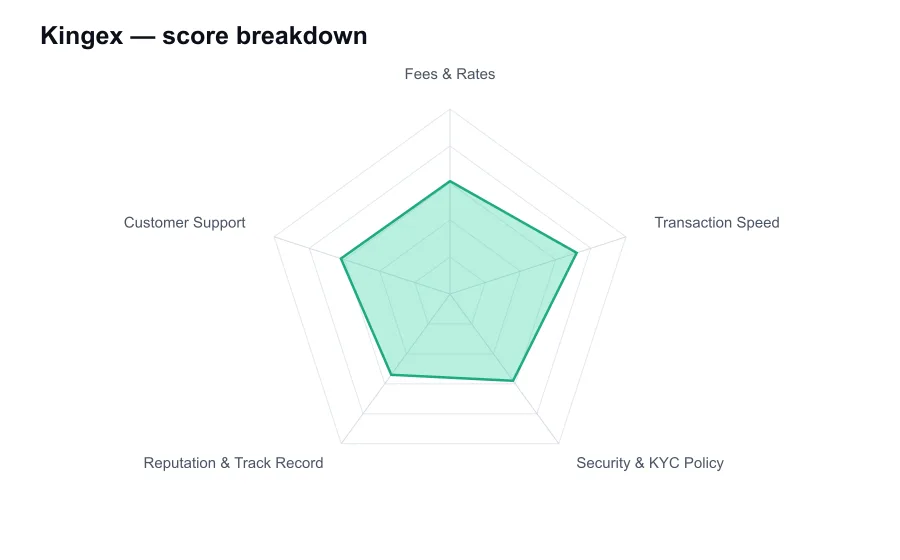
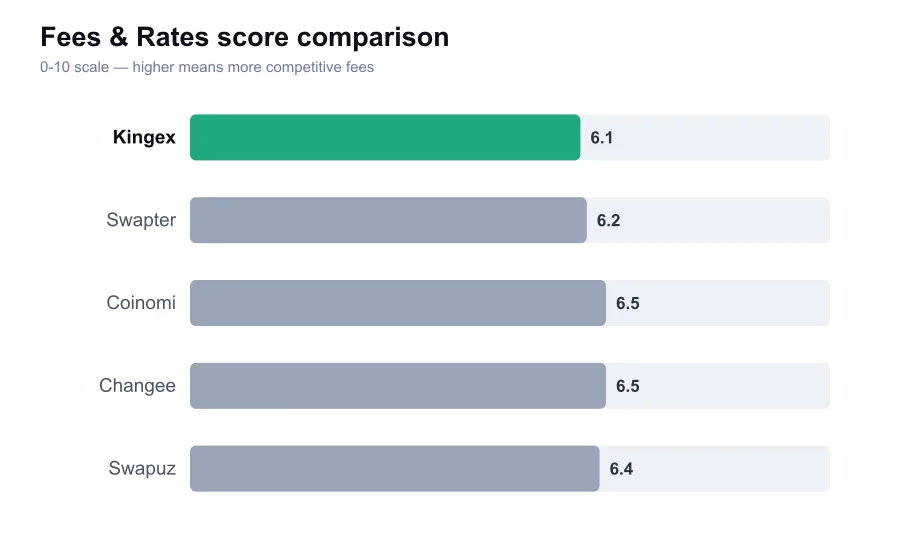
The trade-off is price discovery. Kingex does not operate like a transparent public order book where you can see the maker fee, taker fee, depth, and exact route. Its rate includes provider liquidity, network costs, and service margin. A user can compare the final quoted amount against competitors, but the underlying fee is not as cleanly disclosed as a fixed 0.10 percent spot trading fee.
That does not automatically make Kingex expensive. Instant exchangers often source liquidity from several venues, and the result can be competitive for popular pairs during calm markets. But it means you should never judge the service from a marketing claim alone. Run the same BTC to ETH or USDT to SOL quote through two or three providers immediately before sending funds. The amount you receive is the only fee figure that really counts.
Its speed depends on two separate systems. First, Kingex or its liquidity partner must receive enough blockchain confirmations to credit the deposit. Then the outbound asset must be exchanged and sent on its own network. For fast chains this can be relatively quick. Bitcoin deposits, congested Ethereum transactions, manual checks, and low fee settings can turn a supposedly quick swap into a long wait.
This service is non-custodial in the limited instant-exchange sense: it does not require you to leave an ongoing balance in a user account. That is better than holding money indefinitely on a small exchange. It does not mean the swap is trustless. During the transaction, funds pass through addresses controlled by the service or its partners, and you rely on it to send the promised output after it receives your deposit.
Kingex markets a relatively light onboarding process, and many swaps can be started without routine account registration. Users should not mistake that for an absolute promise of anonymity. Like other instant exchangers, it may apply anti-money-laundering checks and request identification where a transaction triggers internal risk controls. If that happens after funds have been sent, the experience can be unpleasant, especially for someone who expected a fully frictionless swap.
The security question is therefore less about account hacking and more about operational trust. You should use the correct official domain, inspect the deposit address, confirm the chosen network, and avoid sending from an address that might raise compliance flags if you cannot document the source of funds. A wrong network selection can be unrecoverable. Support may try to help, but no instant exchanger can reliably repair a transaction sent to an incompatible chain.
Kingex does not have the public institutional footprint of a large regulated exchange. That is the biggest reason I would keep transaction sizes modest. A smaller service can work perfectly well for routine conversions, but it has less visible regulatory disclosure, less independently verifiable liquidity information, and less resilience if a partner experiences disruption. Trust should be earned with repeated small transactions, not granted on the basis of a polished homepage.
Its asset list is broad enough for common conversions, including major coins and stablecoins. The practical limitation is network support. A token ticker may exist on several networks, and selecting USDT on Ethereum instead of USDT on Tron or BNB Smart Chain has serious cost and delivery consequences. The cheapest route is not always the right route if the receiving wallet or exchange only supports another network.
Customer support is usually available through site chat or ticket channels. That is useful for a missing transaction identifier, an uncredited deposit, or clarification about a swap status. It is not equivalent to dedicated account management. Responses can depend on the partner handling the trade, and support cannot speed up a blockchain that has not confirmed your payment. Keep the transaction hash and order ID before opening a ticket.
I would not use Kingex for active trading, high-value treasury transfers, or anything with a hard settlement deadline. The lack of a deep public reputation and fully transparent all-in pricing puts it behind established exchanges for those jobs. It is more defensible as a convenience tool for converting a modest amount of one established asset into another without opening a full exchange account.
There is a further practical issue with card purchases. Card issuers can decline crypto transactions, charge cash-advance style fees, or trigger fraud controls even if Kingex processes the request correctly. Bank cards are rarely the cheapest way to buy crypto. A bank-funded regulated exchange usually provides better pricing and a clearer record, while Kingex works better for someone who already holds crypto and needs a quick conversion.
Kingex has a place, but it is a narrow one. Use it after comparing the final destination amount with alternatives, double-check the network, and start with a test transaction. Its no-account convenience is real, as is the risk of relying on a smaller counterparty during the middle of a transaction. I would choose a large regulated exchange for large orders and use Kingex only where speed and simplicity genuinely justify the reduced transparency.