Swapter is a non-custodial instant exchange service aimed at people who want to convert one cryptoasset into another without opening an account on a conventional exchange. It sits in the same broad category as ChangeNOW, SimpleSwap, StealthEX, and LetsExchange. The appeal is obvious: pick a pair, enter a receiving address, send the coins, and wait for settlement. That simplicity is real, though it shouldn't be confused with the transparency or consumer protections of a large regulated exchange.
The service's core product is a routing layer. Swapter quotes a swap, provides a deposit address, then sources liquidity through its own counterparties or partner venues. Users do not trade against an order book and they do not keep a balance in a Swapter account. For smaller, routine conversions this is a useful model. It removes registration friction and lets a user keep control of their destination wallet. The tradeoff is that the execution path is less visible than it would be on Binance, Kraken, or Coinbase.
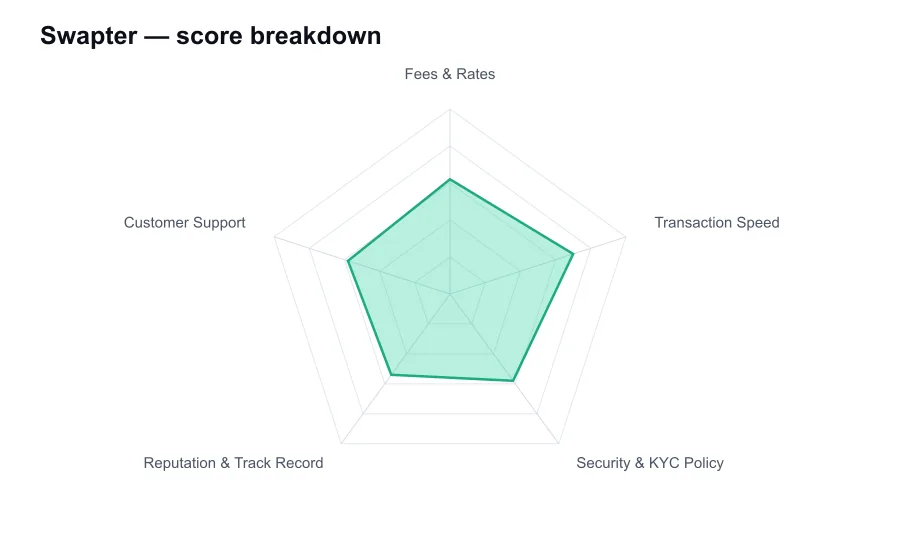
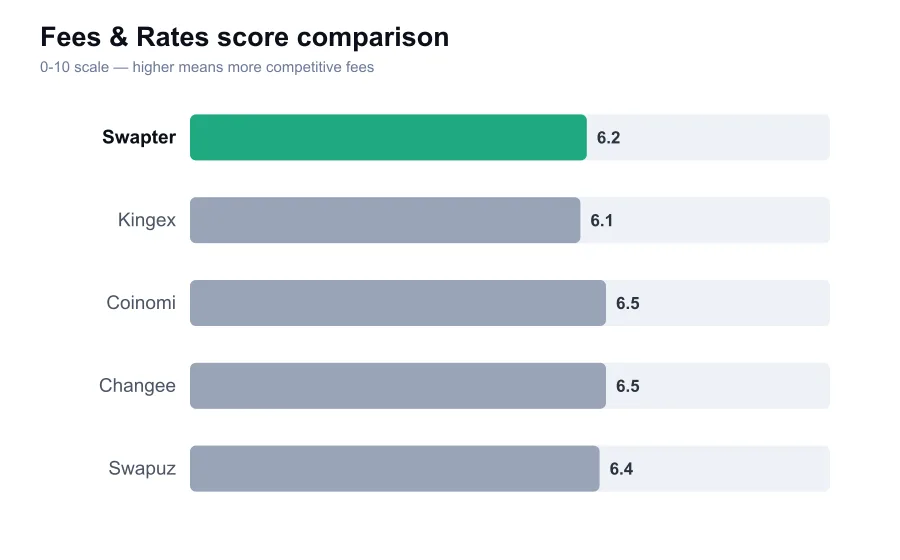
Fees are the first area where Swapter needs a skeptical reading. Its quoted output is more meaningful than any headline claim because the final rate can include a service margin, liquidity-provider spread, and blockchain network fee. That is standard among instant exchangers, but it makes direct comparisons difficult. A swap that looks free at the front end can still be materially more expensive than placing a limit order on a liquid centralized exchange.
The fixed-rate option is the sensible choice for users who care about certainty. It locks the quoted destination amount for a limited window, subject to the deposit arriving on time and in the correct asset and network. Fixed quotes commonly cost more than floating ones, because the provider carries price-movement risk. Floating swaps can produce a better result in quiet markets, but they can also settle below the estimate during a sharp move. Swapter should be judged on the live quote against competitors, not on a generic promise of competitive pricing.
For modest trades, Swapter's all-in pricing can be acceptable. The convenience premium is often easier to tolerate than the work of moving funds into a centralized exchange, trading, and withdrawing again. It becomes harder to defend on large swaps. A one or two percent difference on a five-figure conversion is real money, and instant-exchange quotes can widen quickly on thin pairs. Anyone moving a meaningful sum should obtain simultaneous quotes from Swapter, ChangeNOW, and at least one liquid exchange before sending anything.
Speed depends less on the website than on the source chain, destination chain, asset liquidity, and the risk checks applied to the transaction. A straightforward swap involving established assets can settle after the deposit gets its required confirmations and liquidity is available. Bitcoin deposits naturally take longer than transfers on faster chains. Network congestion, a low fee on the originating wallet, or an unusual token can turn a quick conversion into a wait measured in hours rather than minutes.
Swapter's non-custodial presentation is a benefit, but the phrase has limits. It means the company does not operate a normal customer wallet where assets remain parked indefinitely. It does not mean funds are never in its control. During the exchange process, a user sends coins to an address generated by the service or its infrastructure. If a swap is paused, the user is dependent on the provider to complete it or return the funds. That's an important distinction for anyone treating no-sign-up services as trustless.
The KYC position also deserves precision. Swapter does not require routine account creation for ordinary use, which is why privacy-minded users notice it. Yet no-KYC at entry is not a guarantee that identity checks can never happen. Like other instant exchangers, it can flag a transaction for compliance or fraud review and ask for documents before release or refund. The company needs to make that contingency clear before the deposit is made, especially for users whose funds could be time-sensitive.
Security information is thinner than I would like from a provider handling irreversible transfers. A customer can verify a domain, quoted address, and transaction hash, but cannot independently inspect the service's internal liquidity arrangements, wallet controls, or screening thresholds. That doesn't prove a problem. It does mean Swapter does not earn the same confidence level as an exchange with a long public operating record, formal proof-of-reserves work, detailed security disclosures, and established regulatory accountability.
Its reputation is still developing. Swapter lacks the multi-year public history of veterans such as Changelly or ShapeShift, and it has far fewer independent review data points than household-name exchanges. That is not fatal for a small test transaction. It is a good reason not to use the service as a primary rail for repeated large transfers. Reputation in this category is built by resolving delayed swaps, communicating clearly during checks, and honoring quoted terms, not by polished affiliate pages.
Support is available through the site's contact channels, but this is another area where expectations should stay realistic. Instant exchanges tend to provide ticket or chat-based assistance rather than dedicated account managers or phone support. A useful support team can identify a transaction by its order ID and hash, explain confirmation requirements, and handle an incorrect memo or delayed payout. A poor one leaves customers refreshing a status page with little context. I would save every quote, order identifier, and transaction hash before contacting anyone.
The practical risks are mundane but serious. Sending USDT on the wrong network, omitting a destination tag for XRP, or depositing less than the stated minimum can create a manual recovery case. These are not Swapter-only problems, yet the service model puts the recovery burden on its support staff. Test transfers are cheap insurance. Check the exact chain label twice, and don't assume that a token sharing a ticker with another asset is interchangeable.
Swapter is strongest as a convenience tool for an experienced self-custody user who understands wallet addresses, confirmations, and price spread. It is weaker as a venue for first-time buyers, large traders, or anyone who needs audited custody, advanced orders, and predictable recourse. The lack of a conventional account can feel liberating until something goes wrong. Then the absence of a deep customer relationship becomes a disadvantage.
My view is that Swapter is usable, but it has to earn each transaction through its live quote and execution. The service is not a bargain by default, and its relative youth makes caution appropriate. Use it for a small, uncomplicated conversion if its rate is clearly attractive and the network details are familiar. For large amounts, fiat access, or a situation where a delay would hurt, a major exchange or a better-established instant provider is the safer call.