Quickex is a non-custodial instant crypto exchange service aimed at people who want to swap one asset for another without opening a full trading account. It sits closer to ChangeNOW, SimpleSwap, and LetsExchange than to a conventional exchange such as Kraken or Coinbase. There is no order book to study, no portfolio dashboard to manage, and no reason to leave coins parked with the service after a completed exchange.
That simplicity is Quickex's main attraction. You choose a pair, enter the destination address, send the requested amount, and wait for the received asset to arrive. For a user who already holds crypto in a self-custody wallet, that is a cleaner experience than depositing to a centralized exchange, trading manually, then withdrawing again. It removes several steps, though it does not remove blockchain risk or price risk.
Quickex offers floating-rate and fixed-rate exchanges. The distinction matters more than the marketing wording suggests. A floating quote can change between the moment you see it and the moment your deposit receives enough confirmations. In a quiet market this may be barely visible. During a sharp move, the received amount can be materially worse than the first estimate. Fixed-rate swaps give more certainty, but the quoted rate usually includes a bigger buffer.
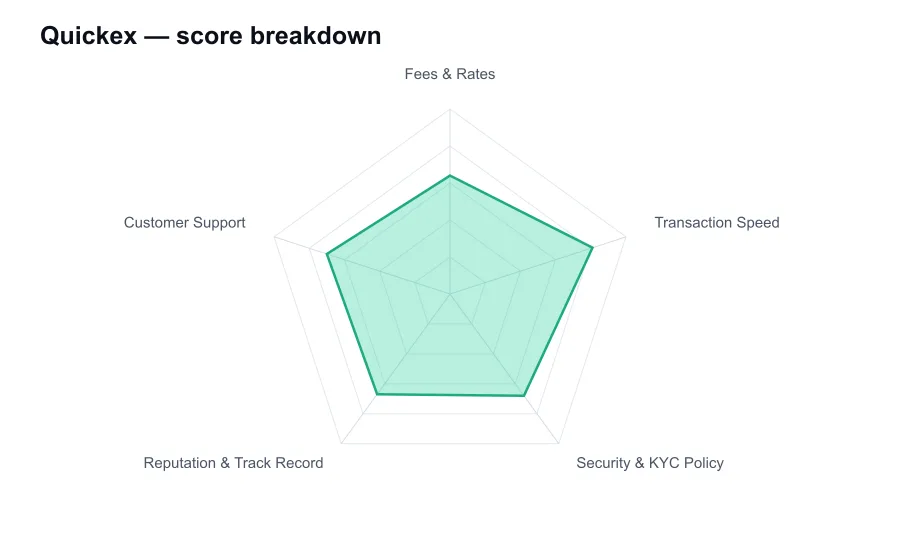
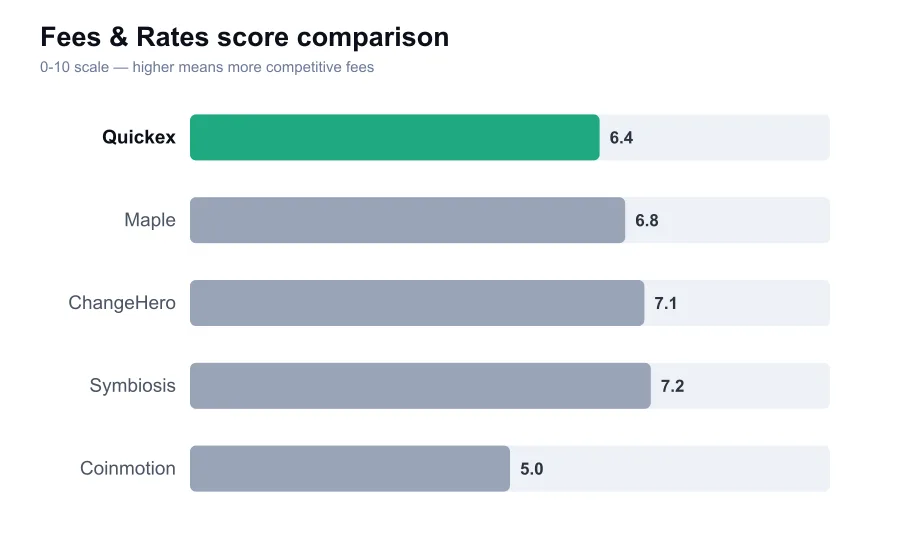
The site does not present a simple universal trading fee such as 0.25 percent. Instead, its economics are baked into the quoted exchange rate, along with liquidity-provider costs and network fees. That is common in the instant-exchange category, but it makes Quickex less transparent than an exchange with a published maker and taker schedule. You should judge the service by the final amount displayed against at least two competitors, not by assuming a no-account swap is cheap.
On common pairs such as BTC to USDT, ETH to BTC, or SOL to USDC, Quickex can be competitively priced if its liquidity route is favorable. On thin tokens or obscure network combinations, spreads can widen quickly. That is not unique to Quickex, but the lack of a visible order book means users have no direct way to inspect available depth. A quote may be fair, or it may simply be the best rate Quickex can source at that instant.
Speed is generally good for a service of this kind. The internal conversion is usually the easy part. The waiting comes from the deposit chain, confirmation requirements, and the outbound withdrawal from the liquidity source. A swap involving Solana or Litecoin can finish far faster than one involving Bitcoin during congestion. Quickex cannot make a slow Bitcoin confirmation fast, and it should not be blamed for that, but users should understand the difference before calling a swap delayed.
The fixed-rate option is useful for people making time-sensitive conversions, particularly if they are moving funds to meet a payment, collateral, or bridge deadline. It is less compelling for a casual holder swapping a small amount, because the premium can outweigh the benefit. I would use floating mode for a small, liquid conversion after checking the estimate, and fixed mode only where the exact expected output has real value.
Quickex calls itself non-custodial, which is broadly accurate in the sense that it does not operate a customer balance account like a regular exchange. Still, funds pass through addresses controlled by the service or its partners during a swap. That means users must treat it as a transaction intermediary, not as a trustless protocol. A typo in the receiving address, an unsupported token contract, or an incorrectly selected network can still cause a permanent loss.
There is no routine account signup or standard identity verification step for ordinary use. That does not mean every transaction is immune from compliance review. Quickex can request verification under its AML procedures, particularly where transaction-monitoring tools flag a transfer. This is an awkward reality for privacy-minded users, because a swap can be paused after funds have already been sent. Anyone who needs a guarantee against KYC requests should not use any centrally operated instant exchanger.
The provider's public reputation is decent but limited by its relatively modest brand profile. Quickex has operated for years and has an established review footprint, which is more reassuring than a newly launched swap widget with no operating history. It has not built the institutional reputation of Coinbase or Kraken, nor the broad consumer recognition of ChangeNOW. That is not fatal, but it means caution should be higher for large transfers.
Support is available around the clock through the site's live channels and email, and that is important because swaps do not respect office hours. Reports from users tend to follow a familiar pattern for this sector. Straightforward swaps are rarely memorable. Difficult cases involving delayed deposits, incorrect amounts, or compliance checks can take longer and feel frustrating because the user has no account dashboard with a detailed operational trail.
The practical way to use Quickex safely is to start small. Confirm the exact token and chain, especially for USDT and USDC, where several networks may appear similar. Save the transaction ID and the swap reference before contacting support. Do not send an amount below the stated minimum, and do not send from an exchange withdrawal if that exchange might delay the withdrawal beyond a fixed quote window.
Quickex is strongest as a convenience tool, not as a primary trading venue. It works for a wallet-to-wallet conversion when you value speed and minimal account friction more than perfect fee transparency. It is a weak fit for active traders, anyone converting very large sums, or users who want tax reports, advanced orders, proof-of-reserves disclosures, and a conventional customer account relationship.
My view is that Quickex is a credible utility service with the normal compromises of the instant-exchange model. The interface is simple, the non-custodial flow is appealing, and the availability of fixed quotes gives users a useful choice. Its pricing needs comparison shopping, and its AML review policy means it is not truly permissionless. Use it for deliberate, modest swaps, then move on, rather than treating it like a bank or long-term exchange account.