ChangeHero is a noncustodial instant exchange service aimed at people who want to convert one cryptoasset into another without opening a trading account or learning an order book. It sits in the same broad category as ChangeNOW, SimpleSwap, StealthEX and Changelly's consumer swap product. Its appeal is obvious: choose a pair, receive a deposit address, send coins, and get the destination asset back. For a quick wallet-to-wallet conversion, that can feel much cleaner than funding a centralized exchange and withdrawing again.
The service does not hold a conventional user balance or offer a full trading terminal. That matters because ChangeHero's convenience comes with a trade-off. You are accepting a quoted exchange rate rather than placing an order yourself, and the service is often sourcing liquidity through external partners. That is normal for this part of the market, but it means the user has less visibility into execution than they would on Binance, Kraken, Coinbase Advanced, or a decentralized exchange.
ChangeHero offers floating-rate and fixed-rate swaps. The floating option is usually the cheaper-looking route, though the final amount can move while the transaction is waiting for confirmations and liquidity execution. The fixed-rate option gives a known destination amount within the stated validity window, which is valuable when the market is moving quickly. Fixed rates are not magic protection against every failure, though. Send the wrong asset, use an unsupported network, or miss an expiry condition and the transaction can still require manual handling.
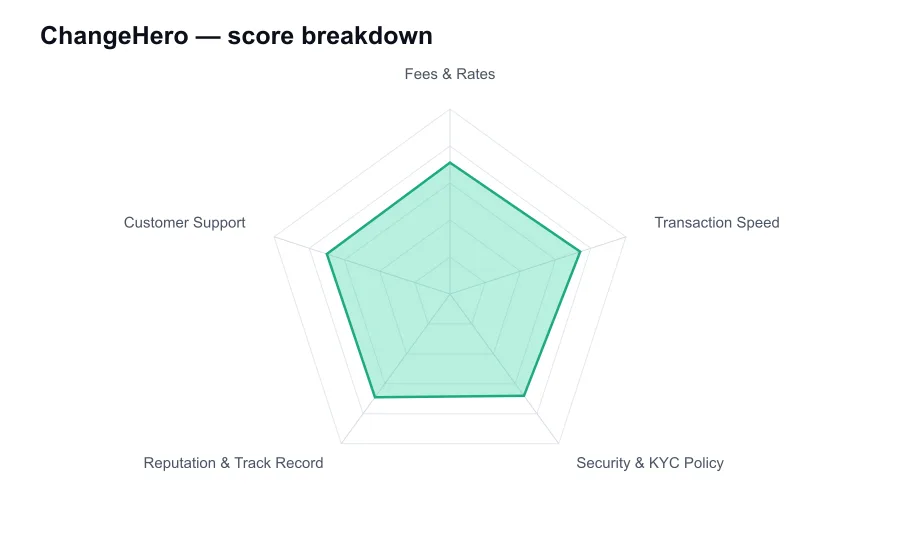
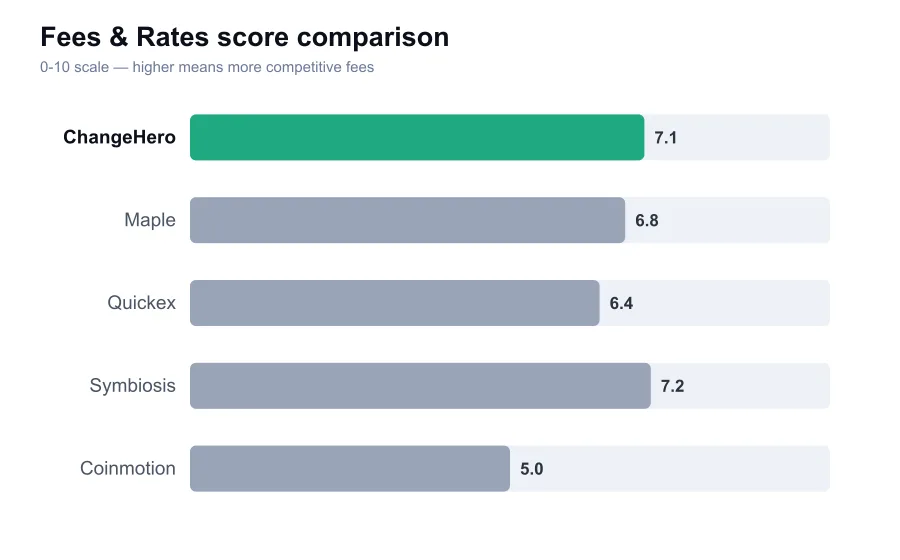
Its stated exchange fee for floating swaps has commonly been presented as 0.5 percent, while network charges and liquidity-provider pricing affect the final quote. That is not terrible for a retail instant exchanger, but the headline alone can mislead. A 0.5 percent service fee does not tell you the whole cost of a swap. The spread embedded in the quote, gas costs, and the price movement between quote creation and settlement can matter more than the advertised percentage, particularly on thin pairs.
My view is that ChangeHero is reasonably priced for small, time-sensitive conversions, but it is not the place to chase the best possible execution. Before sending anything meaningful, compare the received amount with at least two competitors and with a liquid exchange. On major pairs such as BTC to USDT, ETH to USDC, or SOL to USDT, a centralized exchange can often beat an instant exchanger by a noticeable margin even after withdrawal fees. Convenience is what ChangeHero sells, not price discovery.
Speed is usually good when both assets have fast block times and the incoming transaction confirms normally. A Litecoin, Solana, Tron, or Polygon transaction can be processed much faster than a Bitcoin transfer during congestion. The phrase "instant exchange" should still be read as a product category, not a promise of immediate settlement. ChangeHero cannot release your output before it sees enough confirmations on the incoming chain, and a swap routed through outside liquidity can add another delay.
Bitcoin and Ethereum are the pairs where users should set realistic expectations. A Bitcoin deposit can require several confirmations, and a high-fee Ethereum period can make the process feel slow and expensive. If the receiving asset is on an account-based network, the destination address also has to be compatible. Sending USDT on TRON when you intended an ERC-20 USDT transaction is not a minor typo. It can turn a five-minute swap into a support case, and recovery may not be possible.
ChangeHero's noncustodial framing is a genuine advantage, but it needs to be understood precisely. The platform does not ask users to park funds in an account for routine swapping, reducing the risk of a broad exchange-account takeover. During a transaction, however, you are sending coins to a deposit address controlled by the service or its execution partner. That is temporary custody. The safety question is therefore whether its operational controls, liquidity counterparties, and compliance process handle that brief custody responsibly.
KYC is not normally required before every swap. ChangeHero uses an AML and risk-screening model, so a transaction can be flagged and documents can be requested where its systems identify a concern. That approach is common, but it is also the point where no-account exchangers frustrate users most. Someone who came for privacy may find a transfer held pending identity verification. The service should be clearer than many rivals about this possibility before a user sends funds, because a surprise review is not a minor inconvenience.
The practical security burden falls heavily on the customer. There is no login security layer to save somebody who pastes a scammer's address into the destination field. There is no cancellation once an on-chain transfer is confirmed. Fake ChangeHero adverts, lookalike domains, and wallet-drainer links are more likely threats than a sophisticated compromise of the swap interface itself. Bookmark the real site, verify the exact domain, and never trust an exchange address delivered through a private message.
ChangeHero has been operating since 2017, which gives it a longer record than many short-lived swap brands. It has also built enough recognition to be regularly included in instant-exchange comparisons and wallet integrations. Still, it does not have the institutional standing, public financial disclosure, licensing footprint, or independently demonstrated reserves associated with the largest regulated exchanges. Its reputation is credible within the no-account swap niche, rather than bulletproof. That distinction should influence transaction size.
Public user feedback is mixed in the familiar way for this sector. Straightforward swaps often receive praise for simplicity and speed. Negative reports tend to involve rate differences, delayed transactions, unavailable liquidity, or compliance checks. I don't dismiss those complaints as automatically unfair, but neither do I treat every delayed swap as evidence of misconduct. Blockchains stall, providers lose liquidity, and automated risk tools can flag legitimate funds. The meaningful test is whether support can explain the issue and resolve it without evasive handoffs.
Support is available around the clock through live chat and email, and ChangeHero publishes transaction-tracking information that is useful when an exchange is still processing. For a small transaction, that setup is adequate. For a large or urgent conversion, it is thin compared with a regulated exchange that has formal escalation channels, detailed account controls, and phone support in some regions. A support agent can investigate a delayed swap, but they cannot reverse an irreversible chain transfer or guarantee that a compliance review will clear quickly.
I would use ChangeHero for a modest, carefully checked conversion between mainstream assets, especially where avoiding account creation is more valuable than extracting the last basis point of price. I would not use it as a trading venue, a savings account, or the first choice for a large transfer that must settle by a deadline. Its fixed-rate option, clear transaction flow, and no-account design are useful. Its opaque execution economics and risk-based KYC stops keep it from being a top-tier choice for serious volume.