Report Chain logo Report Chain

Maple

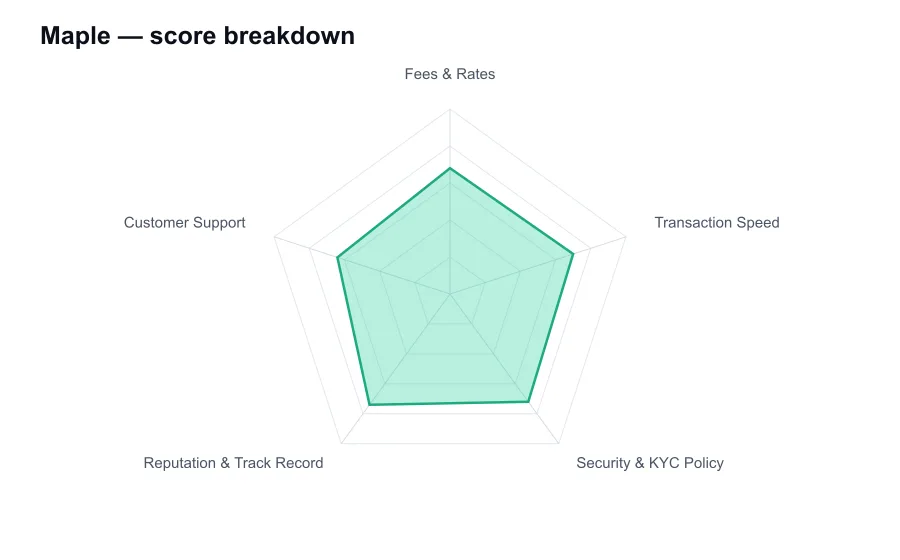
Maple scores 7.0/10 overall in our independent review, measured against every other provider we've compared, strongest on Reputation & Track Record (7.4/10) and weakest on Customer Support (6.4/10).

Visit official site
Status: active (checked 2026-10-13T18:10:58.449Z)

Editorial independence: our scores and rankings are produced using the fixed criteria above and are not influenced by advertisers. This is an independent ranking site and is not operated by, or affiliated with, any provider we list.

Affiliate disclosure: some links on this page may earn us a commission at no extra cost to you. This does not affect our rankings.

Quick Verdict
Maple is one of the few decentralized credit platforms that deserves to be evaluated seriously rather than dismissed as a yield farm. Its products are useful, its track record is substantial, and its team has operated through a major credit shock. That same shock is why it should never be treated as risk-free yield. Maple can reward informed capital, but it requires more judgment than Aave-style overcollateralized lending. Use it as a credit allocation, not a cash account.
  • Best for: Established onchain credit protocol
  • Best for: USDC-focused Syrup products
  • Best for: More sophisticated than anonymous yield farms
  • Best for: Visible institutional credit focus
  • Best for: Public documentation and onchain transparency
  • Not for: Credit losses are possible
  • Not for: Withdrawal liquidity can differ by pool
  • Not for: Fees and terms are not uniform
  • Not for: Not suitable for emergency stablecoin reserves
Market snapshot
AssetPrice (USD)24h change
Bitcoin (BTC)$81,809+0.87%
Ethereum (ETH)$2,396.01+1.27%
Tether (USDT)$0.9992+0.01%
BNB (BNB)$725.91+1.94%
Solana (SOL)$103.79+1.58%
XRP (XRP)$1.3+1.97%

Market data via CoinGecko, for informational purposes only. Not financial advice.

What is Maple?

Maple is a decentralized credit protocol that facilitates lending pools for institutional and onchain borrowers. Users can access products tied to USDC lending and curated credit strategies. Unlike fully collateralized money markets, Maple can expose lenders to borrower and liquidity risk.

How Maple Works

  1. Connect a compatible self-custody wallet
  2. Review the chosen Maple or Syrup product terms
  3. Deposit the supported asset, commonly USDC
  4. Receive the applicable pool or receipt token
  5. Track yield, pool conditions, and withdrawal rules
  6. Request redemption according to the product's liquidity terms

Criteria Breakdown

Scoring breakdown for Maple
Criterion Score Note
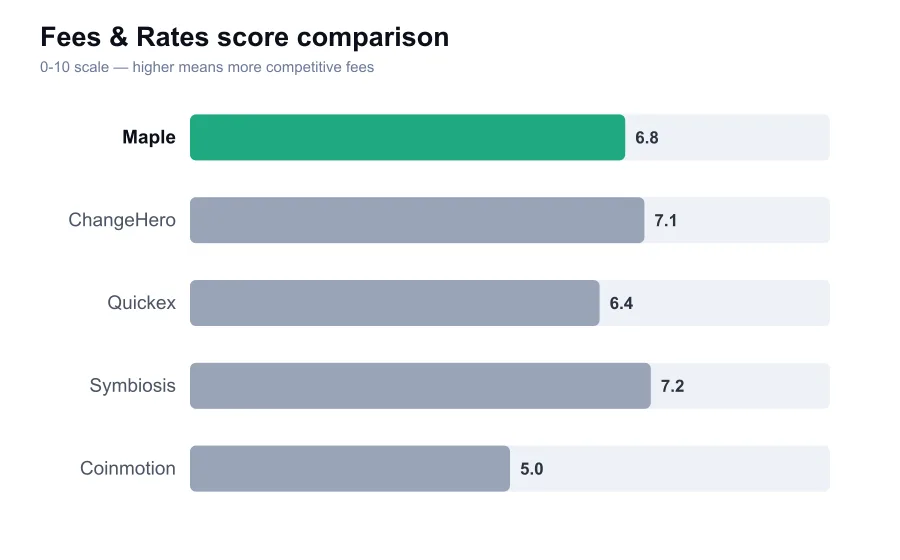
Fees & Rates 6.8 Fees and yield economics vary by pool and product.
Transaction Speed 7.0 Onchain actions are quick, but pool withdrawals can take longer.
Security & KYC Policy 7.2 Mature protocol, but smart-contract and credit risk both matter.
Reputation & Track Record 7.4 Established onchain credit brand with a notable 2022 default history.
Customer Support 6.4 Good documentation and community access, limited personal recourse.

Key Facts

Key facts for Maple
Fact Value Source
Founded 2021 Source
Primary settlement network Ethereum Source
Key lending asset USDC Source
Notable credit event Orthogonal default, late 2022 Source
Protocol token MPL Source
Credit model Curated institutional and onchain lending Source

Review of Maple

Maple is a credit protocol, not a retail exchange. It occupies a distinctive part of crypto finance by connecting capital providers with institutional and onchain borrowers through curated lending pools. Its more recent Syrup products also give ordinary DeFi users a route into USDC-denominated yield. That positioning makes Maple more sophisticated than a simple lending app and more exposed to credit judgment than an overcollateralized protocol such as Aave or Liquity.

The central fact about Maple is that credit risk is real. In a collateralized DeFi money market, a falling borrower position can be liquidated automatically. Maple's institutional lending model has historically depended more on underwriting, pool delegates, legal agreements, and borrower assessment. That can produce capital efficiency that fully collateralized systems cannot match. It also means the safety of deposited capital depends partly on people making good credit decisions.

Fees vary by pool and product rather than following one simple platform-wide schedule. Lenders should read the pool terms closely, because the quoted yield is not automatically the amount that reaches their wallet. Management fees, performance fees, withdrawal conditions, and protocol economics can differ. That is not unusual for credit products, but it makes Maple less straightforward than depositing USDC into a basic onchain lending market.

Syrup's USDC products are easier for a retail user to understand than Maple's older institutional pool structure, but they should not be mistaken for a bank account. A yield figure is compensation for risk, not a gift. If a product offers materially more than a comparable Treasury-backed token or a conservative lending market, the first question should be why. Maple's answer is generally credit exposure and lending strategy, not magic.

On speed, Maple works at blockchain speed for deposits, token transfers, and many position updates. Ethereum confirmations usually settle within minutes, subject to gas and network conditions. Withdrawals can be slower than a spot exchange withdrawal because lending capital may be deployed. Pool liquidity, notice periods, and redemption mechanics matter. A lender should understand how exit works before entering, rather than discovering it during market stress.

That is where Maple differs from holding USDC in a wallet or trading it on a large exchange. Your claim may be liquid, but it is not necessarily instantly redeemable in every market condition. A pool can need time to receive borrower repayment or manage its liquidity buffer. This is normal in credit, yet crypto users accustomed to immediate exits often underestimate the difference.

Maple's security profile is reasonably mature for DeFi, but it has to be viewed through its history. The protocol has used audits, public documentation, and onchain pool structures, and it has survived several difficult market cycles. Yet smart contract security is only half the story. A lending protocol can have clean code and still lose money through borrower default, weak underwriting, or a failure by a pool delegate.

The Orthogonal Trading default in late 2022 remains the event every serious Maple user should understand. Orthogonal's default affected Maple lending pools and exposed the limits of undercollateralized crypto credit during the collapse of market confidence. Maple did not simply disappear, and the event pushed the sector toward more cautious risk practices. Still, anyone describing Maple as low-risk without mentioning this history is selling a fantasy.

Maple's current reputation is stronger than it was in the immediate aftermath of that credit crisis. The team adapted, expanded its product offering, and focused more heavily on sustainable lending and institutional structures. It is now one of the more recognized brands in onchain credit. Recognition should not be confused with a guarantee. Maple has a real operating history, including a painful lesson about counterparty risk.

KYC depends on the product and participant role. Institutional borrowing and certain managed-credit arrangements can involve onboarding and compliance requirements. Permissionless DeFi access through public smart contracts is different, although front ends, jurisdictions, and particular products can apply their own restrictions. Users should not assume that Maple's institutional credit opportunities are open to every wallet in every country.

Support is better than the average anonymous DeFi protocol, with documentation, community channels, and a visible team presence. But it is still not retail banking support. If you connect the wrong wallet, sign a malicious transaction, or misunderstand pool risk, a support agent cannot make you whole. For questions about a specific pool, documentation and terms matter more than a generic chat answer.

Maple is best judged against the correct peers. It is not a direct substitute for Uniswap, a centralized exchange, or a fully collateralized stablecoin loan. Its closest conceptual alternatives are institutional crypto-credit platforms, tokenized credit funds, and curated DeFi lending pools. That comparison makes its strengths clearer: serious credit infrastructure, known product design, and a more developed brand than most decentralized credit experiments.

The weakness is equally clear. Credit products demand analysis, and Maple gives users enough complexity to make poor decisions if they chase headline yield. The right way to use it is to inspect the borrower type, pool terms, withdrawal design, historical losses, and applicable legal restrictions. If that sounds like work, the product is probably not for you.

Maple is credible, useful, and meaningfully riskier than the simple yield interface may suggest. I would consider it for an informed user who understands credit risk and can tolerate imperfect liquidity. I would not use it as the home for emergency funds, stablecoin spending money, or capital that cannot withstand a delay or loss. Maple has earned a place in serious DeFi discussion, but it has not earned blind trust.
Pros & Cons

Pros and cons of Maple
Pros Cons
Established onchain credit protocol -
USDC-focused Syrup products -
More sophisticated than anonymous yield farms -
Visible institutional credit focus -
Public documentation and onchain transparency -

Verdict

Maple is one of the few decentralized credit platforms that deserves to be evaluated seriously rather than dismissed as a yield farm. Its products are useful, its track record is substantial, and its team has operated through a major credit shock. That same shock is why it should never be treated as risk-free yield. Maple can reward informed capital, but it requires more judgment than Aave-style overcollateralized lending. Use it as a credit allocation, not a cash account.

KYC

Requirement tiered
Notes KYC requirements differ by product and role. Institutional borrowers and managed-credit arrangements may require onboarding, while public DeFi interactions may not.

Supported Assets

Notable Coins: USDC, MPL
Networks: Ethereum

Limits

NotesDeposit, withdrawal, and access conditions vary by pool or product. Review the relevant pool documentation before committing capital.

How to Use Maple Safely

  • Read each pool's withdrawal and fee terms before depositing
  • Treat yield as compensation for credit risk
  • Do not use emergency funds or required short-term cash
  • Verify the official Maple interface before connecting a wallet
  • Keep wallet approvals limited and review signed transactions

Frequently Asked Questions

Is Maple the same as a crypto exchange?

No. Maple is an onchain credit and lending protocol. It connects capital with lending pools rather than primarily serving as a spot trading venue.

What happened with Orthogonal Trading and Maple?

Orthogonal Trading defaulted in late 2022, affecting Maple lending pools. The event showed that undercollateralized crypto credit can produce real lender losses.

Are Maple withdrawals always instant?

No. Blockchain transactions settle quickly, but redemption timing can depend on the pool's liquidity, borrower repayments, and withdrawal terms.

Does Maple require KYC?

It depends on the product and role. Institutional borrowing and managed credit arrangements can require onboarding, while public DeFi access differs by product.

Why can Maple yield be higher than a basic stablecoin account?

The yield compensates lenders for credit, liquidity, and protocol risk. It should not be viewed as equivalent to an insured bank deposit.

Is Maple suitable for emergency funds?

No. Pool liquidity and credit risk make Maple unsuitable for money you may need immediately or cannot afford to have delayed.

Editorial independence: our scores and rankings are produced using the fixed criteria above and are not influenced by advertisers. This is an independent ranking site and is not operated by, or affiliated with, any provider we list.

Affiliate disclosure: some links on this page may earn us a commission at no extra cost to you. This does not affect our rankings.

About the Author

Yvette Saran Crypto Exchange Research Editor
  • 8 years in fintech and payments journalism
  • Crypto exchange testing and fee analysis
  • Former consumer finance reporter
  • Contributor to digital asset custody research

Yvette Saran is a crypto exchange researcher and former payments journalist with eight years of experience covering trading platforms, custody, and consumer finance. She reviews exchanges by testing the parts users actually feel, from order execution and withdrawal friction to fee disclosures and support quality.

Maple score breakdown by criterion, shown as a radar chart
Score breakdown
Maple fees score compared against similar providers
Fees vs. alternatives
Illustrative swap flow preview for Maple - not an actual product screenshot
Illustrative swap flow preview

Alternatives to Maple

Alternatives to Maple
AlternativeScore
ChangeHero Review7.0/10
Quickex Review7.0/10
Symbiosis Review7.1/10
Coinmotion Review7.1/10
EasyBit Review7.1/10
Exolix Review7.1/10