Nexchange is a noncustodial instant crypto exchange service built for users who want to convert one asset into another without opening a conventional trading account. The experience is closer to a transaction desk than a full exchange. You select a pair, receive a deposit address, send funds, and receive the output asset at your chosen wallet. That simplicity is its appeal, especially for users who do not need charts, custody accounts or order-book trading.
It occupies a crowded category alongside services such as ChangeNOW, SimpleSwap, StealthEX and Changelly. The important distinction is that instant exchangers are not magical peer-to-peer swaps. They commonly source liquidity from external venues and manage the exchange process between the incoming and outgoing blockchain transfers. A user gets convenience, but has less visibility into execution than on a decentralized exchange or a professional spot market.
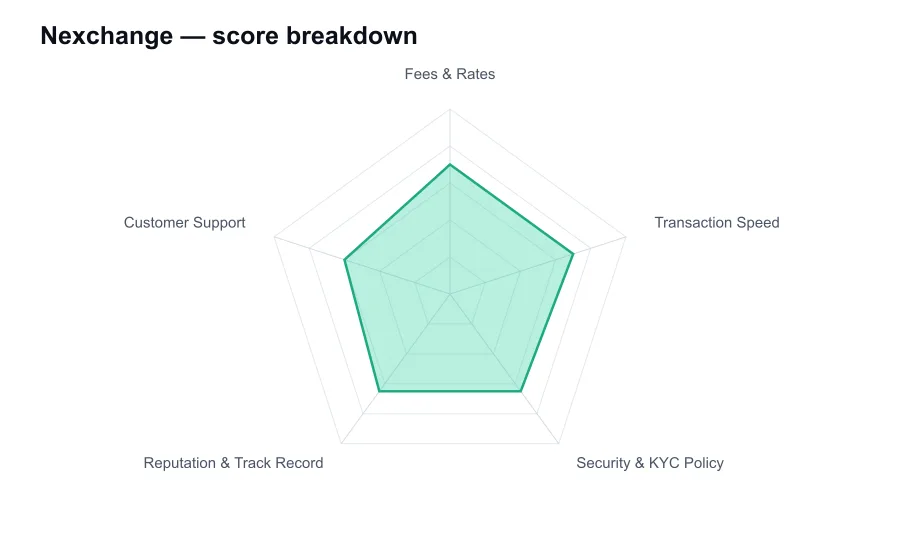
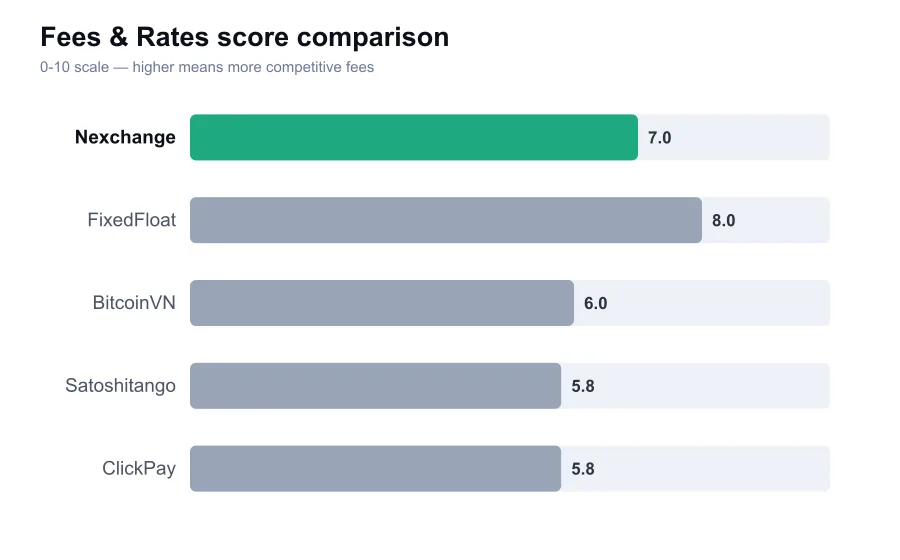
Nexchange's published pricing has generally centered on a 0.5 percent exchange fee for floating-rate swaps. That is straightforward by instant-exchange standards, and a clear percentage is preferable to a service that conceals its margin entirely inside a quoted rate. Still, 0.5 percent is not cheap compared with a liquid spot pair at Kraken, Coinbase Advanced or Binance, where active users can often trade for considerably less. The convenience premium is real.
The quote is only one part of the cost. Network fees, spread from the liquidity route and price movement during a floating-rate transaction can all affect the final received amount. This is particularly important for thinly traded assets, small-cap tokens and congested networks. A service may accurately apply its stated fee while the resulting execution is still worse than an order-book trade. Compare the final amount, not merely the percentage written on the fee page.
For a typical mainstream swap, the process is reasonably fast. The practical clock begins once Nexchange sees the required blockchain confirmations, then ends when the outgoing transaction is broadcast and confirmed. Bitcoin deposits can take longer because confirmation requirements and block times are slower than those of many smart-contract networks. Ethereum transactions can be delayed by gas conditions. A swap that takes minutes is normal, but it should never be marketed as guaranteed instant settlement.
Fixed-rate quotes are useful where offered, because they give the sender more certainty about the output amount. They also come with time and amount conditions. If a customer sends too late, too little, too much or via the wrong network, the order can require manual handling. This is a basic reality of instant exchangers and one of the reasons users should send exactly the instructed amount. Rounding a transfer casually can turn a quick conversion into a support case.
Nexchange does not require users to create a standard custodial account for an ordinary swap. That reduces the amount of personal data needed for simple use and eliminates the usual password, account-lockout and withdrawal-whitelist problems. It does not mean every transaction is anonymous or immune from compliance review. Blockchain transfers are traceable, and the company can ask for information where its anti-money-laundering controls flag a transaction.
That conditional KYC model is reasonable in principle, but it creates the category's most frustrating customer outcome. A user may send funds expecting a rapid conversion and later be asked to complete verification or explain source of funds. If the user cannot satisfy the request, the transaction can remain delayed while the service reviews its options. Anyone moving funds that may trigger sanctions, fraud or chain-analysis alerts should use a fully verified regulated exchange before sending, rather than gambling on a no-registration workflow.
Security is strongest where Nexchange avoids holding a long-term customer balance. There is no standing exchange wallet account to raid and no reason to leave coins parked on the service. That is better than keeping trading funds on a weak centralized exchange. Yet the service remains a temporary counterparty during execution. You are trusting its website, deposit-address generation, liquidity operations and payout controls for the duration of the swap.
The main practical security risk is user error. Copying a fraudulent deposit address, choosing USDT on the wrong network, or landing on a phishing clone can be expensive mistakes. The correct habit is to confirm the network, asset ticker and destination address before submitting the deposit. A small test transfer is sensible for an unfamiliar route, though minimums and network fees can make it inefficient. It is still cheaper than losing a large payment.
Nexchange has been operating for years and is a recognizable name in the instant-exchange segment, which gives it a better track record than a newly launched swap widget with no visible history. Its public profile is still much smaller than the major global centralized exchanges. That is not automatically a problem, but it means a user should not treat brand familiarity as a guarantee of liquidity or a promise that every unusual transaction will be resolved quickly.
Support is available through the site's channels and transaction-specific assistance is one of the areas where Nexchange has to perform well. A clean mainstream swap often needs no conversation. The real test is a delayed deposit, an incorrect network selection or a compliance hold. Like most noncustodial swap services, it cannot reverse confirmed blockchain transfers, and response quality is more important than polished marketing when a transaction is stuck.
I prefer Nexchange for one-off conversions between established assets when the user already has self-custody and has checked the final quote against alternatives. I would not use it as a primary trading venue, a place to store funds or the route for a time-critical high-value payment. For large trades, the additional transparency and lower potential slippage of a liquid order-book exchange are usually worth the extra account setup.
Nexchange is a competent utility, not a replacement for a full exchange. Its 0.5 percent advertised fee is easy to understand, and the no-account flow is genuinely convenient. The weaknesses are the familiar ones of this category: variable execution, network-dependent timing and the possibility of an AML review after funds have been sent. Use it for convenience, not for blind trust, and compare the output quote before every meaningful transaction.