Godex is an instant crypto exchange that has been around long enough to be familiar to regular swap-service users, though it has never reached the public profile of Changelly or ChangeNOW. Its pitch is simple: no account, a fixed exchange rate, broad asset coverage and a stated 0.5% commission. That formula is appealing to people who want a straightforward conversion without handing an exchange their identity documents.
Like most services in this category, Godex is a transaction processor rather than a trading venue. Users select a pair, provide a destination address, send the deposit and wait for the service to source and deliver the output asset. There is no charting suite, no margin market and no customer balance intended for long-term storage. It should be judged as a swap tool, not as a replacement for a full exchange.
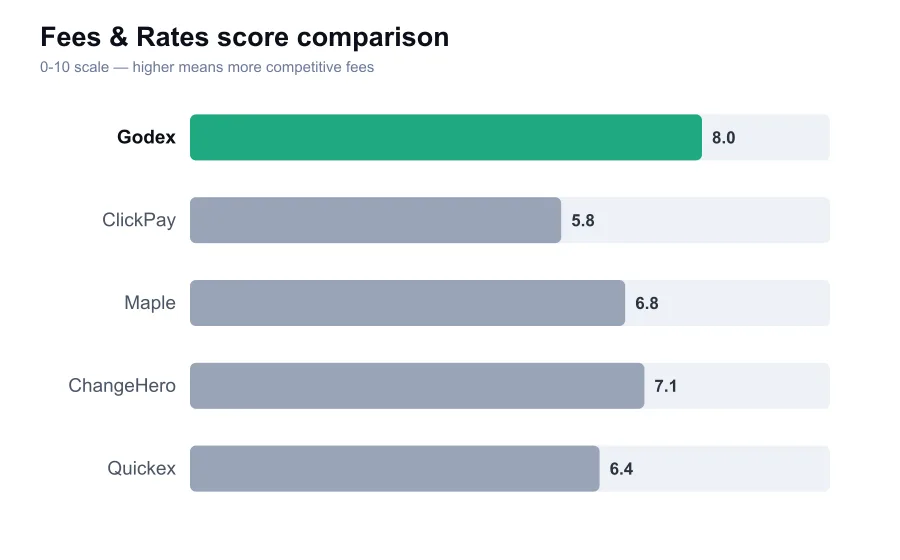
Godex's 0.5% stated commission is its most compelling commercial feature. The service presents its quotes as fixed, so the amount shown before payment should be the amount received if the customer follows the instructions and sends within the allotted window. Compared with a 1% fixed-rate fee at FixedFloat, that looks attractive. It can be especially useful when the market is moving sharply.
The catch is familiar to anyone who compares instant-exchange quotes carefully. A quoted result includes more than the displayed service fee. Godex's liquidity routing and embedded market spread can make the final amount less competitive than a centralized exchange, or occasionally less competitive than another instant exchanger. The only number that matters is the amount that will arrive in the destination wallet. Check it before sending.
Godex says it does not impose maximum exchange limits. That helps its marketing, but customers should interpret it cautiously. Available liquidity, network conditions and internal risk controls can still affect whether a very large order is practical. A service without a stated ceiling is not necessarily the right place to send a six-figure transaction without testing its execution and support first.
Its fixed-rate approach is a real advantage for buyers who dislike the anxiety of floating quotes. The rate is designed to be protected from normal price movement after the transaction begins. There are conditions, though. Deposits must arrive in time, and a materially incorrect amount or delayed payment may need manual handling. Fixed rate is helpful, but it is not a blank cheque against user error.
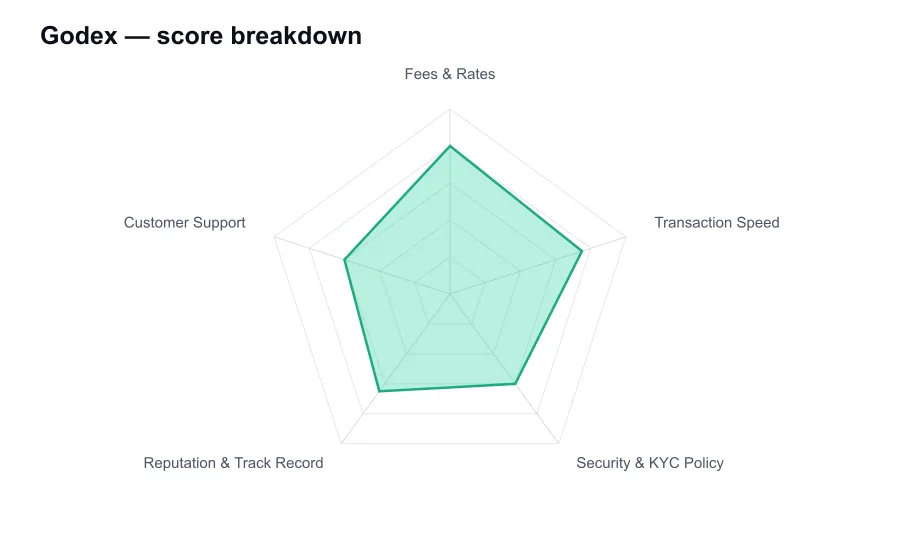
Settlement speed is respectable. For common routes with adequate liquidity, Godex often completes the exchange within minutes after sufficient deposit confirmations. Bitcoin and Ethereum are the usual sources of delay, not necessarily Godex itself. A Bitcoin transaction sent with an uncompetitive mining fee can hold up the entire process. Token conversions on faster chains may appear nearly immediate by comparison.
The service has a wide list of supported cryptocurrencies, including major coins, stablecoins and many less mainstream tokens. That breadth can be useful, especially for users trying to exit an older altcoin without creating a new exchange account. It can also create false confidence. An obscure asset being listed does not mean there is deep liquidity or a consistently attractive rate for it.
Godex's privacy policy has been one of its selling points. The normal flow does not require an account or routine identity verification, and users can exchange without setting up a profile. Yet no-KYC should never be read as no-compliance. Godex can apply anti-money-laundering checks, ask for documentation or delay a transaction under its policies. That is an uncomfortable surprise only for customers who ignored the terms.
Security is adequate for the type of service, but it is not unusually strong. Godex reduces account-takeover risk by not requiring customers to hold a persistent login balance. In return, users have no account-level protections such as withdrawal whitelists, device management or robust two-factor authentication. The security burden moves to the customer's wallet, browser hygiene and careful verification of each destination address.
Reputation is reasonable but not exceptional. Godex has operated for years and has a recognizable product, which separates it from newly launched anonymous swap pages. Still, it has less public transparency than large regulated exchanges, and support complaints common to instant exchangers appear in user discussions: delayed orders, compliance reviews and frustration where blockchain timing does not match expectations.
Support is offered around the clock through website channels, and the transaction ID is central to resolving a problem. In my view, that is sufficient for a small routine conversion but weak for anything high stakes. There is no branch office, dedicated account representative or meaningful phone escalation. If a swap becomes complicated, the customer is largely dependent on written support and the quality of the provider's internal investigation.
Godex is best approached with a disciplined workflow. Check the live quote against at least two alternatives. Send from a wallet you control, verify the chain and destination address character by character, and keep the transaction ID. Do not initiate a large swap while you are traveling, distracted, or unable to respond if support requests information.
I rate Godex above many obscure instant exchangers because its fee policy is easy to understand, fixed-rate model is useful and long operating history gives it some credibility. It still belongs in the convenience category, not the trust category. For ordinary wallet-to-wallet conversions it can be a sensible option. For major amounts, fiat access or legal recourse, a well-regulated centralized exchange remains the safer choice.