ClickPay is not a crypto exchange in the ordinary sense, and that needs to be said plainly before assessing it beside ChangeHero, Changelly, and ChangeNOW. ClickPay is a payments platform for merchants. It helps businesses accept and manage customer payments through cards and local payment methods, with checkout, invoicing, payment links, and related services. A reader looking to swap Bitcoin for USDC, trade tokens, or withdraw crypto to a wallet is in the wrong place.
That does not make ClickPay irrelevant to people working in crypto. A merchant that sells crypto-adjacent products, operates a digital service, or accepts payments in markets served by ClickPay may encounter it as a payment processor. But it should be evaluated as payment infrastructure, not as an exchange provider. The merchant is the customer, while the buyer is usually the payer passing through a hosted checkout. That distinction changes almost every part of a meaningful review, from fees and KYC to speed and support.
ClickPay's strongest selling point is payment acceptance rather than asset conversion. The company presents a range of checkout tools, APIs, payment links, invoicing functions, and merchant integrations. Those are practical capabilities for a business that wants to take card payments without building its own acquiring stack. It is a different job from the one performed by an instant exchanger. There is no public consumer trading book, no wallet-to-wallet crypto swap flow, and no evidence that users should treat ClickPay as a venue for holding digital assets.
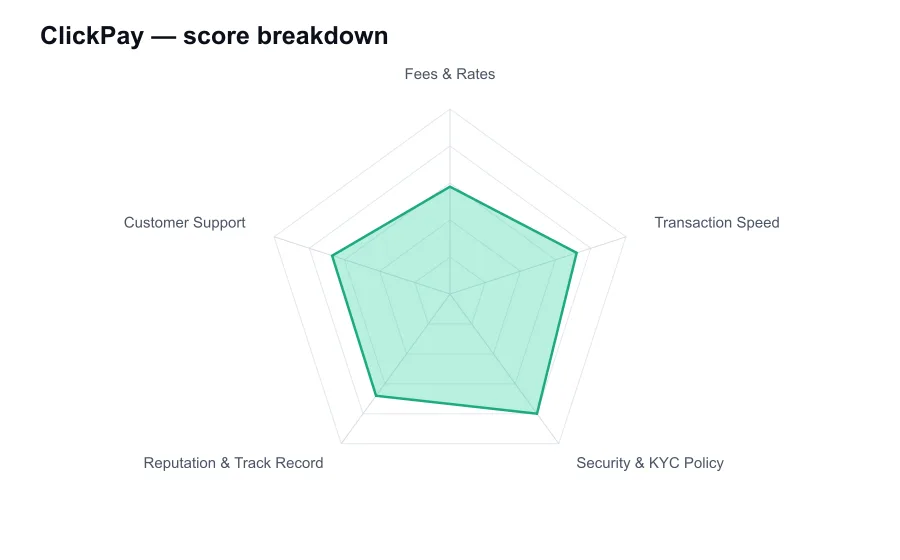
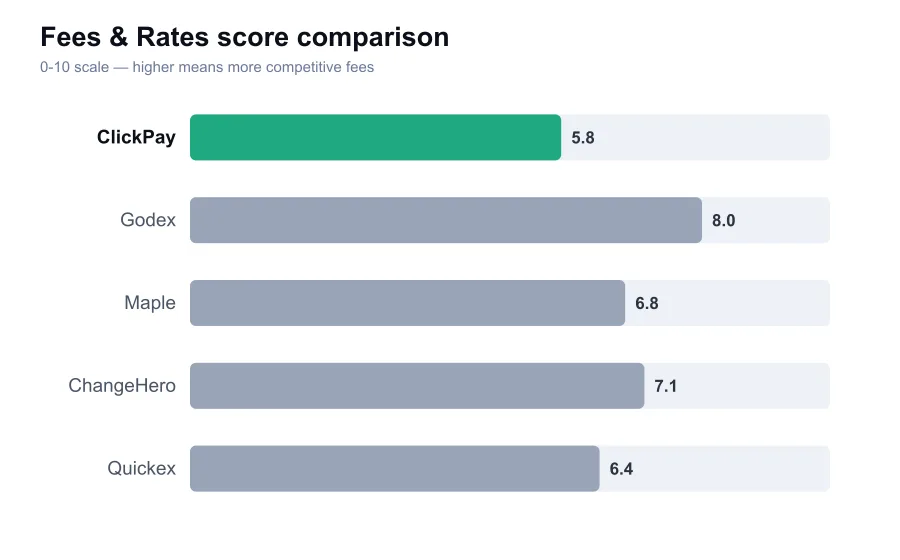
Fees are consequently less transparent to a casual visitor than they are at a retail crypto service. Merchant processing prices are commonly tailored by country, payment method, transaction volume, settlement currency, risk category, and commercial agreement. ClickPay does not present a universal retail crypto conversion fee because it is not selling retail conversion. That is not inherently a criticism. Payment processors often need custom commercial pricing. It does mean a merchant should get a written quote and understand every component before integrating.
A sensible fee review must include more than the advertised processing rate. Ask about onboarding charges, recurring platform fees, refund fees, chargeback handling, cross-border costs, payout fees, settlement timing, currency conversion, and whether tax is added to the invoice. A low card-acquiring rate can stop looking attractive if settlement conversion is expensive or if dispute administration is poorly defined. ClickPay may be a suitable processor after negotiation, but it is impossible to call it cheap or expensive in the abstract without a merchant quote.
Payment speed also means something different here than it does on a blockchain. A card authorization can appear immediately at checkout, while final settlement to the merchant's bank account follows the processor's payout cycle, banking cutoffs, reserve rules, and risk monitoring. That is normal for acquiring. It would be misleading to score ClickPay as slow because it does not settle a Bitcoin swap in ten minutes. It would be equally misleading to call checkout authorization the same thing as cleared merchant funds.
For online merchants, a smooth payment page and reliable API matter more than a flashy dashboard. ClickPay offers hosted payment experiences and integration options designed to reduce implementation work. That can be valuable for a small business that has no payments engineering team. Larger merchants should still test the API, webhook reliability, reconciliation tools, refund workflow, and reporting exports before committing. Payment problems are rarely dramatic until they affect a busy sales day, then even a small integration weakness becomes expensive.
Security is a relative strength for a dedicated processor. ClickPay presents PCI DSS compliance and payment-security tools such as 3D Secure as part of its payments offering. Those are relevant protections for card transactions and merchant checkout flows. They do not translate into crypto custody security, because ClickPay is not presenting itself as a custody provider. A merchant should also ask about API key controls, user roles, audit records, webhook signature validation, incident notification, and how customer card data is tokenized or handled.
KYC and business verification are expected, not optional. Unlike the no-account crypto services in this group, a payment processor must onboard merchants, assess business activity, verify beneficial owners where required, and monitor fraud and chargeback exposure. A merchant that wants to hide its identity or avoid compliance should not apply. More importantly, a merchant should be candid about what it sells. Misrepresenting product categories or processing prohibited transactions is the quickest route to withheld funds, account restrictions, or termination with any acquiring provider.
ClickPay's reputation should be judged in the context of the regions and payment rails it serves, not against global crypto brands. It has been active for years as a merchant payments company and has built a recognizable regional payments presence. That is useful evidence that it is a real operating business rather than a random checkout widget. Still, it does not have the globally visible public record, balance-sheet disclosure, or universal consumer awareness of Stripe, Adyen, PayPal, or major regulated crypto exchanges.
Customer support is another area where merchant needs differ from consumer needs. A business needs help with integration, declined payment patterns, settlement questions, account verification, and disputes. ClickPay offers contact and support channels for customers and merchants, but a prospective merchant should establish service expectations before launch. Ask who owns escalation during a payout issue, whether support is available outside local business hours, what information is required for a chargeback response, and how quickly a production API incident is acknowledged.
The most serious limitation for crypto readers is not a flaw in ClickPay's product. It is category mismatch. There is no basis for comparing its checkout fees with Changelly's 0.25 percent floating exchange fee, or comparing its settlement cycle with a ChangeNOW blockchain swap. These products solve different problems. If a directory has placed ClickPay alongside exchange providers, the directory should make that clear rather than encouraging readers to assume that any payment brand is a crypto brokerage.
A merchant considering ClickPay should conduct normal payments due diligence. Read the acceptable-use rules, ask which payment methods and settlement currencies are available for the legal entity's country, and review reserve and rolling-hold provisions. Test refunds and webhooks in a sandbox or controlled production deployment. Make sure the checkout descriptor is clear to customers, because avoidable chargebacks are a commercial problem before they become a support problem. Crypto businesses should get explicit written confirmation that their activity is acceptable before integrating.
My take is that ClickPay may be a practical regional payment processor for businesses that need card checkout and local payment collection, but it should not be recommended as a crypto exchange. Its security and compliance posture make more sense in merchant acquiring than in self-custody crypto. The absence of public universal pricing is normal for its category, though it demands careful sales diligence. Choose ClickPay if you are evaluating merchant payments in its supported markets. Choose an actual exchange or instant swap provider if your goal is to buy, sell, trade, or transfer cryptoassets.