Report Chain logo Report Chain

Magnatus

Magnatus scores 1.7/10 overall in our independent review, measured against every other provider we've compared, strongest on Fees & Rates (2.0/10) and weakest on Customer Support (1.5/10).

Visit official site
Status: active (checked 2026-10-13T18:10:58.421Z)

Editorial independence: our scores and rankings are produced using the fixed criteria above and are not influenced by advertisers. This is an independent ranking site and is not operated by, or affiliated with, any provider we list.

Affiliate disclosure: some links on this page may earn us a commission at no extra cost to you. This does not affect our rankings.

Quick Verdict
Magnatus fails the first test a crypto provider must pass: verifiability. Its potential convenience cannot be evaluated meaningfully because core facts about operations, pricing, security, and support are not dependable. That puts users in the worst possible position, sending irreversible assets to a service they cannot properly assess. There are too many better documented alternatives to justify taking that chance. Do not treat an unfamiliar name as a bargain merely because it promises a quick exchange.
  • Best for: May appear in legacy or promotional listings
  • Best for: Could be researched by users tracing old transactions
  • Best for: Highlights the value of verifying swap providers
  • Not for: Operator and current status are unclear
  • Not for: No verified transparent fee disclosure
  • Not for: No established security or reserve evidence
  • Not for: No reliable support record
Market snapshot
AssetPrice (USD)24h change
Bitcoin (BTC)$81,809+0.87%
Ethereum (ETH)$2,396.01+1.27%
Tether (USDT)$0.9992+0.01%
BNB (BNB)$725.91+1.94%
Solana (SOL)$103.79+1.58%
XRP (XRP)$1.3+1.97%

Market data via CoinGecko, for informational purposes only. Not financial advice.

What is Magnatus?

Magnatus is a crypto-provider name with an insufficiently clear current public record. Available information does not reliably establish its operator, policies, fee model, or support standards. Prospective users should verify the service independently before considering any transaction.

Criteria Breakdown

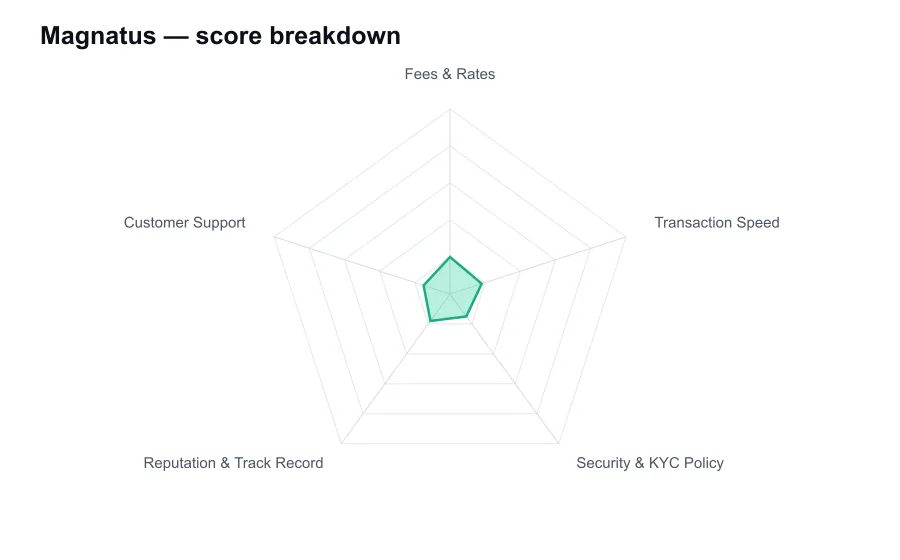
Scoring breakdown for Magnatus
Criterion Score Note
Fees & Rates 2.0 No authoritative current pricing and spread disclosure verified.
Transaction Speed 1.8 No reliable current evidence of typical swap completion times.
Security & KYC Policy 1.5 Security controls and transaction-review policy are not established.
Reputation & Track Record 1.8 Insufficient independently verifiable operating track record.
Customer Support 1.5 Dependable active support channels could not be verified.

Key Facts

Key facts for Magnatus
Fact Value Source
Fee disclosure Not independently verifiable -
Swap completion time Not independently verifiable -
Security documentation No verified current disclosure found -
KYC policy Not independently verifiable -
New transfer recommendation Do not send funds -

Review of Magnatus

Magnatus is a difficult provider to review because the name does not carry a clear, well-documented public identity comparable with established exchanges or recognized DeFi protocols. That ambiguity matters more than a glossy website or a claim of easy swaps. Before judging exchange rates or transaction speed, a reviewer has to establish who operates the service, where it is based, what it does with client assets, and whether users can reliably withdraw. I could not verify enough current public information to answer those questions confidently.

The name may appear in crypto-related search results, listings, or promotional material, but that is not equivalent to a verified operating history. Small exchangers can be legitimate, yet they must earn trust with current documentation, transparent terms, public wallet policies, and real evidence of service quality. Magnatus does not have a sufficiently clear public footprint for a positive recommendation.

Fee assessment is therefore limited. A reputable instant exchanger should disclose whether its advertised quote includes a service fee, a spread, a network fee, or all three. It should also show the rate before the user sends funds and explain what happens if market conditions move before settlement. Without a current and authoritative Magnatus fee page, users cannot tell whether a seemingly attractive quote is actually competitive.

This is important because instant exchange pricing is often misunderstood. A provider can advertise no commission while earning through the spread between its buy and sell prices. That is not inherently dishonest, provided the final amount is visible before confirmation. The issue arises when the quote, minimum, fee treatment, or refund policy is unclear. With Magnatus, those details are not independently established well enough to give its pricing any credit.

Speed is another area where claims are cheap. An instant exchanger is only as fast as its deposit detection, liquidity sourcing, compliance checks, and outbound wallet processing. A swap may settle quickly on a quiet network, but a manual review or liquidity shortfall can turn a short transaction into an open-ended support problem. I found no reliable current evidence establishing Magnatus's normal completion times or its handling of delayed orders.

That uncertainty is particularly risky for time-sensitive swaps. If you are moving funds to meet a collateral call, catch a market price, or transfer to another venue, an opaque exchanger is the wrong tool. Use a service with status pages, published processing rules, and a long history of completed transactions. The slightly better rate promised by an unknown provider is not worth the chance that funds become stuck in a manual queue.

Security information should be easy to find. Users need to know whether a provider is custodial during the swap, how it protects operational wallets, whether it has a clear incident process, and what happens when a user sends the wrong network or wrong amount. I could not establish a current security disclosure, audit record, proof-of-reserves statement, or accountable operator for Magnatus. That is not enough for a service that may temporarily control customer funds.

The same caution applies to KYC. Some instant exchangers advertise low-friction access but reserve the right to request documents under anti-money-laundering controls. That can be legitimate if the policy is clear before funds are sent. A user needs to know whether identity checks are optional, transaction-triggered, or mandatory, and what happens to a transaction while verification is pending. Magnatus's present policy cannot be verified with enough confidence to call it private or predictable.

Reputation cannot be separated from traceability. An exchange does not need celebrity founders, but it should have a stable record that independent users can inspect. Public feedback has to be recent, varied, and hard to manipulate. Magnatus lacks the visible depth of independent reporting that would let a reviewer distinguish a capable small service from a temporary or impersonated brand.

This does not mean every unfamiliar service is fraudulent. It means the burden of proof is on the operator, not on the customer. A provider asking users to send irreversible cryptocurrency must make verification easy. Clear legal terms, transparent rates, active support channels, a well-maintained help center, and evidence of ongoing operations are minimum expectations. Magnatus has not met that evidentiary threshold in this review.

Support is the practical breaking point for a questionable exchanger. If a swap is delayed, users need a ticket number, a reachable team, a documented refund path, and a way to confirm the provider received their deposit. I could not independently verify a dependable support operation or service-level commitments. That makes even a small test transaction a poor idea, because a test only helps if the service can resolve the failure case.

People who encounter Magnatus should also watch for clone-site and social-engineering risks. Search advertising, Telegram contacts, and direct messages can be manipulated. Do not trust a URL simply because it contains the provider name. Verify the domain through more than one credible source, inspect the wallet address carefully, and avoid sending funds after being promised a special rate or a recovery service.

For comparison, reputable swap providers such as ShapeShift's self-custody tools, THORChain interfaces, or established centralized services present much more material for scrutiny, even if each has different risks. Their fees may not always be lowest, but users can inspect documentation, liquidity conditions, and history. Magnatus offers too little confidence to justify choosing it over an exchange or protocol with a visible operating record.

My judgment is firm. Magnatus should not be used for new transfers until its operator, fees, transaction rules, support channels, and security practices can be independently verified. There is no score high enough in convenience to offset unknown custody and withdrawal risk. Crypto transactions are final. Use a provider that makes its business verifiable before it asks for your coins.
Pros & Cons

Pros and cons of Magnatus
Pros Cons
May appear in legacy or promotional listings -
Could be researched by users tracing old transactions -
Highlights the value of verifying swap providers -

Verdict

Magnatus fails the first test a crypto provider must pass: verifiability. Its potential convenience cannot be evaluated meaningfully because core facts about operations, pricing, security, and support are not dependable. That puts users in the worst possible position, sending irreversible assets to a service they cannot properly assess. There are too many better documented alternatives to justify taking that chance. Do not treat an unfamiliar name as a bargain merely because it promises a quick exchange.

KYC

Requirement optional
Notes A dependable current KYC policy could not be verified. Do not assume document checks will not be requested after sending funds.

How to Use Magnatus Safely

  • Do not send funds based on a social-media message
  • Verify the exact domain through independent sources
  • Never pay an extra fee to release a pending swap
  • Record transaction hashes and quoted terms before sending
  • Use a well-documented provider for time-sensitive transfers

Frequently Asked Questions

Is Magnatus recommended for a first crypto swap?

No. Its current operations, pricing, security disclosures, and support quality could not be independently verified well enough for a new-user recommendation.

Are Magnatus fees publicly confirmed?

No authoritative current fee or spread schedule was verified. A quoted exchange rate alone does not reveal the provider's full cost.

Is Magnatus a no-KYC exchanger?

Its current KYC policy cannot be verified. Do not assume that a swap will remain document-free if a transaction is flagged for review.

What should I do if I sent funds to a Magnatus address?

Save the transaction hash, recipient address, amount, timestamps, screenshots, and all correspondence. Do not send additional funds to release or recover the transfer.

Can I trust a Magnatus contact on Telegram or social media?

No. Treat unsolicited contacts as high risk. Verify any domain and support route independently, and never disclose wallet recovery phrases.

Does Magnatus publish verified proof of reserves?

No current independently verifiable proof-of-reserves publication was established in this review.

Editorial independence: our scores and rankings are produced using the fixed criteria above and are not influenced by advertisers. This is an independent ranking site and is not operated by, or affiliated with, any provider we list.

Affiliate disclosure: some links on this page may earn us a commission at no extra cost to you. This does not affect our rankings.

About the Author

Yvette Saran Crypto Exchange Research Editor
  • 8 years in fintech and payments journalism
  • Crypto exchange testing and fee analysis
  • Former consumer finance reporter
  • Contributor to digital asset custody research

Yvette Saran is a crypto exchange researcher and former payments journalist with eight years of experience covering trading platforms, custody, and consumer finance. She reviews exchanges by testing the parts users actually feel, from order execution and withdrawal friction to fee disclosures and support quality.

Magnatus score breakdown by criterion, shown as a radar chart
Score breakdown
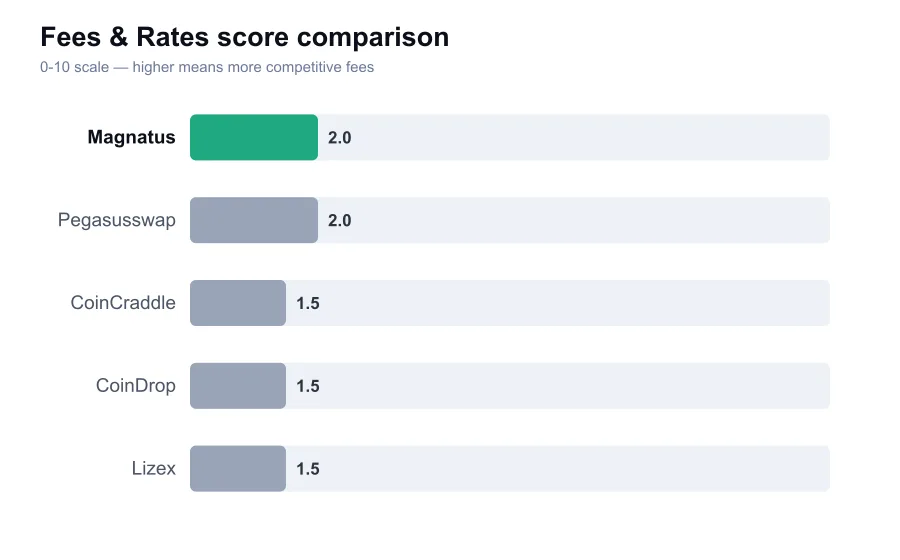
Magnatus fees score compared against similar providers
Fees vs. alternatives
Illustrative swap flow preview for Magnatus - not an actual product screenshot
Illustrative swap flow preview

Alternatives to Magnatus

Alternatives to Magnatus
AlternativeScore
Pegasusswap Review1.8/10
CoinCraddle Review1.4/10
CoinDrop Review1.4/10
Lizex Review1.3/10
HotExchange Review2.2/10
Mine Review2.2/10