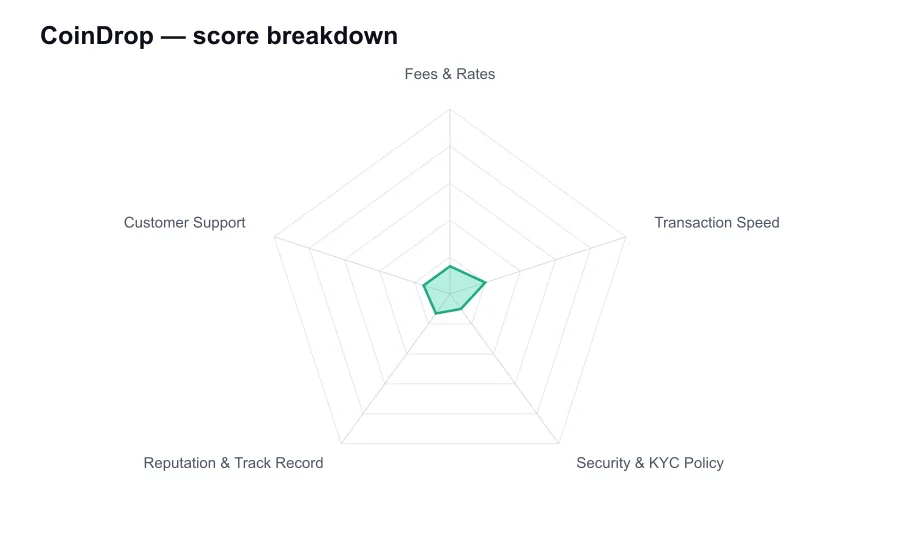
CoinDrop is another name where identification comes before evaluation. The crypto industry has used similar names for promotions, faucets, token distribution campaigns, applications, and purported trading services. Without a confirmed legal entity and official domain, it would be irresponsible to attach the reputation of one project to another simply because the name matches.
That ambiguity is a serious problem for a financial provider. A user should never need to guess which CoinDrop website, app, social account, or support representative is legitimate. Established exchanges make the legal entity, official applications, fee table, asset list, and terms easy to locate. Brand ambiguity gives impersonators room to operate.
I could not confirm a single official CoinDrop exchange operation with a transparent, durable public record adequate for a conventional review. That means there is no dependable trading-fee number to cite, no confirmed list of supported networks, and no verified withdrawal policy. A review should say that plainly rather than manufacture precision.
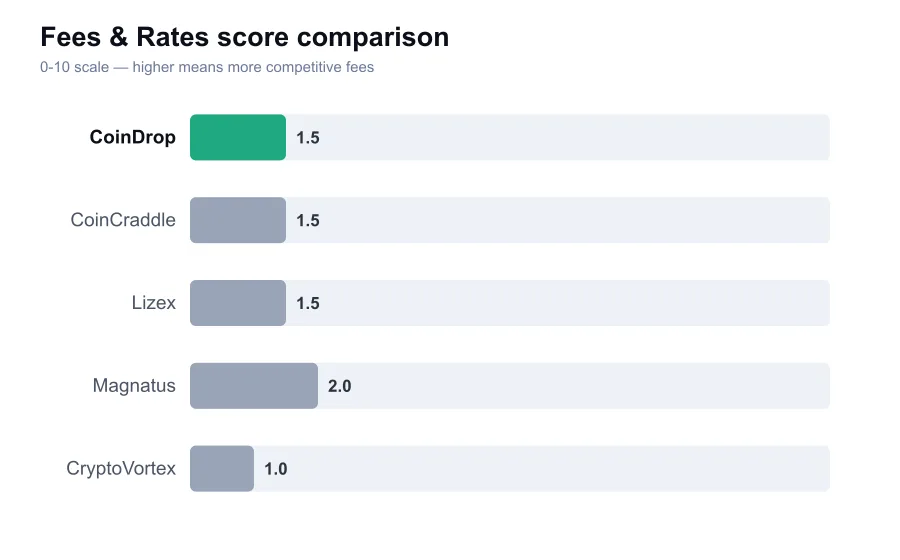
Price is where vague services often sound most tempting. A website may promise free crypto, guaranteed rewards, unusually favorable swaps, or a bonus that appears to multiply after a deposit. Those offers should invite scrutiny, not excitement. Crypto transfers are final, and an offer with no clear commercial logic is usually funded by someone else's risk.
A real exchange's cost is measurable. It publishes maker and taker fees, spread treatment, deposit conditions, withdrawal fees, and any minimum order size. It also allows customers to compare its all-in quote against the market. If CoinDrop cannot provide those details in stable terms from a verified operator, its apparent price advantage has no value.
Speed claims deserve the same skepticism. A fast on-screen balance update is not the same as a completed blockchain transfer. Before trusting any service, users need evidence that funds can be withdrawn to a self-controlled wallet without arbitrary delays, extra payments, or last-minute identity demands that were absent from the original terms.
KYC is not simply an inconvenience to shop around. Clear KYC rules are part of an accountable service. Users should know whether verification is mandatory before depositing, whether limits apply before and after verification, which countries are excluded, and how long a review normally takes. An unclear policy is a route to disputes, especially during withdrawals.
Security information should include more than a padlock symbol and generic statements about encryption. Look for account security controls, withdrawal protections, incident disclosure, custody explanations, legal terms, and a means to contact an accountable company. I could not verify a sufficient body of such information for CoinDrop.
Reputation is earned over time by handling ordinary customer problems publicly and consistently. Users should be able to find independent discussion of deposits, withdrawals, account reviews, and support outcomes. A few promotional testimonials or influencer clips do not meet that standard, particularly where the promoter is paid or receives referral income.
CoinDrop's biggest issue is therefore not that it has a known high fee. It is that a prospective customer cannot confidently establish what service they are dealing with. You cannot assess a counterparty's solvency, compliance standards, or security practices if you cannot first establish its identity.
If someone has directed you to CoinDrop through WhatsApp, Telegram, a dating app, a job offer, or a supposed investment mentor, stop before connecting a wallet or sending funds. Those channels are frequently used to route victims toward fake trading portals and withdrawal-fee schemes. The channel does not prove fraud, but it materially raises the risk.
Be cautious with wallet connections too. A crypto site does not need custody to cause harm. A malicious approval can allow a contract to spend tokens from a connected wallet. Use a fresh, low-value wallet for testing unknown decentralized applications, inspect approvals, and revoke unused permissions through a reputable wallet-security tool.
There is no reasonable reason to choose an opaque CoinDrop-branded service over a provider with clear ownership and a track record. Established platforms may ask for KYC and charge visible fees, but those tradeoffs buy you something valuable: terms you can read, a company you can identify, and a history you can investigate.
My recommendation is simple. Do not treat CoinDrop as a verified exchange or wallet provider based on its name alone. Confirm the exact entity through official regulatory records and independently sourced documentation, or use a recognized alternative. The uncertainty is too fundamental to be offset by a promised promotion or a supposedly cheap conversion.