CryptoVortex is difficult to review in the same way as Coinomi, Curve, or DefiLlama because its public identity is not clearly established. The name has been used in promotional material and websites associated with crypto trading, but I could not verify a stable, authoritative operator, regulatory identity, published ownership structure, or durable official documentation. That is not a minor missing detail. For a service asking users to deposit money or cryptocurrency, it is the starting point of the risk assessment.
A credible exchange should make several basics easy to find: its legal entity, country of incorporation, terms of service, fee schedule, supported assets, custody model, security controls, and customer contact route. CryptoVortex does not have a widely recognized public record comparable to Binance, Kraken, Coinbase, Bitstamp, or even smaller established regional exchanges. The absence of verifiable information makes any positive claim about its operations impossible to support responsibly.
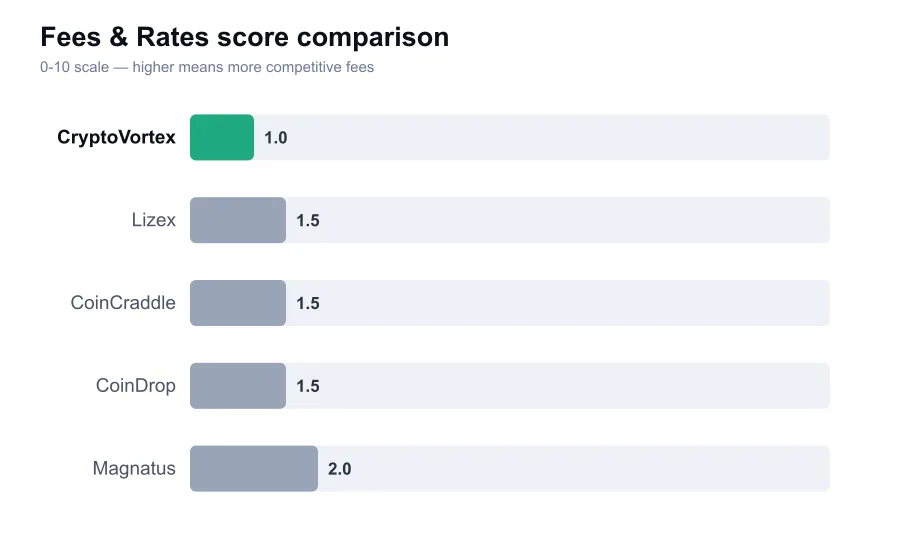
That uncertainty immediately affects fees. I cannot confirm a published maker and taker schedule, withdrawal charge table, spread policy, or conversion fee for CryptoVortex. A platform without a clear public fee page leaves customers unable to calculate the real cost before they trade. That is especially dangerous in crypto, where a service can advertise zero commission while charging a large spread or imposing costly withdrawal conditions.
The right standard is not whether a website displays attractive exchange rates. It is whether users can independently check what they will pay, what they will receive, and whether a withdrawal can be completed without a surprise verification demand. Major platforms publish fee tiers and network withdrawal charges, even if users dislike the prices. CryptoVortex does not provide enough independently verifiable disclosure for it to earn trust on this point.
The same problem applies to speed. Claims of instant settlement mean very little without evidence of actual blockchain withdrawals, order matching, liquidity sources, and user reports from credible channels. Blockchain transactions have observable identifiers. Exchange withdrawals should have clear status information and a transaction hash once sent. If a provider cannot show a transparent process, a customer has no reliable way to distinguish a routine delay from an account problem.
There is also no dependable public basis for assessing whether CryptoVortex holds customer assets, uses third-party custody, or simply routes orders elsewhere. That distinction is crucial. A centralized exchange can freeze balances, reject withdrawals, or demand additional verification. A non-custodial service creates different risks, including malicious approval requests and unsafe smart contract interactions. CryptoVortex's public footprint does not support a confident classification beyond treating it as an unverified trading service.
Security claims need more than a padlock icon and generic language about encryption. Responsible providers explain whether they use cold storage, two-factor authentication, withdrawal address controls, proof of reserves, security audits, bug bounty programs, or incident disclosure procedures. None of those protections can be assumed merely because a website uses crypto terminology. A user should assume the opposite until a provider demonstrates controls that can be checked.
KYC is similarly unclear. Some questionable platforms market themselves as no-KYC until a customer attempts a large withdrawal, at which point they request documents, impose a review period, or introduce a deposit-linked fee. I cannot say that CryptoVortex follows that pattern, but the lack of accessible, verifiable terms means users have no good reason to take the risk. A legitimate service should state verification triggers before it accepts a deposit.
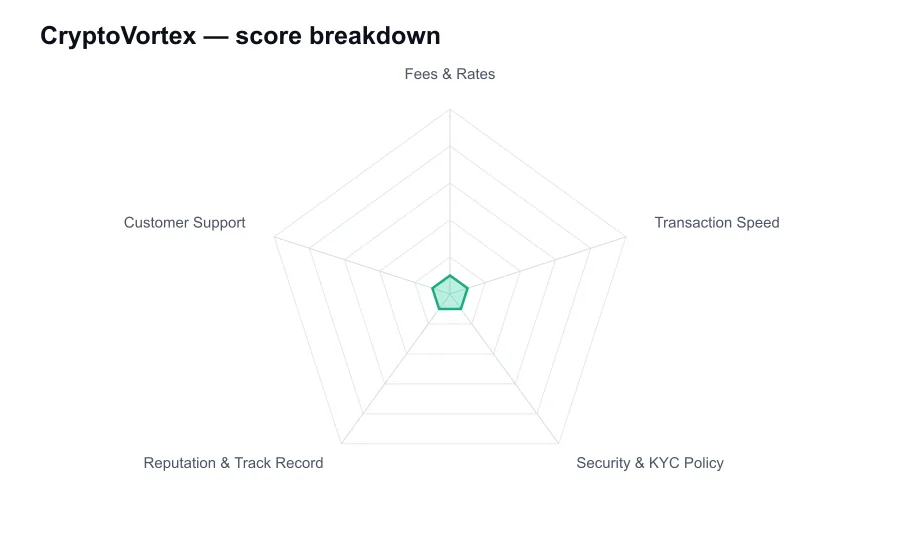
Reputation is where CryptoVortex scores particularly poorly, not because every obscure company is dishonest, but because crypto customers need evidence before they hand over irreversible assets. A provider with no established record has not earned the benefit of the doubt. There is no obvious multi-year history of operations, recognized licensing record, public leadership team, audited financial reporting, or widely trusted independent coverage tied unambiguously to this name.
The name itself creates another problem. Generic crypto branding is easy to imitate. Search results and social media promotions can mix unrelated services, affiliate pages, impersonators, and temporary domains. A person who believes they are talking to official support may instead be communicating with a scammer. That danger is worse where there is no clear official domain or verified public channel that users can validate independently.
Customer support cannot be judged positively either. I could not verify a dependable support center, formal complaint route, response-time commitment, or regulated ombudsman process connected to a clearly identified CryptoVortex operator. Telegram, WhatsApp, and direct-message support should never be treated as proof that a financial provider is legitimate. In crypto fraud cases, those channels are often used to pressure victims into sending more funds to release an alleged withdrawal.
The practical advice here is blunt. Do not deposit funds because an unfamiliar site offers a high return, a private trading signal, a bonus, or an unusually favorable conversion rate. Do not pay a supposed tax, activation charge, liquidity fee, or verification deposit to unlock a withdrawal. Blockchain transfers are final, and recovery services that ask for an upfront payment often create a second loss.
Someone testing an obscure provider might argue for sending a tiny amount first. Even that is not a proper answer to the central question, because many fraudulent operations permit small withdrawals to build confidence before blocking larger balances. Testing can reveal a broken wallet address, but it cannot prove solvency, fair dealing, or a future ability to withdraw. The sensible move is to choose a provider whose identity and history are already established.
CryptoVortex therefore cannot be recommended as a place to trade, store, or convert crypto. There are too many unanswered questions about its operator, fees, custody, compliance, and support. A lower score here is not a claim that every mention of the name is fraudulent. It is a judgment that a reviewer cannot responsibly endorse a financial service that does not provide the evidence customers need.
Use a regulated and well-documented exchange for fiat conversion, a reputable self-custody wallet for personal holdings, and a known decentralized protocol only after verifying the real domain. Crypto is risky enough without adding counterparty opacity. CryptoVortex has not earned a place on a serious shortlist until its operator can be independently verified and its terms can be checked before funds are sent.